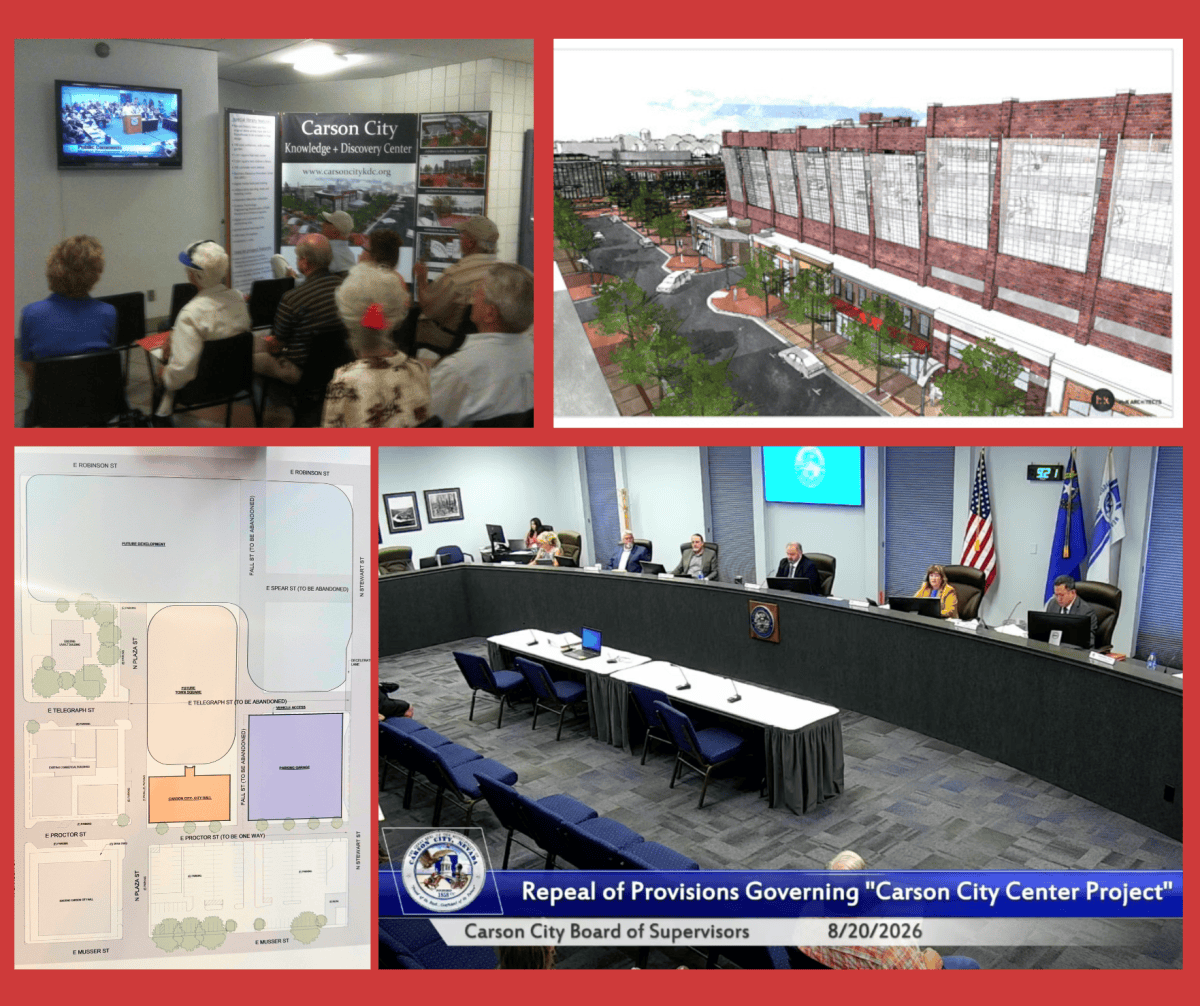
The Carson City Board of Supervisors voted 4-1 Thursday to advance the repeal of a 2012 ordinance requiring voter approval before public funding could be used for the Carson City Center Project, a downtown redevelopment proposal that was never built.
City officials said the repeal is part of an ongoing review of the Carson City Municipal Code and that the ordinance is likely unenforceable, while several residents questioned its removal as the city considers a new downtown City Hall proposal.
The item during today’s Board of Supervisor’s meeting was brief, but Carson City Board Counsel Dan Yu provided Carson Now with an overview of the legal implications and background of where this code came from, why it’s being removed, and what it might mean for the current city hall project.
Why is there a Carson City Code relating to a 2012 Nugget Project?
The Carson City Center Project, also known as the Nugget Economic Development Project or Nugget Project, was a proposed downtown redevelopment project that included a Knowledge and Discovery Library, central outdoor plaza, parking structure, retail space and other public improvements and infrastructure.
The proposal had been under discussion by the Board of Supervisors since at least 2011 and would have required the use of public funding.
Opposition to the project led residents to organize an initiative petition seeking to prohibit the use of public funding for the project without approval from a majority of Carson City voters. Separately, the city placed a quarter-cent sales tax increase on the November 2012 ballot to help fund the development project; voters rejected the tax measure.
The current code on the books which was approved on first reading for removal today (Carson City Municipal Code 2.44.010) prohibits the use of public funding for the Carson City Center Project, also known as the Nugget Economic Development Project or Nugget Project, without approval from a majority of Carson City voters.
However, the provision applies specifically to that named project rather than establishing a broader voter-approval requirement for other city spending or development projects — even those that share similarities to past project proposal.
According to Board Counsel Yu, the ordinance came about following the citizen initiative petition filed during the dispute over that proposed iteration of the downtown project. After opponents gathered enough signatures for the petition to qualify, state law gave the Board of Supervisors several options: adopt the proposed ordinance without substantive changes, reject it and send the question to voters, or seek court action to prevent it from appearing on the ballot.
Yu said the Board chose to adopt the ordinance in August 2012 rather than send it to voters, despite advice from the District Attorney’s Office that the initiative language was likely unlawful because it could conflict with spending authority granted to the Board under the Carson City Charter and state law. The 2012 staff report also mentioned the board had been advised that a future Board could simply disregard the ordinance, deem it to be void and/or repeal it.
When asked if it is typical for Carson City Municipal codes to be dedicated to specific, named proposed projects, Yu said it is not: “This ordinance is unique because it’s an initiative petition ordinance … I am not aware at this time of any other ordinance that was adopted as the result of an initiative petition filing or as the result of a successful ballot initiative.”
Why is it being removed?
The presence of this item on the BOS docket has prompted questions and speculations from citizens about transparency regarding the current 2026 City Hall project. The board, city staff and the Hop & Mae Adams Foundation have been accused of “working behind the scenes” to move the project forward before publicly presenting it.
However, while the timing of the ordinance repeal has understandably raised eyebrows, city staff, including Yu, have been undertaking code cleanup for several months.
During city budget discussions earlier this year, Supervisors specifically discussed tackling a needed overhaul of the city’s ordinances and municipal codes to, among other tasks, update codes to adhere to current laws and remove those that are out of date.
Since that time, the team tasked with reviewing the entirety of the Code have been working in sequential/numerical order.
Recently, the termination of the Cultural Commission came about as part of this ordinance clean up, Yu said, as it is housed in Title 2 above the Nugget project ordinance.
Yu was transparent in acknowledging the timing isn’t great, but there was never going to be a good time to bring this ordinance removal forward after the review had begun, in the context of the city hall project. He said to deviate from the approved step-by-step path would have raised its own transparency concerns.
“If the existing ordinance had been identified earlier, it would have been presented to the Board at that time,” Yu said. “In short, there was probably no ‘good time’ to repeal the ordinance because if it had been done months ago, the suspicion would have been that the City was somehow attempting to clear the path toward the construction of a new City Hall as some underhanded strategy, even when the ordinance is unenforceable and therefore inapplicable. If, after the ordinance was discovered, the City proposed its repeal several months from now, it would invite accusations that the City deliberately buried its existence to ‘hide the ball.’”
It should be noted that is not the first, nor the last, ordinance that will be coming before the board as the code cleanup project continues.
What does this code’s existence — or its removal — mean for the current proposed City Hall project?
There has been public speculation that the removal of this ordinance means that the public will not be allowed to vote on whether or not the current City Hall project moves forward.
However, neither the presence of this code, nor its removal, appears to have legal bearing to the current project being discussed, despite the similarities between the 2026 project and the 2012 project.
Especially because, according to Yu, it was likely unenforceable even when it was first added to the code in 2012.
But it has also lent itself to ongoing frustrations voiced by the public who say the lack of transparency and access to information are ongoing issues. It has also revived debates similar to those that came about during the project’s first iteration over a decade ago.
These concerns were not discussed by the board on Thursday, however. Instead, the item was briefly discussed like any other code cleanup ordinance before it, with Deputy City Manager Stephanie Hicks providing a short presentation on how it was identified and noting it was obsolete.
Public comments made up the bulk of the item’s 15 minutes on the table, bringing up many of the same questions Carson Now asked Board Counsel Yu above.
Which brings us to the larger issue surrounding not just this project, but all public decisions in general: transparency.
Our analysis: When should the public be brought in?
Public bodies face ongoing, and competing, transparency risks.
The main issue today seems to lie in the grapevine versus the public forum: living in a close-knit community means that, if there is a consequential project being discussed, the grapevine is bound to hear of it. And, if it spreads far enough before it is publicly acknowledged, this can lead to accusations of working in the shadows.
But, it also must be acknowledged that a project cannot (or should not) be brought forward into a public forum half-baked.
During the life of the 2012 project, reports detailed public frustrations from supporters and opponents alike regarding consistently changing details and a lack of firm numbers which made evaluating the project nearly impossible.
There was also ongoing criticisms on potential economic benefits to the foundation or the Nugget Casino. Even after the major 2011 redesign, questions about the proposed nonprofit entity which would oversee the project and project financing remained outstanding.
These contexts and the balancing act between public disclosure and working “behind the scenes” are important for both the public and local leaders to recognize.
If the grapevine gets wind of a consequential project on the horizon, and it is not acknowledged until much later by city leaders, it will lend itself to transparency concerns.
But, if a project is brought forward too soon before details are hammered out, any changes will lead to public frustrations about the inability to evaluate a changing project.
Nothing presented with the ordinance repeal establishes that it was undertaken to clear a path for the current City Hall proposal.
But it does indicate that uncertainty about when and how information becomes public can lend itself to distrust, as demonstrated both in 2010, as well as today.