On Thursday, Carson City Supervisors voted to reject the recommendation of denial made by the Planning Commission last week regarding the state’s request to be removed from Carson City downtown design standards.
Much of the angst felt by the community and commissioners seems to be the fact that the state still has not presented a master plan or design elements about the project they intend to build. However, state representatives said that they want to be good partners and aren’t intending to build “ten-story high buildings,” but want to build something that is cohesive with the rest of the capitol complex.
The approved amendment removes the State Office Complex from the Downtown Character Area map and text. Removing the state from Carson City’s design jurisdiction now allows the $111 million construction project to proceed, which representatives say is slated to break ground in March.
The decision resolves a regulatory standoff regarding design standards such as building orientation and height, parking design, set backs and more that the Carson City Master Plan has dictated to ensure downtown buildings follow the same aesthetic design standards.
Planning Commission denial and ‘City Hall’ confusion
The Planning Commission denied the request because the required finding to do so could not be met in that something must have changed since the Master Plan was adopted, which the state could not provide any argument for.
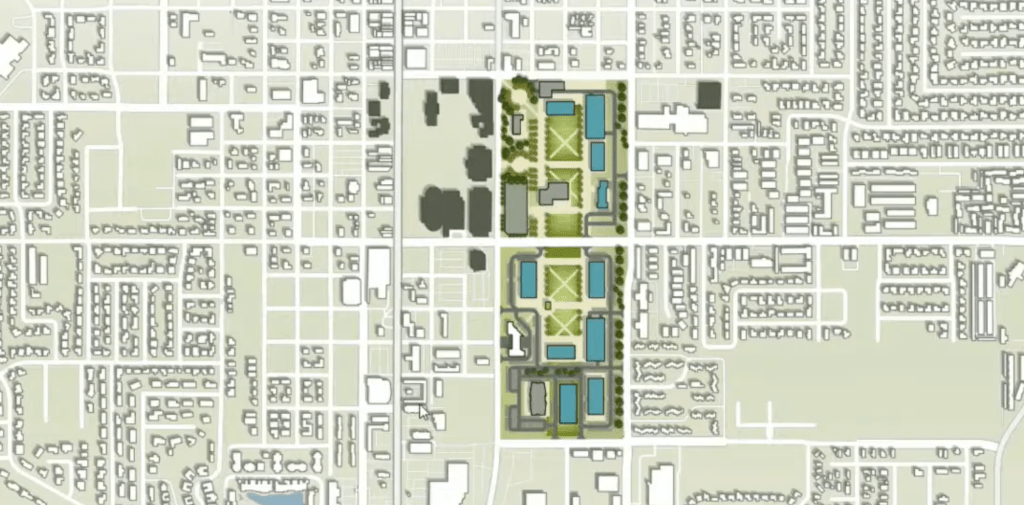
In addition, Commissioners rejected the argument that the amendment should be granted based on the state’s willingness to match design plans with the “City Hall/Town Square” project. While a preliminary mock up with multiple options was presented back in February 2025 to the board of supervisors, the project has never been presented to commissioners, and has never come back before any public body for further discussion.
We did find a video mockup from four years ago which appears to be on the same plot and mentions a “town square.” It’s not clear if this video has ever been presented to the board officially, but it does appears to be what state representatives were referring to.
Board of Supervisors meeting
During discussions at the Board of Supervisors , Mayor Lori Bagwell explained to the representatives that they needed to have a finding met in order to overturn the Planning Commission’s decision — meaning there needed to have been some substantial change in circumstances between when the Master Plan was adopted and now.
Brian Walker said that the “change in conditions” required for Finding 3 was the realization of how the City intended to apply the Master Plan to the State, arguing they did not understand the city intended to assert jurisdiction until they’d submitted their Special Use Permit in November 2025.
State representatives argued that while they wish to be good partners, the specific design requirements of the Downtown Character Area—which prioritize pedestrian engagement and buildings positioned at the street edge—conflict with modern security standards for government buildings.
Jack Robb, Chief Innovation Officer for the Governor’s Office, cited “Crime Prevention Through Environmental Design” (CPTED) as a driver for the State’s proposed setbacks and parking layouts.
“The world we live in is not the world we grew up in,” Robb told the board. “Building design is paramount for the safety… providing government offices that add a level of security.”
When Mayor Bagwell noted that the Planning Commission denied the project because they expected a formal document similar to the city’s Master Plan, Robb explained that the State operates differently. He stated that the Governor ran on a platform of “get stuff done” rather than spending years developing planning documents. He admitted that while they had a “standing master plan,” they prioritized action over producing new public documents, which led to a disconnect where the City and State ideas “ran in parallel… and didn’t intersect”.
Some supervisors seemed to believe that if they did not approve the state’s request, the state would move their workers to other cities more amenable to what the state wishes to build.
“If we don’t do this, the State’s not going to redesign that building. All those jobs are going to Reno,” Mayor Lori Bagwell said. “We need to maintain those jobs in Carson City.”
Supervisor Stacey Giomi echoed the economic concerns, warning that a failure to accommodate the project could result in the state moving operations to neighboring Washoe County.
“I will just tell you that there’s fear in some state employees who I’ve spoken to that are worried… I have already heard from people who are now having to commute to Reno because the state bought an office up there and their office moved. Our citizens … are going to suffer [if more departments move].”
City Manager Glenn Martell urged the board to approve the amendment, emphasizing the economic stakes. He noted the project would retain approximately 1,200 jobs in the downtown area, contributing an estimated $30 million annual economic impact.
Public Comment against amendment
Public comment was not in favor of the state’s request — though not necessarily because they didn’t approve of the project, but because the state wasn’t being clear about what it was they wanted to do or build, which gave the impression of the city signing a blank check with only the verbal promise they would abide by aesthetic standards.
Residents expressed frustration that the State was being granted an exemption from rules that private developers must follow, with some characterizing the move as eroding trust in local government. Especially considering that they had more than enough time to come forward with design mock up showing the public what their plans were.
“Trust isn’t built by asking someone to accept partial truths and promises of clarity later,” said resident Sandra Owens. “When a unanimous planning commission vote can be reversed without new facts or errors, the question is no longer about the amendment but whether the public process itself has meaning.”
Kathleen Beasley, another resident, criticized the justification for the amendment, arguing that the city was fully aware of the State’s intentions when the Master Plan was adopted.
“It’s actually depressing to read [the City Manager’s] report,” Beasley said. “I know he’s a bright, capable man that wants to do good things for Carson City … but this whole idea that there’s some failure on the city to understand what was going on just doesn’t make sense.”
Business owner Mita Sanchez warned the board about setting a precedent. “An exemption says, ‘hey, the process applies until it doesn’t,'” Sanchez said. “We may create this two-tiered system… and at that point Carson City is no longer the steward or driver of its own plan.”
The deliberation highlighted the “weird relationship” between the city and the state, in which Carson City sometimes has jurisdiction over the state on some aspects but not others, while the state often has jurisdiction over the city in similar ways.
Supervisor Giomi (jokingly) likened the “awkward” relationship as “it’s a little like dating your cousin — something just doesn’t feel right about it.”
Despite these misgivings, Giomi and Supervisor Maurice White acknowledged the State’s unique status. However, White ultimately opposed the motion, arguing that the request was a “major amendment” that deviated from the community’s vision.
“The only thing that I can find that has changed since the Master Plan was adopted is that the State has realized they should have been more engaged in the Master Plan process,” White said. “I do not perceive that acknowledgement to be extended to such an extraordinary ask.”
State officials assured the board that leaving the “Downtown Character Area” would not result in uncontrolled development. Robb went on the record stating the State has no intention of building “10-story buildings” that would overshadow the Capitol, confirming the design remains a six-story structure.
“We’re not going to go 10 stories… that was one of the last things I wanted was to overshadow the capital,” Robb said.
With the amendment approved, Robb confirmed the State is prepared to move quickly.
“If we get approval today, we’re coming out of the ground in March,” Robb said. “We are planning on having a ribbon cutting on the first building May of 2027.”