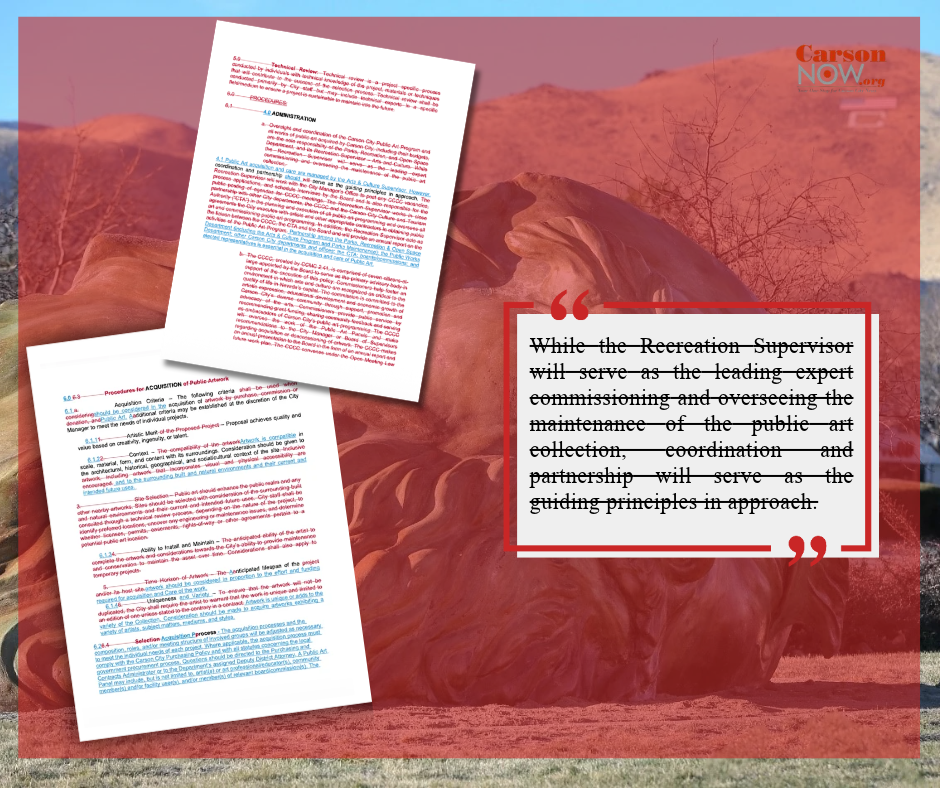

Carson City Supervisors will consider a massive overhaul to the city’s Public Art Policy on Thursday, Nov. 19, eliminating several requirements for public participation and independent review, giving public committee authorities to city staff, and revising provisions addressing arts funding.
The proposed changes would replace several mandatory procedures with discretionary ones, allowing city staff to determine if projects need public review. Currently, public participation and outreach is required, along with, depending on the scope or cost of the project, a multi-step public process prior to approval.
The proposal also removes the current city requirement for a review of the policy every two years, eliminates references to the city’s Arts and Culture Strategic Plan, and removes provisions addressing annual reports, maintenance funding and the responsibilities of the now-dissolved Carson City Cultural Commission.
The city manager is also granted authority to approve public art acquisitions involving less than $20,000 in direct city costs without board approval, as well as greater authority over the relocation and removal of public artwork.
The changes come three months after supervisors formally dissolved the Cultural Commission, which served as the city’s citizen advisory body for arts and culture since 2008.
“While the Cultural Commission was active, the city commonly used separate, project-specific ad hoc panels to evaluate artwork, with the Commission serving as an additional level of review before recommendations reached the Board of Supervisors,” Carson City Arts and Culture Supervisor Anna Freeman wrote. “With the Commission now dissolved, the proposed revisions are intended to reflect the City’s current structure and provide flexibility to tailor the review process to individual projects, including the use of ad hoc panels and opportunities for public input when appropriate.”
It’s unclear from the staff report if the city conducted outreach to partnering artists, cultural organizations or nonprofits while developing the revisions.
How public art decisions are currently made
The Public Art Policy approved in September 2022 established procedures for commissioning, purchasing, accepting, maintaining and removing artwork on city property.
Although the current policy gives the city manager final authority over certain decisions and allows modifications to some selection procedures, it also establishes a series of reviews intended to incorporate artistic expertise, community participation and recommendations from a citizen advisory commission.
The existing policy states that project-specific public art panels are created for evaluating artwork. Panel membership reflects the expertise required for each project including artists, arts professionals, community members, facility users and Cultural Commission representatives.
The policy’s recommended acquisition process includes preliminary public input, technical review by city staff, evaluation by a public art panel and consideration by the Cultural Commission before recommendations reach the city manager or Board of Supervisors.
Prior to its dissolution, the commission was also responsible for determining whether established procedures had been followed and could request additional information or reconsideration of a proposed selection.
The proposal removes any requirements for independent reviews by an equivalent citizen review body. While the current policy states ad-hoc committees (public art panels created temporarily based on a specific project) are mandatory, the new policy leaves the decision on whether or not public review is necessary up to city staff.
For larger projects, staff could conduct artist evaluations or involve a panel. Public surveys, meetings and other participation opportunities could be offered, but would not be required in the same manner as the existing procedures.
The proposed policy also changes the language governing acquisition criteria. Where the current policy states that specified criteria “shall” be used, the revision generally states that those criteria “should” be considered.
Among the provisions removed is an explicit criterion encouraging inclusive artwork that incorporates visual and physical accessibility.
The proposed changes to acquisition approvals could also affect donated artwork.
Other changes affect the maintenance and removal of artwork already owned by the city.
The current policy requires opportunities for public feedback during the deaccession process — the formal process of removing an artwork from a public collection — and includes Cultural Commission review.
The proposed policy instead makes public feedback and outreach about public art removal optional, and gives authority to the city manager to determine if or when art should be removed so long as it is not designated as a capital asset.
Perhaps more importantly, the proposal eliminates the current appeal process entirely, which allows artists or their authorized representatives to appeal the removal or relocation of their artwork to the Board of Supervisors for review.
The End of the Cultural Commission
The Cultural Commission was established in 2008 as a seven-member citizen advisory body to make recommendations on arts and cultural matters. However, a major administrative change that began during a Feb. 25, 2022, Board of Supervisors retreat eventually would lead to its demise.
Its responsibilities included reviewing public art proposals, recommending arts grants, participating in cultural planning, advising on public art policy and providing reports to the Board of Supervisors.
The District Attorney’s Office had determined the Carson City Cultural Tourism Authority (CTA) did not have legal authorization to administer all aspects of the city’s arts and culture program.
Supervisors agreed to create a city-funded arts and culture position within the Parks, Recreation and Open Space Department, while the CTA focused on cultural tourism and related activities. They determined the city position would also take on the majority of the Cultural Commission’s responsibilities.
During the work session, commission representatives questioned what responsibilities would remain with their advisory body. Supervisors said the commission would be retained to oversee the public art policy and strategic plan and review specific projects — but they would no longer be meeting every month as before.
Until 2026, the commission remained active despite the restructuring. It oversaw the roundabout sculpture project process of 2023, as well as a grant application review process in 2024, both of which included the creation of ad-hoc committees, and advised on grant approvals each year through 2025.
However, the commission’s final scheduled meetings in December 2025, March 2026 and June 2026 were canceled from a lack of agenda items, according to Parks and Recreation Director Jennifer Budge when she recommended dissolving the commission to the Board of Supervisors in July 2026. She cited declining activity along with a burden of administrative work required to maintain the commission as reasons they should disband it.
Supervisors unanimously approved the elimination of the Cultural Commission in Aug. 2026.
Changes to arts funding
The current policy identifies multiple funding sources for the city’s public art program, including city appropriations, grants, donations, redevelopment funding and revenue generated by Carson City’s dedicated arts-related lodging tax.
One provision addressing the Board of Supervisors states:
“The Board will appropriate an allocation of funds to monitor and maintain the City’s public art collection.”
The proposed policy removes that commitment.
While there is no mandatory specific dollar amount Supervisors are required to provide, removing the provision eliminates an express maintenance-funding commitment.
Freeman said these funding revisions are intended to clarify existing budget authority.
“The changes from ‘will’ to ‘may’ in the funding provisions clarify that annual City funding allocations remain subject to the Board’s budget decisions and that the Culture and Tourism Authority’s lodging tax funds are governed by the Authority’s own requirements,” she wrote.
The proposal also removes the existing descriptions of redevelopment arts funding and the 1% transient lodging tax used primarily to support arts and cultural planning and tourism.
The arts-related lodging tax was established through a separate ordinance in 2016, which goes to the Carson City Tourism Authority (CTA) and is primarily used towards “the development of cultural tourism” according to City ordinance.
The 1% arts and culture lodging tax began in 2016, and initially anticipated revenues of $100,000 to $120,000 a year to be dedicated toward the implementation of the Arts and Culture Master Plan and developing a cultural tourism campaign.
Today, it is estimated to generate over $300,000 each year.
It is not immediately clear what the 1% specifically is being spent on; while the CTA maintains an “Arts and Culture 1%” designated account, the account includes a significant amount of grant-funded revenues. So, while in 2026, that account listed over $550,000 in payments, the majority of those expenditures appear to be connected with outside grant funding, such as Travel Nevada grants, not the specific 1% tax alone.
However, regardless of the source of the revenue, the designated Arts and Culture 1% account funds are spent on cultural and tourism project and event expenditures. For example, in June 2025, approximately $58,000 was spent from the 1% account which included purchases for Mark Twain Days, event advertising, a membership with the Nevada State Prison Preservation Society and payments to a Reno marketing agency.
Commissioners also used to recommend or allocate funding for specific events and productions; for example, in 2019 the commission recommended funding for performances from seven arts organizations which included plays, the symphony, ballet productions, and more.
The same year, it established the “Celebrate Culture!” grant which was dedicated towards multicultural arts, heritage and cultural traditions. Applications were submitted for that grant including an International Film Weekend at the library, a Lei Day cultural event, musical performances, and cultural programming.
In 2018, the commission also focused on expanding public arts engagement and education: their annual report stated the commission had coordinated presentations from five individual artists and 16 arts or cultural organizations during the year; sixteen organizations also attended an arts grant workshop, ten of which were new to the application process entirely.
Redevelopment arts funding also operates separately from the Public Art Policy and remains subject to applicable budget approvals and state law.
For example, the city’s fiscal year 2025 redevelopment budget included $25,000 for grants to nonprofit arts organizations and $25,000 for Arts and Culture Program expenses.
In February 2025, Freeman told supervisors that redevelopment arts grants were evaluated using criteria that included artistic merit, community impact and alignment with the city’s Arts and Culture Strategic Plan.
How the revisions relate to Carson City’s arts plans
The proposed changes also raise questions about the city’s existing planning documents.
The 2022-2026 Arts and Culture Strategic Plan outlines goals for expanding arts programming, supporting cultural organizations, increasing public art and incorporating arts and culture into municipal planning.
The plan calls for ongoing cultural planning with “broad public participation”, including monitoring of the plan’s implementation with periodic forums involving artists, community members, government representatives and cultural organizations.
Carson City’s newer citywide Master Plan, adopted in May 2025, also addresses arts and culture.
The Master Plan calls for collaboration with Visit Carson City and other partners to implement the Arts and Culture Strategic Plan, as well as encouraging public art in city buildings, public spaces and municipal projects.
Its implementation measures also call for ongoing arts planning and performance measurement.
The proposed policy does not expressly reject those objectives. Nor do the strategic plans require that every individual artwork be reviewed by a citizen commission.
However, removing formal participation and reporting procedures raises questions about how the city intends to carry out its planning commitments and measure progress under the revised system.
The revisions would not eliminate the board’s authority over city budgets or certain public art decisions, and residents would retain opportunities to comment when matters come before public bodies.
The question before supervisors is whether those procedures should remain required elements of the city’s public art program, or become options that administrators may use as they see fit.
See the full policy proposal below:
See the full agenda below: