The Carson City School District Board of Trustees voted Tuesday to authorize potential staff layoffs as the district grapples with declining enrollment and a projected $3.02 million structural budget deficit for the 2026-2027 fiscal year.
During a tense and emotionally charged meeting on April 14, the board approved a motion authorizing Superintendent Andrew Feuling to issue Reduction in Force (RIF) notices to both classified and certified staff.
The potential layoffs could impact several key positions across the district, including teachers, Teachers on Special Assignment (TOSA), administrative assistants, intervention paraprofessionals, and school social workers.
The proposed reductions include:
- Twelve Intervention Paraprofessionals (one vacant)
- Six TOSA (one vacant)
- Six Social Worker Positions
- Six Elementary School School Teachers (two vacant)
- Five High School teachers (one vacant)
- Four Special Education Teachers
- Three Middle School Teachers
- Two Nutrition Service Workers
- Two Admin Asst Grants & PDC (one vacant)
- One Admin Assistant
- One IT Junior Engineer (vacant)
- One HR Benefits Analyst (vacant)
- One Operations Coordinator (vacant)
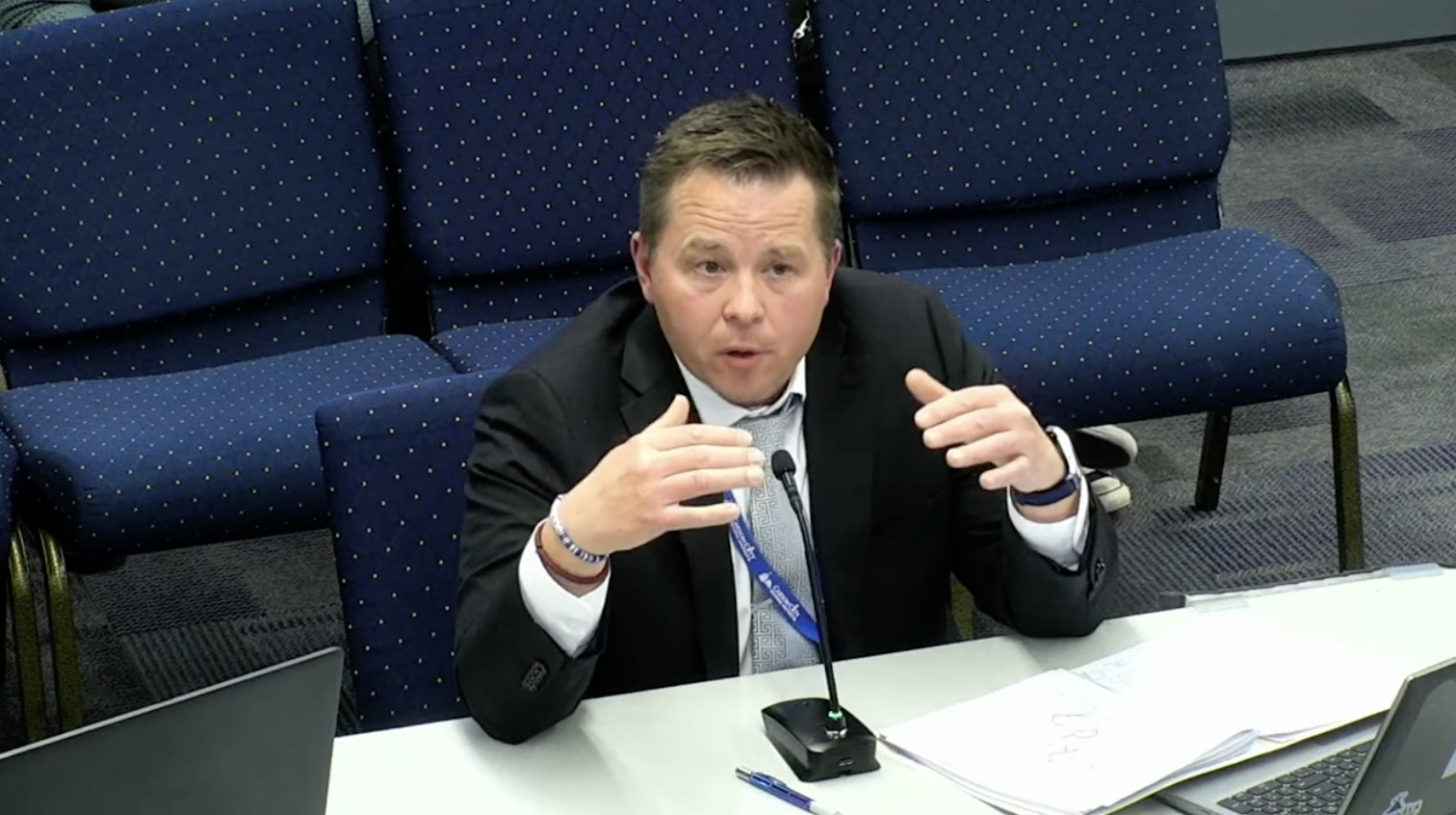
“I don’t think there should be any surprises here,” Feuling said, and added that additional adjustments are expected including staff turnover, and “potential non-staffing costs.”
Superintendent Feuling clarified that what the board was approving was not the final budget, but they needed to submit their tentative budget with the Department of Taxation by April 15, and with over a $3.02 million deficit, this was their solution to reduce the deficit and avoid a budget violation from the state.
A significant portion of the public comment and board discussion centered on the proposed elimination of school social workers and intervention paraprofessionals. Originally, the district proposed cutting 12 social worker positions, but after finding alternative savings — including canceling a $500,000 purchase of two new diesel school buses in favor of acquiring four electric buses via a grant — six of those social worker positions were added back into the tentative budget.
Please don’t balance the budget on the backs of students like my son
Despite this compromise, educators, parents, and union representatives pleaded with the board to halt the cuts entirely.
Brian Wallace, president of the Ormsby County Education Association (OCEA), warned the board against making premature reductions, noting the district’s ending fund balance is currently stable.
“We have the financial stability and with that comes the responsibility to make thoughtful student-centered decisions,” Wallace said. He added that removing school social workers would shift the burden onto already stretched community partners, resulting in slower response times and gaps in mental health care for students.
Parents of vulnerable students also asked the board to put their students at the center of their decisions. Kaylee Young, the parent of a 5-year-old non-verbal autistic child, stated that intervention paraprofessionals are essential for her son’s safety and communication. “Removing that support does not reduce services — it completely removes his access to education completely,” she said.
Steven Rivera, another parent of a non-verbal child, echoed this sentiment. “Paraprofessionals aren’t optional supports for him. They are what makes learning, communication, and safety possible every single day,” Rivera said. “Please don’t balance the budget on the backs of students like my son.”
School social workers asked the board for more time to secure alternative revenue streams, such as Medicaid billing for the services they provide.
“Please give us another chance, invest in us, give us one more year to prove to you that we can do this,” said Patricia Hernandez Huarez, a school social worker at Empire Elementary.
Superintendent Feuling acknowledged the difficulty of the cuts but defended the district’s administrative efficiency. He noted that Carson City spends significantly less on district-level leadership compared to other Nevada districts.
According to Feuling, under the tentative budget, 88.5% of general fund staffing costs will be directed to schools, leaving the district office running “extremely lean.”
Feuling also explained that the authorization for the RIF notices had to be approved Tuesday to comply with statutory deadlines, as letters of intent for certified staff must be issued by May 1.
In the perfect world, we wouldn’t have to make any cuts — but we know that we’re going to have to.
The board spent hours exploring alternative cost-saving measures. School Board President Molly Walt challenged the district to scrutinize roughly $1.3 million spent on special education contractors to see if those funds could be redirected to save staff jobs.
“I really think we need to put that under scrutiny and get rid of the contracts and get those positions back into the classroom,” Walt stated.
Other trustees questioned whether the district should continue fully funding programs like Jump Start — a dual-enrollment college program — or covering Advanced Placement (AP) test fees for all students. Trustee Tina Statuki requested a per-pupil cost breakdown by each school site, raising the possibility that declining enrollment might eventually force the district to consider closing a school facility entirely like both neighboring districts of Washoe County and Douglas County are currently in the process of doing.
“Unfortunately I don’t see an alternative,” said Trustee Mike Varner. “In the perfect world, we wouldn’t have to make any cuts — but we know that we’re going to have to.”
Before the board finalized their vote to issue the layoff notices, they provided Feuling with a directive to continue searching for alternative cuts before the final budget is approved in late May.
Their priorities include preserving as many social workers as possible, scrutinizing contractor obligations, and finding additional savings at the district office level.
The vote passed with a single dissenting vote from Trustee Lupe Ramirez, who cited the direct impact on students.
“I am struggling with the idea of not having social workers and paraprofessionals and teachers in the classrooms,” Ramirez said. She urged the board to analyze district office administrative positions to see what functions the district could live without before cutting school-level staff.