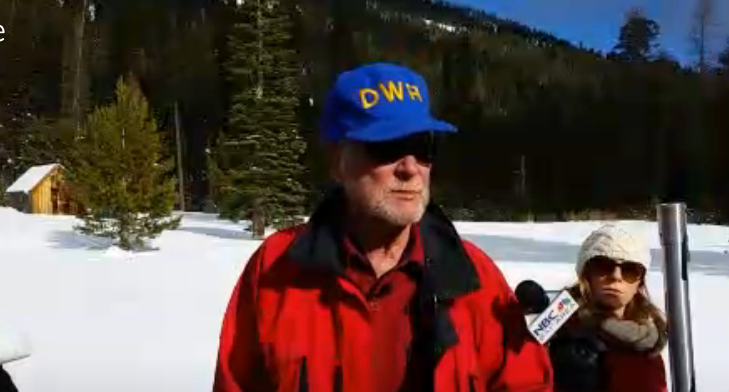
This season’s snow in the Sierra and the forecast for a continued wet El Niño pattern shows promise but there’s still a long way to go in order to make a dent in the four-year drought, said California water officials Wednesday at this winter’s first manual snow survey at Echo Summit, which snowed a snow depth of 54.7 inches, 16.3 inches of water content and 136 percent of average.
Frank Gehrke, chief of the California Cooperative Snow Surveys Program, said more than four years of drought have left a water deficit around the state that may be difficult to overcome in just one winter season.
“Clearly, this is much better that it was last year at this time, but we haven’t had the full effect of the El Niño yet,” Gehrke said. “If we believe the forecasts, then El Niño is supposed to kick in as we move through the rest of the winter. That will be critical when it comes to looking at reservoir storage.”
Despite the higher-than-average water content for the statewide snowpack, officials said snowfall during the remainder of the winter will largely determine whether California’s drought will be entrenched for a fifth year.
California Department of Water Resources Director Mark Cowin said the heavy snowfall so far this water season “has been a reasonable start, but another three or four months of surveys will indicate whether the snowpack’s runoff will be sufficient to replenish California’s reservoirs by this summer.”
Each water year begins on Oct. 1 and ends on the following Sept. 30.
DWR conducts five media-oriented snow surveys in the Sierra Nevada each winter, near the first of January, February, March, April and May at the Phillips Station plot, elevation 6,800 feet), just off Highway 50 near Sierra-at-Tahoe Road 90 miles east of Sacramento.
California’s largest six reservoirs currently hold between 22 percent (New Melones) and 53 percent (Don Pedro) of their historical averages in late December. Storage in Lake Shasta, California’s largest surface reservoir, is 51 percent of its Dec. 30 average.
More telling than a survey at a single location, however, are DWR’s electronic readings today from 99 stations scattered throughout the Sierra Nevada. Measurements indicate the water content of the northern Sierra snowpack is 11 inches, 108 percent of the multi-decade average for the date.
The central and southern Sierra readings were 12.1 inches (116 percent of average) and 7 inches (86 percent) respectively. Statewide, the snowpack held 10.2 inches of water equivalent, or 105 percent of the December 30 average.
One year ago, the north, central, south and statewide readings respectively were 5.8 inches (57 percent of average), 4.7 inches (45 percent), 4.0 inches (48 percent) and 4.8 inches (50 percent).
In normal years, the snowpack supplies about 30 percent of California’s water needs as it melts in the spring and early summer. The greater the snowpack water content, the greater the likelihood California’s reservoirs will receive ample runoff as the snowpack melts to meet the state’s water demand in the summer and fall.
In January 2014, Calif. Gov. Jerry Brown declared a drought State of Emergency and directed state officials to take all necessary actions to prepare for water shortages. On April 1, 2015, when the statewide snowpack’s water content was historically low at 5 percent of that date’s average, Brown mandated a 25 percent reduction in water use across the state. Californians have largely complied with the mandate; from June through October, water consumption was down 27.1 percent statewide compared to the same period in 2013, according to the State Water Resources Control Board.