The Carson City School Board will meet Tuesday, Oct. 13, 2026 to discuss financing requests, a slew of proposed policy changes, and more.
The meeting begins at 6 p.m within the Bob Crowell Board Room in the Carson City Community Center, located at 851 E. William Street. The public can attend in person, or view the meeting live via YouTube.
Public comment is accepted in person or via email at publiccomment@carson.k12.nv.us. Please include your full name for your comment to be included.
Bond requests
Trustees are being asked to vote on a resolution regarding an issuance up to $15 million in bonds for “school improvements,” as well as potentially refinancing existing debt.
The resolution authorizes notification to the Carson City Debt Management Commission of the proposed borrowing and application for a state program that would guarantee up to $25.05 million in bonds.
The district is also asking to apply for a state guarantee covering up to $10.05 million in bonds used to refinance existing debt.
While refinancing would replace existing debt rather than necessarily create entirely new debt, it could change how long the district makes payments and how much taxpayers ultimately pay in interest — for better or worse.
It is not known what the district is seeking to refinance, or any information about the terms.
The agenda item does not specify which schools would benefit, what improvements are planned, or how the new $15 million would be spent.
It is not known if this is related to the recently proposed auditorium / theater at Carson High School. Those figures were far higher than the $15 million being proposed, however, which makes this unlikely. You can read more about that project below.
We’ve reached out for clarification on what the $15 million is to be used for, and what the purpose of the refinancing is.
Policy Changes related to Student Support Services, Parental Rights, Special Education and more
A few months ago, Carson Now undertook an investigation at the request of several Carson City School District families looking into what they said was the district’s failures to adhere to their own policies, as well as state and federal laws, when it came to bullying investigations and managing students with significant behavioral issues.
The district denied all wrongdoing, and stated they follow the law.
However, shortly after during a CCSD school board meeting, a number of district teachers, middle school principals and other staff members discussed issues they were facing causing them to not follow the referenced laws and policies we explored in our investigation.
One of the main issues, according to a staff member who spoke with Carson Now on the condition of anonymity during our initial investigation, is that when school administrators (principals, vice principals or their designee) asked for a student to be removed — including requests for them to be placed in a classroom or school site with a higher level of support — there were significant response delays for evaluation, and nearly all were denied.
During the course of that investigation, Carson Now asked the school district if there were policies, procedures or regulations related to referral requests. The district either did not respond, or stated they were housed under the bullying policy.
However, as it pertains to what is being discussed Tuesday, district regulations do contain detailed parental-rights provisions and timelines for processing student-support referrals — but now, the district has asked for many of those to be removed, and most do not have applicable substitutions that we have been able to find.
Student Support policy changes
During the Sept. 22 school board meeting, trustees reviewed proposed changes to several district policies and regulations governing student-support services, special education and homebound instruction. Four of those policies are scheduled for a second reading and possible approval Tuesday, Oct. 13.
Policy 207 and its associated regulations govern Student Support Services and include rules surrounding behavioral or learning disabilities evaluations and identifying educational support needs.
Depending on the student, those evaluations can include academic and intellectual testing, adaptive-behavior assessments, speech and language evaluations and vision or hearing screening. Nevada regulations similarly require evaluations to consider multiple sources of information when determining a student’s eligibility and educational needs.
The struck regulation identifies the following as part of Student Support Services:
- Emergencies and “extreme anti-social behavior.”
- Crisis intervention.
- Child abuse or neglect.
- Individual and group counseling.
- Health services.
- Classroom observations concerning emotional climate.
- Coordination with mental-health, public-health and other community services.
- Homebound referrals involving emotional problems.
- Support for students with learning disabilities in regular classrooms.
- Parent consultation and supportive services for parents.
Proposed Eliminations:
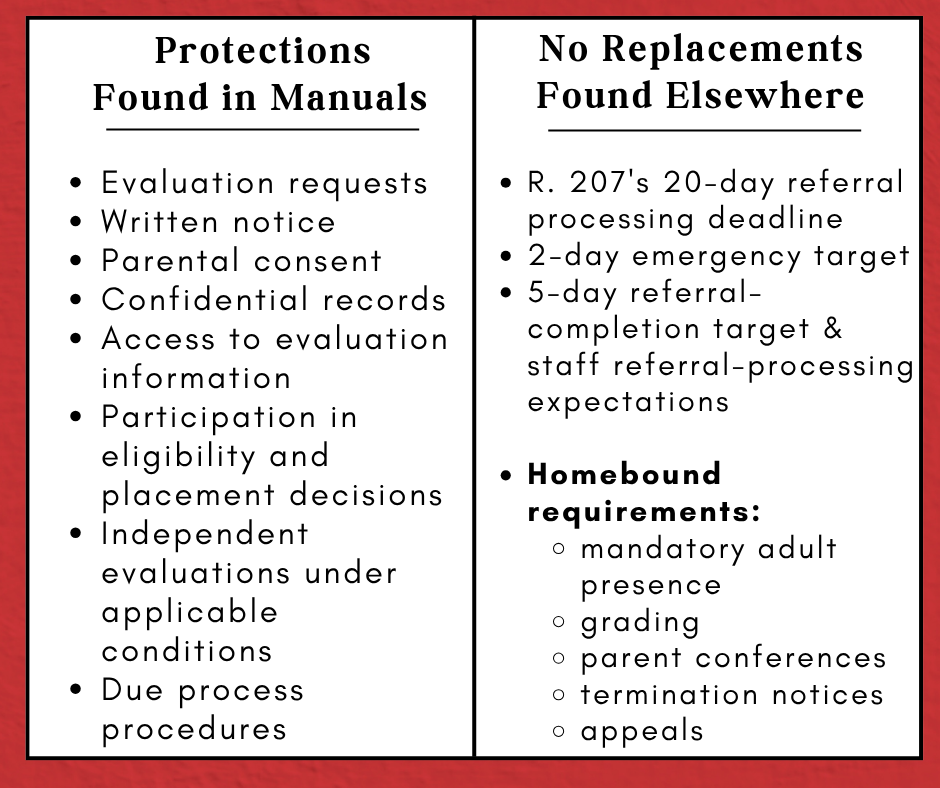
Regulation 207: Referral timelines, staff referral-processing expectations, annual deadlines, and types of psychological and support services available.
Regulation 207.2: Summarizes parental rights during evaluations including notice, consent, access to records, independent evaluations and due process.
The Oct. 13 agenda also introduces a first discussion of Regulation 207.1 which governs referral procedures. During the September meeting, district counsel Ryan Russell told the board that Regulation 207.3 would be the only remaining regulation under 207.
However, information about 207.1 is not included in the agenda, so it’s not clear at this time what the proposed changes are or why it is up for discussion.
During the Sept. 22 discussions, Student Support Services Director Christine Lenox and Superintendent AJ Feuling said the district follows federal and state special education laws and maintains procedure manuals which are updated as necessary.
In a review of these manuals, we found many of the protections outlined in the policies. However, the district-specific timelines and procedures eliminated from 207 do not appear to be included, and we have not been able to locate them elsewhere. The publicly available manuals were last updated in 2020 and 2021.
The proposed changes also transfer who develops and oversees the implementation: if approved, the development and oversight of procedures will change from being under the board’s purview to that of the superintendent and/or their designated staff.
At this time, no proposed equivalent administrative procedure has been included.
The September agenda’s executive summary describes Regulation 207 and 207.2 simply as being omitted and directs the reader to Policy 207, while describing the policy change as an update to its “belief statement.”
Policy 208 is also being struck in its entirety.
Although the Sept. 22 executive summary describes Policy 208 as duplicative of Policy 207 and directs readers back to 207, the evaluation, parental-consent and confidentiality language contained in both policies is being removed from both, rather than consolidated into the new Policy 207.
During the Sept. 22 meeting, Superintendent Feuling said the two existing policies contained essentially identical language and that the protections would remain under applicable law and district procedures.
What is not being replaced
Among the district-specific provisions being removed are the timeline for processing referrals, staff workload expectations, annual deadlines and its statement that evaluation services are available to parents and certified staff.
It also removes a commitment to arrange a parent conference after an evaluation, provide parent consultation upon request, and offer supportive services to parents.
State and federal law requires specific evaluation and parental-participation procedures, but those requirements are not necessarily identical to the additional local commitments contained in the district’s existing regulations.
The requirement to keep reports in a confidential file within the Student Support Services office would also be deleted.
Homebound changes
The homebound program provides temporary instruction to students who cannot attend school because of illness or disability, including certain students in residential treatment.

Notable changes:
A safeguard requirement is being eliminated in that, currently, a parent or guardian must be present for homebound teachers to provide in-person instruction.
The replacement only requires the parent or guardian to “support reasonable access to the student for scheduled instruction.” It does not require another adult to be present during in-person instruction.
The replacement would also change how instructional hours are described. The existing regulation caps instruction at five hours per week, while the proposed version provides for at least five hours of direct individual tutoring weekly for covered students. It also clarifies that students with IEPs must receive any additional instruction required by their individualized plans.
The current regulations also protect certain students in residential treatment or with contagious or infectious illnesses from receiving a zero while they complete contracted coursework; they instead receive an incomplete.
That protection is not reproduced in the replacement regulation.
Separately, the current Policy 204 says homebound coursework will be monitored by staff at the student’s school, while the proposed policy instead directs the superintendent or designee to establish procedures for progress monitoring and coordination with the school.
During the September meeting, a trustee requested more specific requirements for reviewing homebound students’ continued eligibility and family-support needs. However because the policy was not provided in the agenda, it’s not known at this time if that language is included. We reached out to the district for the updated policy drafts.
Other policy changes
Trustees will also review proposed changes to several additional district policies and regulations. The agenda identifies the following items:
- Policy 201: Education Research — first reading.
- Policy 202: Curriculum Assessment — first reading.
- Regulation 202: Development of New Courses — discussion only.
- Policy 206: Comprehensive School Counseling Program — first reading.
- Policy 505: Assignment Within District — first reading.
The agenda does not describe the proposed revisions or explain why the changes are being considered. No supporting documents detailing the proposed changes were included with the agenda provided for review.
We’ve reached out to the district for additional information and will update if that information becomes available.
It should be noted that these are just some of several recent policy or regulation updates the district has undertaken. One of which was a transgender reporting policy, mandating that district staff report students to their families if staff believes they might be undergoing a “gender or social transition.”
The impetus, according to district legal counsel Ryan Russell, was to adhere to what he said are ‘parental disclosure rights’ the district must follow.
You can read more on that reporting here:
In other items:
The board will receive an informational update on the district’s SWORN program for fifth-grade students. The agenda does not provide further details about the presentation.
Trustees will consider recommendations from the district’s Benefits Committee concerning group health insurance plan design and renewal of coverage for 2027. The board could approve changes with a financial impact within its approved budget.
Representatives from the University of Nevada, Reno, and the school district will present information on a joint “Transcript Project.” No other information about the project is available at this time.
The board will receive an update on summer capital improvement projects and consider approving a revised five-year capital improvement plan covering fiscal years 2027 through 2031. The agenda does not identify the projects or proposed revisions to the plan.
Trustees will also consider approving a letter to local businesses expressing concerns about employers scheduling students to work during school hours.
Students will be dismissed early Oct. 13, 20 and 27 for staff professional learning. Elementary and middle schools will be closed Oct. 21-22 for parent conferences, and district schools will be closed Oct. 30 for the Nevada Day holiday.
Disclosure: Robots helped compile the summary.