A proposed performing arts center at Carson High School could include a 600-seat auditorium, full stage and rehearsal space under a concept that would cost roughly $32 million at current construction prices before additional project expenses, according to plans presented to Carson City School District trustees Tuesday.
No action was taken on the project, which remains in the conceptual stage.
Superintendent AJ Feuling said the presentation was intended to give trustees their first detailed look at the proposal before the district determines how much money could be available and whether to proceed.
Van Woert Bigotti Architects developed several versions after working with a district committee formed about two years ago to look into a potential theater build on the Carson High School (CHS) campus.
Architect Brad Van Woert said their firm is currently working on a theater project for TMCC, which is around $1,000 per square foot (roughly $60 million for a 60,000 square foot space). A similar project has been considered for the proposed CHS project at around $50 – $60 million, but he said that in addition to this “Mercedes” version, they also have been working on a “Honda” version as well.
Van Woert said they came up with the concepts based on what Feuling had told him what funding may be coming available.
“We started to drill down and we did a whole bunch of options: the Honda model, Chevy model and the Mercedes model. When superintendent’s told us how much money we might be able to procure in the future to build this thing, [we] came up with what I’m gonna call it the ‘Honda Plus.’”
The “Honda Plus” concept, which would be about the size of the Carson City Community Center’s theater, was estimated to cost roughly $32 million (32,000 square feet at $1,000/sq ft)in current construction costs. However, Van Woert said that additional costs such as “soft costs, entitlement, fees and FF&E’s (meaning builds/items like furniture, seating, lighting and sound equipment, curtains, stage equipment, storage etc)” is not included in that number.
Funding remains the main unresolved question.
Fueling said they believe around $30 million in bonding capacity could becoming available in the next two to three years, though he said that number hasn’t been finalized.
Fueling said that while the price tag is “pretty substantial,” it’s also “probably within the realm of possibility.”
“The problem is it would eat up all of the possible funding and leave us nothing to do anything else,” he added. “And we have a lot of aging buildings in the district. So that would be a real concern.”
Trustees asked if there was the potential to do a private-public financing or funding to get the fund the project without completely wiping out capital funding capacity.
“I think there’s lots of possibilities how to do it,” Fueling said.
Van Woert said a public-private model could include major donors followed by smaller fundraising efforts once the district determines how much public funding it would commit.
The facility could also be available for community events. Feuling said rental revenue could potentially be set aside to maintain or replace theater equipment.
Carson High theater teacher Darby Beckwith told trustees the school’s programs currently rely on the Carson City Community Center and have encountered scheduling and transportation challenges.
“We have run into some instances of being double booked and our venue dates are given to another organization,” Beckwith said. “An outside organization — which is difficult for our students; it’s frustrating and it makes them feel like they are not valued members of our school community, which they certainly are.”
Beckwith said the school’s fine arts team estimated that choir, band, orchestra, theater and musical theater classes together make up about half of Carson High’s student body.
“It’s really challenging to train our students and to be college and career ready in our fine arts pathways without having the facilities for them to train on and to perform in,” she said.
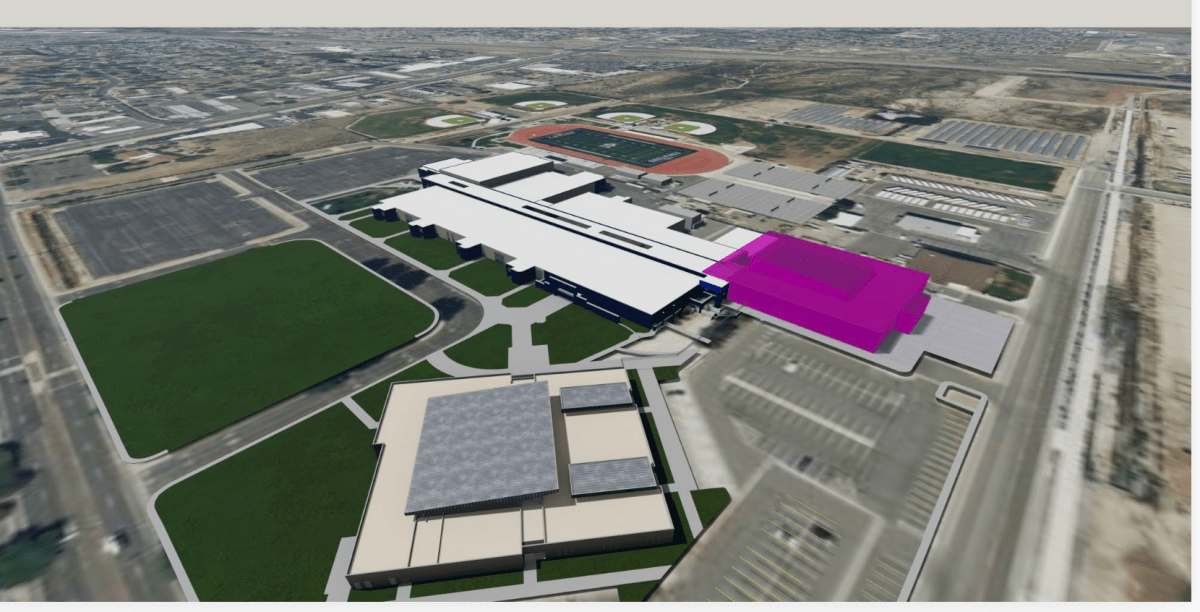
Parking would remain a consideration if the project advances. Van Woert estimated a full 600-seat event could bring 150 to 200 vehicles, although the proposed south-side location was selected in part because it would eliminate less existing parking than other locations studied.
Several proposed locations and concepts for the theater were included, including those created the last time this item was proposed in the early 90s.
Feuling said the district would return to the board after it has a clearer picture of available capital funding and existing facility needs, at which point trustees could decide whether to commit district funding and authorize additional design work with Van Woert and his team.
There was no staff report or additional information provided about the committee or its members, or the project discussions leading up to this point in the concept. The committee is not listed on the district’s Committee page. However, Bond Oversight Committee meeting minutes from 2025 show the proposed performing arts center was brought forward by Fueling since at least March 2025. No minutes are publicly posted prior to 2025, and no audio recordings from any meetings are posted.
See the full presentation below:
District scales back NEPF legislative proposal
Trustees also unanimously agreed to move forward with a narrower legislative proposal involving the Nevada Educator Performance Framework after Feuling backed away from the district’s original plan to seek elimination of the statewide educator evaluation system.
The bill draft request included in the board’s agenda packet proposed eliminating NEPF and returning evaluation authority to individual school districts.
Feuling told trustees Tuesday that conversations in the days before the meeting had led him to conclude that the Legislature was unlikely to consider a full repeal after recent state-level work to revise the system.
“If we are going to be proposing a bill, we want something that has a chance,” Feuling said.
The revised concept would instead seek to reduce evaluation requirements for educators who have repeatedly been rated effective or highly effective while directing more administrative time toward probationary teachers and those rated developing or ineffective.
Under concepts presented Tuesday, effective and highly effective teachers could focus their evaluations on fewer instructional practice or professional responsibility standards. Educators with consecutive years of strong ratings could also move into reduced evaluation cycles before periodically returning to the full process.
Administrators said the change could allow principals to spend more time supporting teachers who need additional assistance rather than applying the same evaluation workload to every employee.
The proposal could also seek changes to a requirement that a principal supervisor review at least 3% of licensed employee evaluations.
Trustees spent part of the discussion considering how formal and informal classroom observations should be defined under the proposal, including whether observations should be scheduled and require a follow-up conference.
Trustee Tina Statucki supported reducing some evaluation requirements for effective and highly effective teachers but argued against replacing formal observations with less structured reviews. She said the evaluation process can serve as a professional growth tool that highly effective teachers are grateful for, because it provides teachers with substantive feedback on areas they can improve on further.
The board ultimately voted to “partially approve” the bill draft request on the condition that it seek only to eliminate or modify portions of NEPF discussed Tuesday and more clearly define formal and informal observations.
Student progress policy approved
Trustees unanimously approved revisions to Policy 513, which governs reporting student progress.
The additional change made between the first and second readings defined what the district means when it requires grades and feedback to be provided in a “timely” manner.
“Timely means feedback is returned while the essential skills are actively being taught,” the policy states. “This allows students time to reflect on their progress, relearn key concepts, and demonstrate improvement before taking an end-of-unit test.”
The version approved Tuesday also lowers the district’s percentage-based definition of mastery at the elementary level from 80% to 75%, while maintaining an 80% threshold at the secondary level.
Staff provided no additional explanation during Tuesday’s second reading for the reasoning behind the lower elementary threshold, and trustees asked no question about it. A grammatical error was corrected in the policy before it was unanimously approved.
See more here:
Test security plan
Trustees unanimously adopted the district’s 2026-27 test security plan after making several wording corrections.
Director of Accountability and Assessment Ricky Medina said there were no substantive changes to the district’s testing procedures this year.
He reviewed examples of testing irregularities reported during the previous school year, including a handful of instances of students entering the wrong test, technology-related test unlocking, two cellphone incidents (one involved cheating, the other accidental) and an incident in which a vendor employee photographed a test screen while attempting to document a technical problem.
Medina said one of the cellphone cases involved a student attempting to cheat.
Trustees also identified inconsistent wording governing investigations of testing irregularities.
The approved plan will specify that site test coordinators have 10 calendar days to complete an investigation rather than simply “10 days.”
Essay contest
Trustees selected civil discourse as the topic for the district’s 2026-27 Great American Essay Contest.
The board modified one of six proposed topics to define civil discourse for younger students and add a question asking students to consider their own conduct.
The final topic asks students to explain the importance of listening respectfully to people with different views and how “civil discourse, the ability to disagree respectfully,” strengthens a community. It concludes: “How can you encourage and be an example of this to others?”
The annual contest is open to public, private, charter and homeschooled students in Carson City at the elementary, middle and high school levels. First-, second- and third-place winners at each level receive $100, $50 and $30, respectively.