The Carson City School District Board of Trustees advanced sweeping and controversial new parental disclosure mandates Tuesday night amid mounting concerns in a move that likely violates Nevada’s Open Meeting Law, despite apparent attempts to fix the issue by referring to some policies as a “first reading.”
The district’s agenda posted last Thursday simply lists “Proposed Changes to the following Objective Policies,” followed by the name and number of seven policies, while burying the addition of significant mandates requiring staff to disclose a student’s “social/gender transition” to their parents, and granting broad opt-outs for curriculum going against families’ “moral beliefs” or “sensitive personal topics” among others.
However, concerns of transparency extended beyond the pages of the agenda.
Board attorney fails to cite laws, even when asked directly to do so
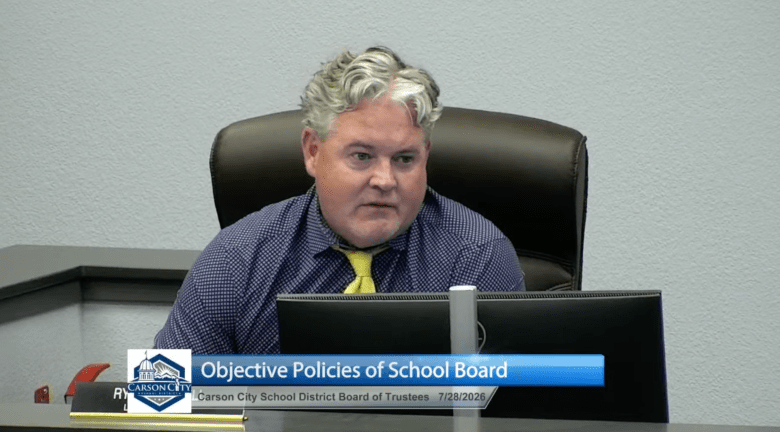
During the meeting, when the policies in question came up for discussion, Board Counsel Ryan Russell was asked directly why these additions were made.
Initially, Russell described them as “housekeeping” — a term describing minor changes such as routine language update (changing the term “parents” to “families,” or “CCSD” to “the District” for example). The term does not extend, however, to changes that would be seen as a topic of public importance, or would create new rules, obligations or mandates, according to the Nevada Legislature.
He also said repeatedly that the changes proposed in Policy 106 — newly renamed the Family Engagement Policy — are mandated by law. However, unlike the other CCSD policies and revisions mandated by law, Russell’s proposed changes do not include legal references.
In comparison, Policy 104, which covers nondiscrimination, cites the Americans with Disabilities Act, Title IX, the CROWN Act, and USERRA at the bottom of its draft.
“This had to be updated as a result of not only changes in the law but of Supreme Court interpretation,” Russell told the board Tuesday. “It’s mandating essentially transparency between parents and the schools. It’s clarifying that the schools are not permitted to withhold the information you see added to policy 106 from parents.”
He then referenced Nevada’s “Family Life” law, which requires an opt-in (rather than an opt-out) for sex education. However, the language within Policy 106 does not contain references to the Family Life law, and requires new mandates distinct from what that statute requires. In addition, Family Life is implemented through the district’s Family Life Advisory Committee, not Policy 106.
Instead, the added language mandates families be allowed to opt-out from any assignment they consider to be against their religious or moral beliefs or “sensitive personal topics,” and teachers must provide alternative assignments when requested, as opposed to requiring parental consent before a student can take a sex ed course.
The largest additions to the policy are included below; however, it’s not clear what Russell was referencing in his explanations to the board when he discussed Family Life, or his comment that “it was just a little cleanup on here [to] bring it in line with the law when that comes up.”
Additions to policies
In the first section of the policy about family engagement it adds: Regular and meaningful communication strictly includes a policy of complete transparency regarding a student’s mental, physical, emotional, and social health. School personnel shall not withhold, conceal, or forgo sharing information with parents regarding changes to a student’s health, well-being, or social/gender transition at school, except in narrow instances where a specific, good-faith safety concern requires immediate mandatory child abuse reporting.
In a section stating that student achievement increases when parents are involved in their learning process, it now adds: To protect this integral role, the District guarantees parents the right to proactive, advance notice and an accessible opt-out accommodation for instructional materials or supplemental curricula that substantially intersect with a family’s religious development, moral beliefs, or sensitive personal topics, with alternative academic assignments provided without penalty.
In a section that begins that parents and educators are both responsible for making informed decisions relating to the education of their student, it now adds: Shared decision-making requires that the District never exclude parents from critical choices regarding their child’s identity, health accommodations, or educational pathway.
He added that “just for complete transparency, the law always trumps a policy — we want our policies to be in line with the law, and that’s why we do this, but we’re always gonna be governed by the current state of the law; that’s always gonna be the ‘Trump factor’ for lack of a better term.”
When Russell was asked by Trustee Michelle Pedersen what laws he was citing, and if the language was legally mandated to be included, Russell said it was.
I can see if I can find less, I don’t know, nefarious language if you want — I don’t know what the words are.
“So it’s not open for change?” Pedersen pressed, to which Russell said “as long as we don’t change the substance of it — like the language we can work on as long as it’s consistent with the spirit of what’s being said.”
Pedersen then asked about the term “sensitive personal topics” noting that it is “very subjective” and asked if there was any guidance that came with the mandated language they were given.
Russell stated that he could “find some” adding that “I can see if I can find less, I don’t know, nefarious language if you want — I don’t know what the words are.”
Pedersen noted that the language doesn’t include what constitutes a sensitive personal topic, and asked if there was going to be a process for determining if a request qualifies, or who would decide the outcome, “because I could see some students saying ‘I don’t like this, it’s sensitive, I’m not gonna do that.’”
Russell said that because it’s in the parent engagement policy, it’s “ultimately the parents decision to opt-out of curriculum, and the intent is to give them the ability to do so when they feel something is a sensitive personal topic.”
He told Pedersen that the better question to ask is when a sensitive personal topic is identified, how can the district provide the opportunity to a parent who wants to opt-out “because we have to honor that.”
He said the issue the board needs to be discussing is when parents should be notified of a sensitive personal topic.
Russell was repeatedly asked where the language originated from, but did not respond directly until Pedersen explicitly said “Section one: where did we get that verbiage from, why are we adding that subject material into this policy?”
Russell still did not provide the citations; instead he said “the short answer is in the Supreme Court cases that came out, they used this language, which I don’t think it’s mandated being there, so is there a part of this language that you don’t like?”
Pedersen said she was fine with references to well-being and health, but she was not comfortable with the addition of the specific language citing “social and gender transitioning.”
Taking away confidentially from the safe adults within the walls of our school, from people who may be the only safe adults in these children’s lives … it makes me uneasy.
Pedersen said she appreciates it’s worded in a way that there is not an obligation to initiate the conversation, but that conclusion is not necessarily supported by the language used.
The language states that “school personnel shall not withhold, conceal or forgo sharing information with parents” — but the use of “shall not forgo sharing” in its most literal reading can be interpreted as “cannot voluntarily abstain from sharing.” Or, simply: personnel are mandated to share, as “shall” and “shall not” are legally defined terms in Nevada law.
Regardless, Pedersen said she “does not love” including the language at all, especially after several constituents reached out to her with concerns, including those who are the “safe spaces” for children who are “trying to figure things out, and there are families unfortunately who will kick you out or disown you or abuse or be completely horrible to you — taking away confidentially from the safe adults within the walls of our school, from people who may be the only safe adults in these children’s lives … it makes me uneasy.”
Russell said that, “regardless of what the policy says, our staff cannot withhold that information if they’re asked as a matter of law.”
However, he again did not specify what law he’s referencing, and this directly contradicts a Washoe County School District policy which states a student’s transgender status is a matter of personal privacy. Further, WCSD staff is prohibited from revealing a student’s transgender or gender non-conforming status to others, including guardians, “unless there is a specific ‘need other know,’ they are legally required to do so, or the student has authorized such disclosures.’”
Pedersen then asked Russell again, “as a matter of law, are we required to have [that language] in here?”
It’s protecting transparency.
Russell avoided the question, instead responding that it’s “strictly compliant with the law, which is why it’s smart.”
President Molly Walt interjected that it’s “protecting.”
“It’s protecting transparency, it’s protecting a parent’s right to participate in the education of their kids, it’s protecting the district’s obligation to provide that transparency to parents,” Russell agreed.
Trustee Richard Varner said that he’s “not really upset about the language, I think we should keep it.”
Russell then stated that the policy reflects that the parental engagement policy language is “a constitutional right to raise your kids and be involved in their education,” adding that while he understood what Trustee Pedersen was saying, “it’s the law.”
He added that it’s “smart” for the district to have a “paper trail” showing they are staying up on and being as compliant as possible, and it serves as a “good notification for all the parents that are looking to understand the legal waters that you guys have to swim in.”
Walt said that she was contacted by parents who said they appreciate the transparency of updating these policies, “because a few parents that reached out were unaware, and now they’re aware.”
There was no further discussion on the polices aside from grammatical fixes.
Violation of Open Meeting Law still likely despite apparent attempts to smooth noticing failures
During the short meeting, the board appeared to try and sidestep what are likely violations of legal requirements by verbally declaring half of the items in their “policy changes” items as being a “first reading” despite the agenda stating they would be up for a vote.
Open Meeting Law can be convoluted, but it’s important for public transparency. All public bodies are required to provide adequate notice to the public on what they will be discussing and voting on. This means that agenda items must be detailed, clear and provided in full by 9 a.m. three business days preceding the meeting.
However, the agenda provided to the public on Thursday morning did not include any information as to what the policy changes were — only that changes were being made.
Significant changes to three of the seven listed policies were added by Board Counsel Ryan Russell between the June meeting and Tuesday’s meeting, despite no discussion being held during the first reading about the additions he intended to make.
The district has ignored all attempts Carson Now has made to gain clarity on these items — including an email detailing why their agenda was likely a violation of Open Meeting Law.
Instead of pulling the item from the agenda and rescheduling it for a future meeting, after the public was properly noticed, President Molly Walt opened the item by declaring three of the items were now “on first reading, for discussion only.” However, as was relayed by Carson Now to the district prior to and following the meeting, discussion of the item at all after recognizing the public has not been properly noticed is still a violation.
The Attorney General’s Office oversees Open Meeting Law enforcement, and is tasked with determining if violations occur.
You can watch the full meeting below: