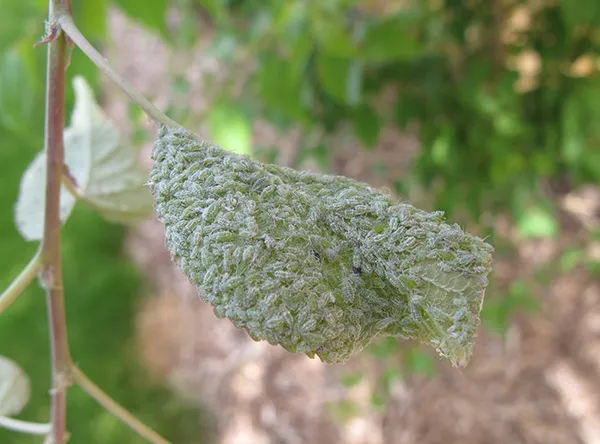
I was asked about scale damage to trees. Scales, relatives of aphids and whiteflies, suck plant juices out of many types of plants. Soft scales exude a sticky residue called honeydew that drips all over leaves, trunks, cars or anything else under the infested plant. Armored scales, on the other hand, do not excrete honeydew.

Identifying which scale is on the plant determines your management strategy. Some scales do not need to be controlled since damage is minimal. Scales are immobile for much of their lives.
Soft scales are usually larger than armored ones with a smooth, cottony, or waxy surface. Their turtle-like shell is the actual insect rather than a protective hiding place. With soft scales, flipping the shell does remove the insect body. Ants often “tend” these scales like shepherds with sheep, harvesting the sticky nutrient-dense honeydew they exude and protecting them from natural predators.
Armored scales have a flattened cover protecting insects and eggs underneath. Removing the cover doesn’t remove the insect. There are several generations per year.
Female scales produce eggs that they usually hide under their bodies under the shell. Eggs will hatch into tiny crawlers, the stage at which they are most easily controlled. They can be moved from plant to plant by the wind, birds or people. After crawling from the shell, they settle down and begin to feed within a day or two of hatching. They often will live out their lives in one spot. Most soft scales have one generation per year and overwinter as second stage nymphs. Armored scales can have multiple generations and overwinter as first stage nymph and adult females. However, soft brown scales can have multiple generations.
Scales can weaken a plant, slow growth and make it look stressed or scorched. If the infestation is heavy, whole branches or plant parts can die. Usually scale infestations are managed by natural predators and parasites. The shepherding ants can interfere with natural enemies though. The repetitive use of broad-spectrum herbicides can lead to chemical resistance by the insects and death of natural predators. Amazingly enough, often the best way to manage scales is to control the ants and let the natural enemies do their job without interference.
Horticultural oil sprayed “during the dormant season, or soon after scale crawlers are active in late winter to early summer, can provide good control of most species of scale.” Imidacloprid, a systemic insecticide, can control soft scales, but not armored or cottony cushion scales.
More on imidacloprid and other forms of control next week.
— JoAnne Skelly is an Associate Professor and Extension Educator, Emerita, University of Nevada Cooperative Extension. She can be reached at skellyj@unr.edu.