By Cameron Dopke
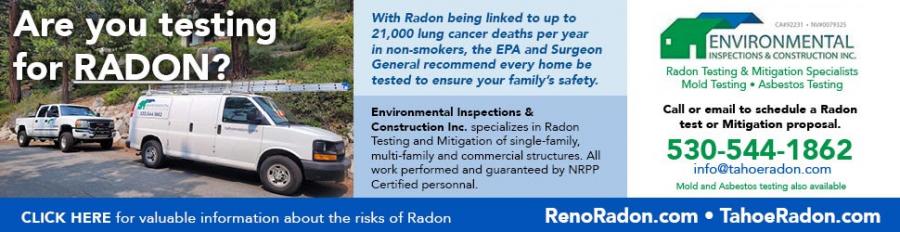
Have you tested your home and office for radon? Do you have suspected mold in your home? Wet or damp crawlspace?
We are all blessed to live in such a beautiful area. Whether you are in the mountains or the beautiful sprawling valley, these are a few issues area homeowners deal with.
Risk of exposure to radon gas within your home and at work is often not addressed. The EPA recommends all homes be tested to be sure radon levels fall under the recommended action level of 4.0 pCi/L(picocuries per liter).
These tests are often performed during real estate transactions at the request of the buyer or seller. Radon testing is a possible choice of either client and is not always standard during the inspection process. Commonly, standard home and pest inspections are conducted for the sale while testing for environmental health concerns such as radon and general air mold occur far less often. Was environmental testing performed during your property purchase?
Have you lived in your home for many years unaware of the dangers of radon gas and airborne mold spore exposure? We all spend a significant amount of our day at work as well. Is your workplace safe from these hazards?
Each subject needs to addressed individually. Simple testing performed by a licensed and trained technician or contractor can provide home and business owners peace of mind that they are living or working in a safe environment.
Radon is a naturally occurring radioactive gas that emits from the decay of uranium. As Radon gas is normally dissipated to the natural air at low levels, the structure of a home can trap radon gas within the living space creating hazardous levels.
Radon is the second leading cause of lung cancer in the U.S. behind smoking. The EPA recommends remediating homes with a Radon concentration of 4.0 pCi/L and above, whereas the WHO has set a maximum threshold of 2.7 pCi/L. Through testing and reporting data, maps of every county in the United States have been given a zone designation for their Radon Potential. Carson City has a designation of Zone 1-Predicted average indoor levels greater than 4.0 pCi/L. Other areas in Nevada have a Zone 2 designation of 2.7 to 4 pCi/L which is still a consideration level to repair your home or office to lower your exposure levels.
As a Licensed Radon Mitigation Specialist, I come across many misconceptions on radon intrusion into the structure. “My home should test fine, I have a vapor barrier in the crawlspace.” “It’s slab on grade, nothing should be coming through.” “How did it test above action level? I have foundation vents.”
These are just a few of the common ones. The truth is that radon gas can collect in the living space through the smallest of openings, cracks in the slab, collecting in the crawlspace and rising into the home through wall and floors. Rain, snow, wind and other weather events can also cause a fluctuation of radon levels.
The only way to know if mitigation is required, is to TEST. All of our tests are performed with industry leading, calibrated, NRPP approved testing equipment.
Mold is the other overlooked health hazard in the home environment. Mold is all around us. The type and concentration are the key factors that determine if it imposes a risk. Mold exposure affects people differently. For many, it creates allergies or undiagnosed illness.
People often refer to many types of mold as “Black Mold”. The variations of mold spores is very extensive, and not identifiable by color. With some types of mold falling into the toxigenic category, the first step is to identify the species of mold so it can be treated properly.
Using physical sampling of areas or just a general mold test can give an overall assessment of the air quality of the home. We have all had a water leak at one point or another. But where did that water go? Was it properly dried out? Did it stay moist in a wall cavity where it had conditions to grow? Visual inspection and sampling by a certified mold assessment technician can help the homeowner, buyer, or seller understand the issue and the possible health hazard associated with the current state of the home. Mold affected areas should be treated by a licensed remediation company.
Another major contributing factor to mold growth is a damp or wet crawlspace. Some homes are built in high water table areas while others have poor drainage near the foundation. Subgrade areas with a relative humidity above 50% can cause mold growth to the framing and insulation of your crawlspace. This mold can be distributed through the home through leaking ducts and other openings. Properly installed vapor barrier can assist in moisture control but sometimes encapsulation and mechanical ventilation is required to control the moisture. In almost all cases, the subgrade area can be repaired to help prevent mold growth.
Environmental Inspections and Construction Inc. is a family owned local business committed to providing services that create healthy home and work environments. We offer full radon testing and mitigation, mold and asbestos testing, as well as crawlspace moisture control and encapsulation for all areas of Northern Nevada and California.
Give us a call today and let out family help keep your family healthy and safe.
Environmental Inspections and Construction Inc.
1-530-544-1862
tahoeradon.com
renoradon.com
Email info@tahoeradon.com
For more information about radon visit
extension.unr.edu/radon