By Kirk Caraway

The good news is that the V&T Railway is expected to make a profit of $164,132 on their popular Polar Express event for the coming year.
The bad news is the railway’s main runs between Eastgate Siding and Virginia City is projected to lose $108,192, even with an expected $67,250 in donations.
The resulting $56,000 in projected profit is almost enough to pay for the $60,000 shortfall in the previous season’s sales tax revenue that pays for the bonds that helped rebuild the historic railway. That is a shortfall that is expected to continue and grow larger.
So the question is, how can the V&T make their regular runs as popular and profitable as the Polar Express event?
I had the opportunity last year to participate in both of these train rides, so let me add my two cents.
The Polar Express was quite the event. The train was packed with kids and their parents, all eager for an adventure. The ride is short, with the round trip taking a little more than an hour. It was dark outside, so there wasn’t much to see until we arrived at illuminated mockup of Santa’s village.
All of the action was inside the train, with the characters in costume, hot chocolate and cookies, and the story being read aloud for the kids.
I can see where almost every kid on that train will want to do it again this year. If they could figure out how to fit in more runs and get more kids from Reno on the train, it could grow even bigger.
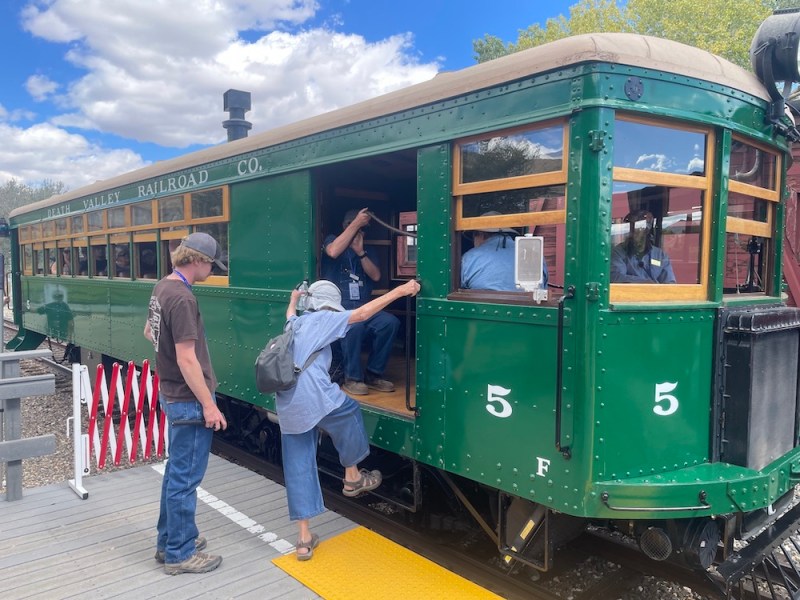
As for the regular run up to Virginia City, well, it was OK. If you haven’t done it, you will experience country you haven’t seen before, and get a little history lesson along the way.
There is some nice scenery on the route, but there’s also a lot that’s not very scenic. Funny how traces of human activity from 100+ years ago is considered interesting, but remnants of the more recent past is looked on as an eyesore. Let’s just the say the historic/eyesore ratio could be better.
The ride is advertised as one and a half hours each way, which is kind of long. After you have seen the sites and heard the history going up, there’s not much to do on the way down, if you decide to take the whole round trip. You could do it one way if you want, but then you have the logistics of getting back to your starting point.
It’s a ride that everyone with an interest of this area’s history and trains should do at least once. The problem is, unlike the Polar Express, I’m not sure there’s a good reason to do it more than once, as it stands right now.
If all you want to do is just ride a steam train and learn some history, you can take the much shorter and cheaper Gold Hill-Virginia City ride, or go to the Nevada State Railroad Museum. As just a simple mode of transportation, taking the train to Virgina City is not a very efficient way to spend your time.
Perhaps when the track is finally extended through the Carson River Canyon to within Carson City limits, people will see it differently. I’ve been down this canyon in a raft (definitely another great activity people should try at least once), and the scenery is very nice.
On the downside, the longer route will add considerable time to the trip. The current three-hour round trip would turn into four or five hours. That also doesn’t leave much time to explore Virginia City, which I think is a big drawback. The longer route would also mean more cost, both in the building and maintenance of the track and the operation of the trains.
If you expect people to enjoy sitting on a train for that long (when driving to and from VC is about four times faster), you better take a page from the Polar Express and find a way to entertain them.
Perhaps there needs to be more interactive programs on the train with characters acting out the history with the help the audience. Maybe the whole ride could be one continuing western melodrama play put on by a local theater company. Maybe there could even be different programs or themes each week. Or, they could just hire my old friend McAvoy Layne to entertain the riders with his tales of Mark Twain.
Having a bar car and appetizers wouldn’t hurt, either, especially on the way back down. That is one way to make the ride more social, where people can interact with other riders instead of just sitting in their seats staring out the windows.
Maybe having fewer runs and making each one more special can coax those budget numbers out of the red.
There are some out there who think that government-supported activities like the V&T should have to directly pay for themselves. I’m sure we’ll be hearing from them about these latest budget numbers, calling for the city to pull the plug on the whole project and the millions we already have invested.
Frankly, if we listened to some of these folks, we would have no public parks, sports fields or other amenities that make living here or any city worthwhile.
But we do have to be careful that these activities are profitable in the larger scheme of things. That means beyond the direct revenue collected, they should bring in tourist dollars to the community (and the tax dollars that comes with it), as well as adding to the quality of life that attracts new residents and keeps the existing ones here to stay. Sometimes it’s not always easy to quantify this value. After all, can you put a price on the value of a park, or our open space? These judgements will always be subjective to a certain extent, where the opinions of the majority will trump pure dollars and cents.
Many people have worked very hard to make the V&T reconstruction a reality. But there is a lot of hard work left to do to make it the iconic attraction they envisioned.
What we need now is to work together to find ways to make this more than just a simple train ride, to make it an experience people will want to do over and over. Perhaps others out there have their own ideas of how to make this train better. Now’s the time to pitch in and help out.
UPDATE: If you read the Nevada Appeal story this morning about the V&T bond shortfall, you might be under the mistaken impression that next year’s shortfall is going to be $1.75 million to $2 million. Wrong. That number refers to the total projected shortfall in the city’s budget, not the bond shortfall.
Also, a friend pointed out that technically, the train does go to Carson City since Eastgate station is just inside the county line.