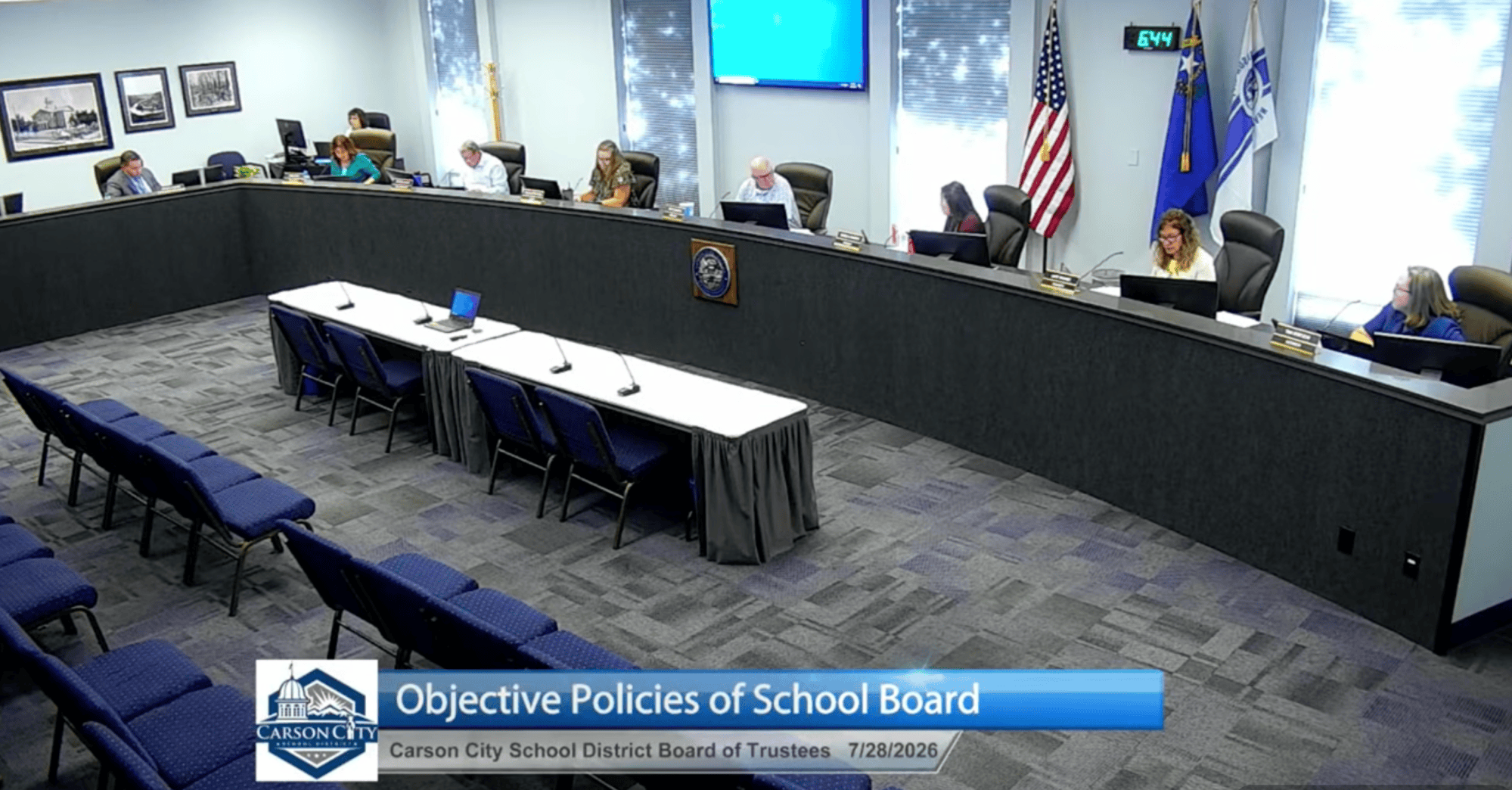

The Carson City School District Board of Trustees will meet Tuesday, Aug. 11, to consider an overhaul of the district’s K-5 grading system, changes to communication of student progress to families, a legislative effort to eliminate state evaluation framework for staff evaluations, and final approval of the district’s controversial new parental disclosure policy.
With the exception of the staff evaluation topic, none of the items were mentioned in the publicly-posted agenda (required to be posted Thursday mornings), nor the executive summaries (provided to the board and uploaded to the district’s Google Drive Friday afternoons).
Instead, the substance of the proposed changes can only be found in the line-edits of the policies themselves provided in the trustee’s board packet which is
The meeting comes just one week before students return to school Aug. 18.
The meeting will begin at 6 p.m. Public comment is limited to three minutes in person, or can be provided by email before 12:30 p.m. Tuesday August 11, 2026 to be included for consideration by trustees prior to the meeting: publiccomment@carson.k12.nv.us
Need to catch up on the last meeting? See our previous reporting below:
During the July 28, 2026 meeting, the Carson City School Board heard proposed changes to their policies relating to reporting gender transitioning of students, opt-outs for “sensitive” subjects and more. No indication of those topics had been provided within that meeting’s agenda, nor were legal citations included.
The board will hear those items again on their formal, second readings. No substantial changes have been made despite questions raised on their legal basis and scope.
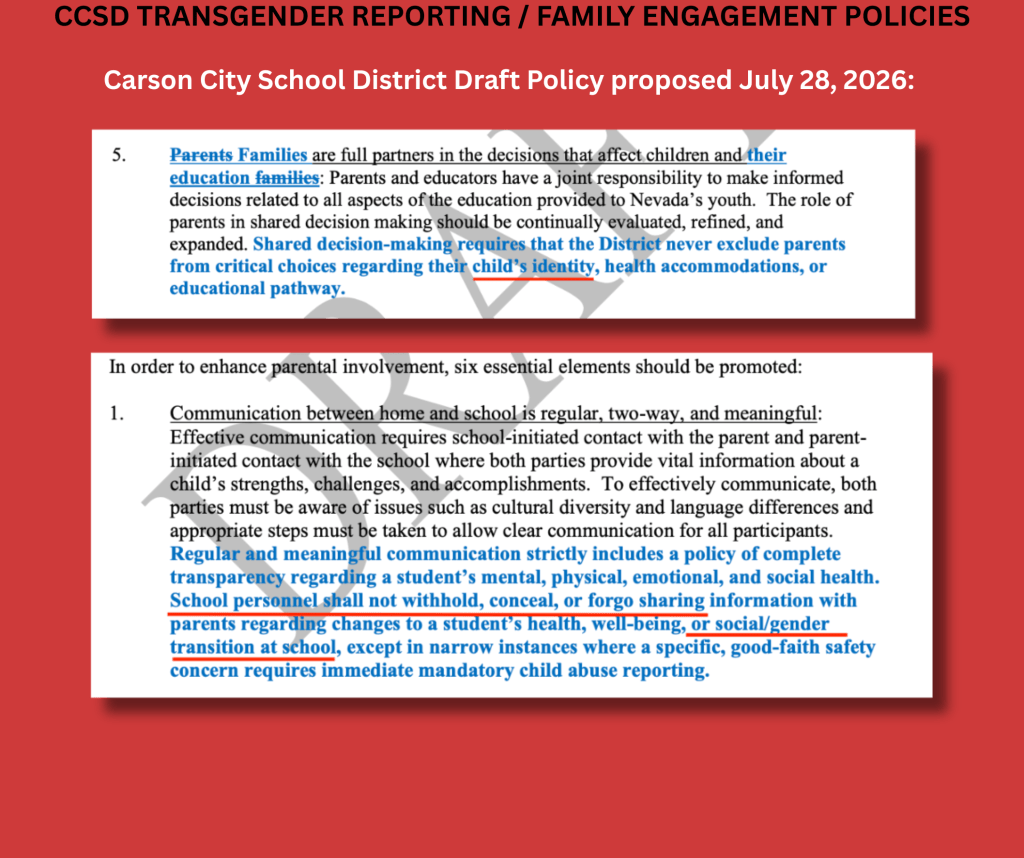
This is also despite the fact that Trustee Michelle Pedersen asked board attorney Ryan Russell to return with explanations, definitions and citations relating to the transgender-reporting policy and the “sensitive personal topics” assignment opt-out policy changes.
Despite Pedersen’s request, no changes have been made in the policy with the exception of adding the word “highly” before “encouraged” in the statement “Families shall be encouraged to participate in educational planning…”
The controversial policies still lack any legal citations. This is in contrast to the other policy changes proposed mandated by specific state and/or federal laws.
K-5 Grading overhauls
Proposed changes to Policy and Regulation 513 would make substantial changes to how Carson City School District elementary students are graded and how academic progress is communicated to families.
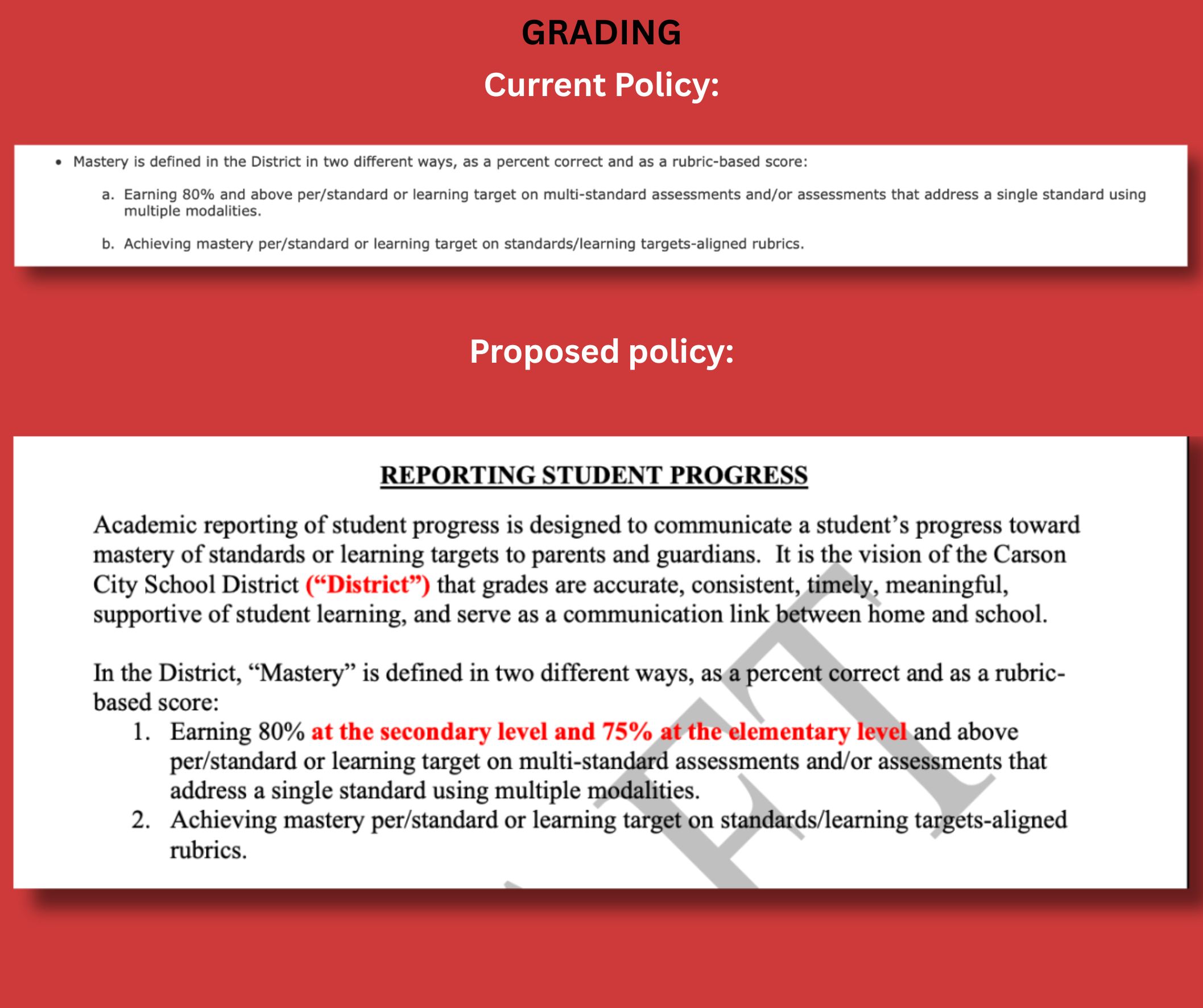
The definition of “mastery” is proposed to be changed from receiving an 80% score on learning targets or assessments across to board, to 80% for middle and high school, but 75% at the elementary level.
The reason for the proposed change has not been provided at this time.
The current elementary “standards-based grading system” is also proposed to expand from its 1-3 current “mastery of standards” grading score to a 1-4 with half steps scoring system as follows:
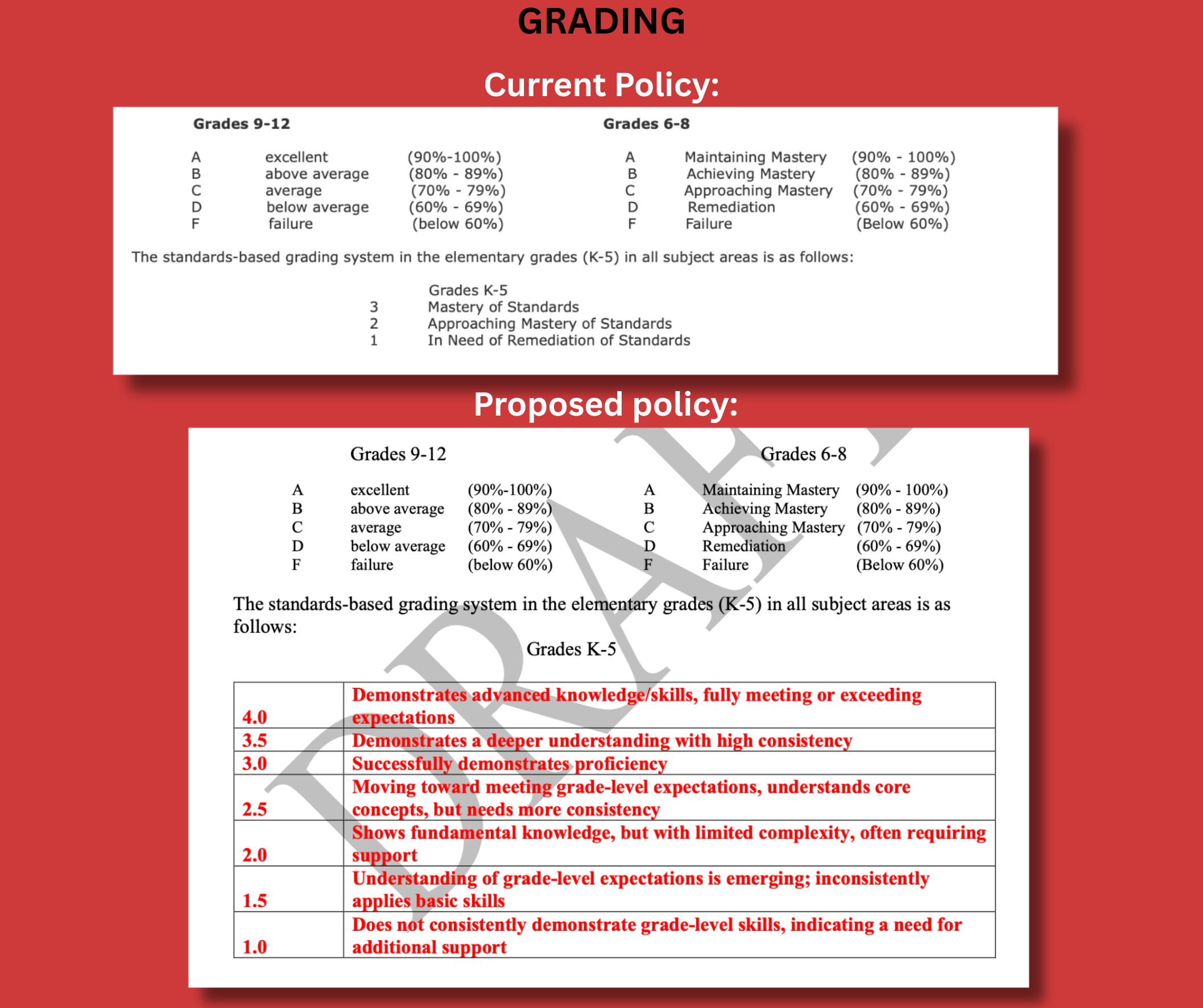
High school retains the traditional A-F system in that A denotes “excellent,” C is “average” and F is “failure.” Middle school grades currently are based on “mastery” language, but use an A-F basis.
However, the proposed changes extend beyond grades themselves.
No more Pee-Chee folders home
The proposed changes, if adopted, will completely eliminate take-home folders which include graded work, conduct reports, the school newsletter, special schedules and more.
Instead the new policy eliminates the weekly updates and take-home folder and replaces it with the language: “regular communication regarding student progress will occur through the District’s approved electronic methods.”
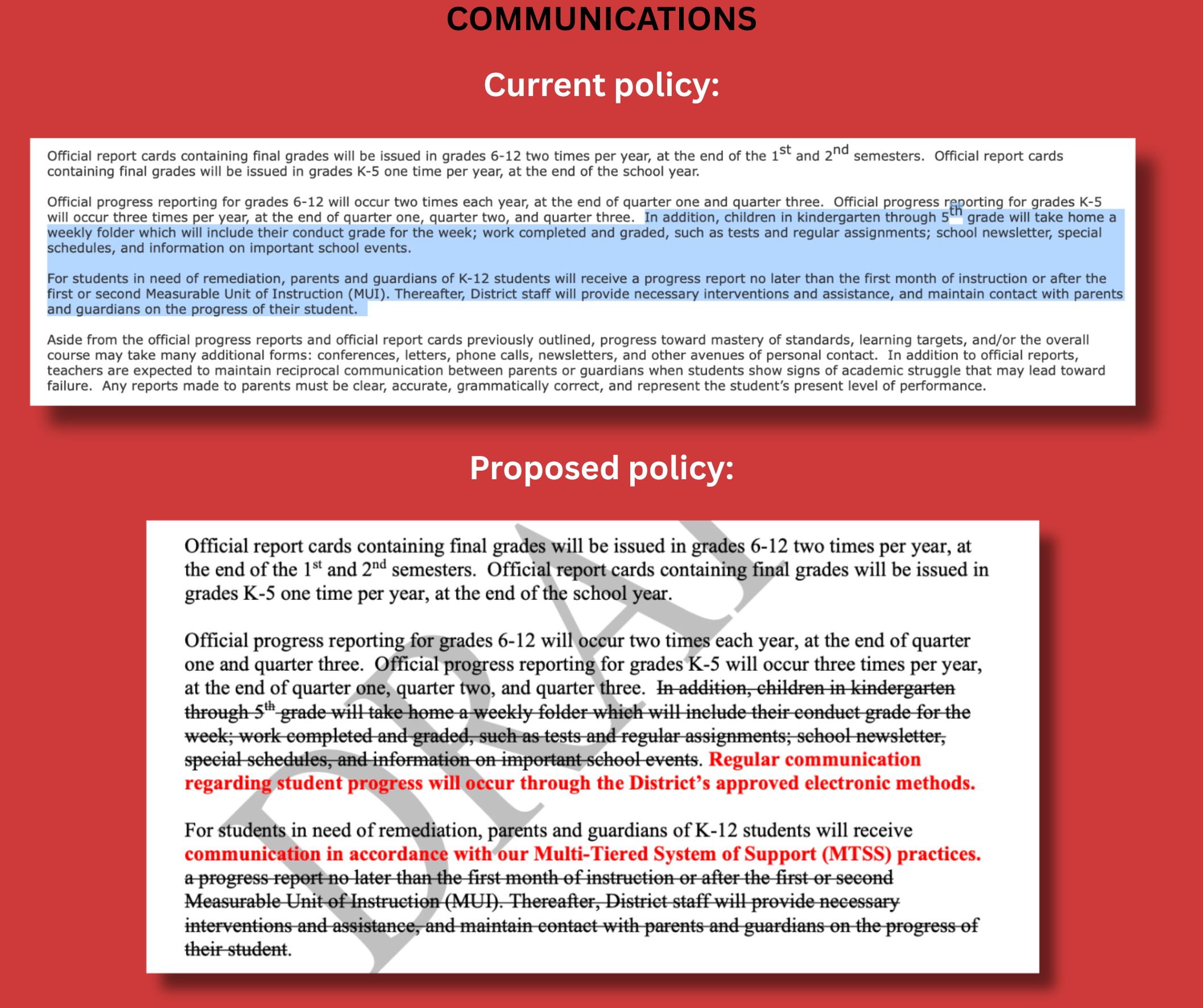
“Regular communication” is not defined; however, current policy states that official progress reports for K-5 students occur three times per year at the end of quarters 1-3.
The district would also remove a specific requirement governing communication with parents of students who need remediation.
Currently, the regulation calls for parents to receive a progress report no later than the first month of instruction or after the first or second Measurable Unit of Instruction, followed by continued interventions and communication regarding the student’s progress.
That language would be replaced by a requirement that parents and guardians receive communication “in accordance with our Multi-Tiered System of Support (MTSS) practices.”


The agenda identifies Item 7 only as “Discussion on Proposed Changes to Policy 513, Reporting Student Progress” and Item 8 as “Discussion on Proposed Changes to Regulation 513, Reporting Student Progress.”
The district’s executive summary provides only one additional explanation for both items: the changes are being proposed “in order to align with a change in Infinite Campus for the elementary grading platform.”
District wants to eliminate statewide educator evaluation framework
The board will also discuss whether to use its single Bill Draft Request for the 2027 Nevada Legislature to seek elimination of the Nevada Educator Performance Framework, or NEPF, the state’s performance evaluation system for educators.
There is currently little detail in the agenda packet about what specifically CCSD would seek or why. The board’s packet contains a two-page Local Government Bill Draft Request for the 2027 Legislative Session form, but it is blank.
According to the Nevada Department of Education, NEPF is intended to “identify effective instruction and leadership and establish criteria for evaluating educator performance.”
The department maintains separate tools and protocols for teachers and school administrators, including updated protocols for the 2026-27 school year.
State law requires the Nevada State Board of Education to establish a statewide performance evaluation system incorporating multiple measures of employee performance. The system assigns overall ratings of highly effective, effective, developing or ineffective.
For teachers and administrators who provide direct instructional services, pupil growth generally accounts for 15% of the evaluation.
Nevada law already allows individual school districts to seek approval from the State Board to use a different evaluation system and different tools. However, the State Board may approve an alternative only if it determines the proposed system applies standards and indicators equivalent to those prescribed by the state.
Session 2025’s Senate Bill 460 revised several pieces of the framework including student-growth measures, observation requirements and performance improvement plans.
It also added requirements for evaluator certification and reviews intended to promote consistency in how evaluations are conducted. Those changes are being phased in through July 1, 2027.
CCSD’s executive summary says district staff have discussed pursuing legislation that would eliminate NEPF. The district says doing so would not eliminate employee evaluations altogether, but instead would give individual districts greater discretion over what their evaluation systems look like.
The district’s BDR must be submitted to the Legislative Counsel Bureau by Sept. 1.
CCSD Superintendent AJ Feuling is also the current president of the Nevada Association of School Superintendents, or NASS, which is pursuing its own legislative priorities through its iNVest 2027 platform, which calls for changes involving education funding, SB 460, early literacy and Pre-K.
According to talking points provided to the Douglas County School Board in June, NASS says it wants SB 460 revised to protect local control and reduce unnecessary compliance requirements while maintaining accountability.
Learn more about the iNVest platform below:
District maintains cone of silence
At the time of publication, no trustee, district representative or Counsel Ryan Russell has responded to multiple requests for clarification, including an answer as to what legal premise these changes are based on.
You can view the Aug. 11, 2026 meeting’s board agenda packet below: