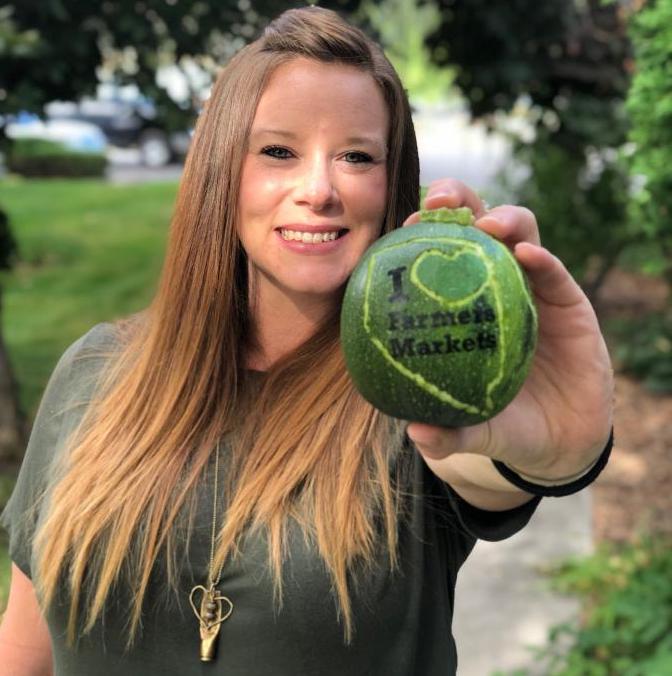
As the Carson Farmers Market heads into its 19th year, its future is uncertain due to local and federal funding cuts, and the fact they’ll need to leave Mills Park for an unknown amount of time while the Mills Park Master Plan construction takes place.
Four years ago, the Carson City Board of Supervisors began reducing the amount of funding the city provides for the market, according to Carson Farmers Market Manager Breana Owens. While the city has always funded the market in its current form, the amount and method has shifted over the past two decades.
In the beginning, the city paid Owens’ grandmother to establish the market in 2008 along with funding to host it. Over time, that has shifted to a standard grant payment.
Initially, Owens said, the amount was around $15,000, and at its peak increased to over $20,000. However, with the announcement of cutting city funding, that number has been decreasing each year. The 2026 season will be the last year the city funds the market, with a $15,000 grant.
In addition, Owens said SNAP match funding has been eliminated and senior coupons have been reduced — programs that not only help feed local families, but also directly support farmers and vendors.
Owens said the market has historically relied on a combination of funding sources that have worked together to keep the market running since its inception. Since learning of the various cuts, she said she has spent the past year looking for ways to increase revenue without increasing costs for farmers.
Those steps include registering as a nonprofit organization to solicit community donations and grants, as well as launching a new dinner fundraising event hosted on a local farm, cooked by local chefs and featuring local produce and products.
But within the past six weeks, Owens said she learned of another challenge: the market may be forced to move from its current home at the Mills Park pavilion once Mills Park Master Plan construction begins. According to discussion at a recent Carson City Board of Supervisors meeting, the work could take anywhere from one to five years to complete.
Owens said she is concerned the market may not survive another relocation.
Third and Curry: The Market’s Beginning
Since the city first approached Owens’ grandmother about starting a local market back in 2008, the market has faced as many challenges as it has successes.
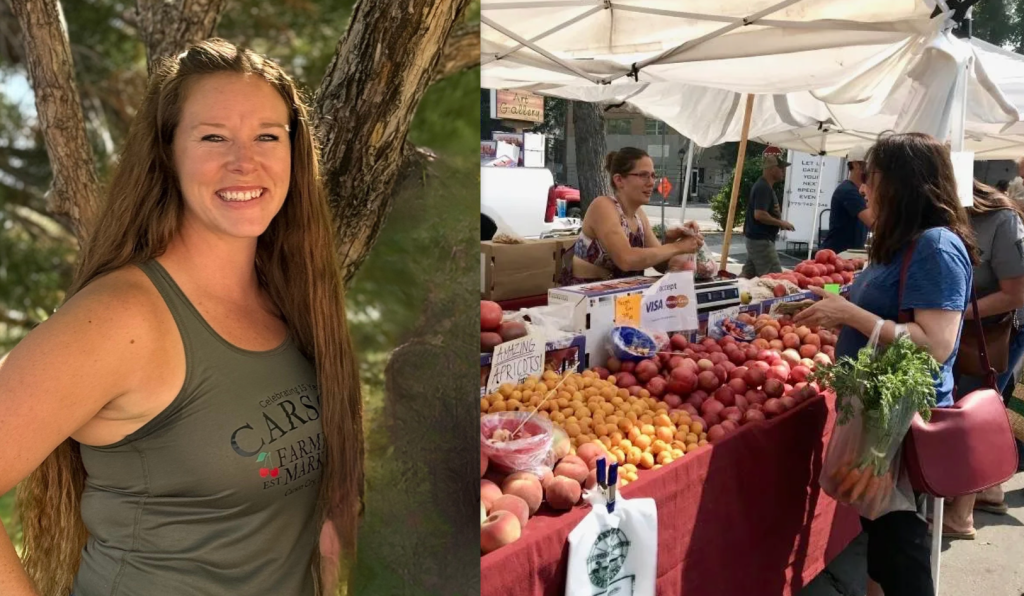
What initially began as a small pop-up market of a dozen or so tents in the Third Street parking lot has since grown to a major community anchor bringing over 60 vendors and thousands of shoppers to Mills Park every Saturday.
Seeking to generate downtown foot traffic during the recession, the city approached Linda Marrone — Owens’ grandmother — to establish a new market at Third and Curry, as farmers markets have been shown to be an economic booster for all varieties of business in downtowns nationwide.
“They came to my grandmother to begin the market because in 2008, we were in the recession,” Owens said. “They wanted to revive downtown, so they thought a farmers market would be the way to go, because it’s traditionally an investment strategy for healthy communities.”
And it worked. The first opening brought an estimated 1,500 to 2,000 people to Curry Street, Owens said.
For a decade, Owens said, the city paid Marrone around $25 per hour to run the market and contributed roughly $15,000 per year to help host it. The city also provided the space, Parks and Recreation employees, Sheriff’s Office deputies and general event assistance, including cleaning, portable toilets and maintenance.
Owens said that for the first two years, the city did not charge vendors fees if they agreed to stay on for the full season. The goal was to establish consistency in the downtown market and make participation more attainable while the economic downturn was hitting the local community hard.
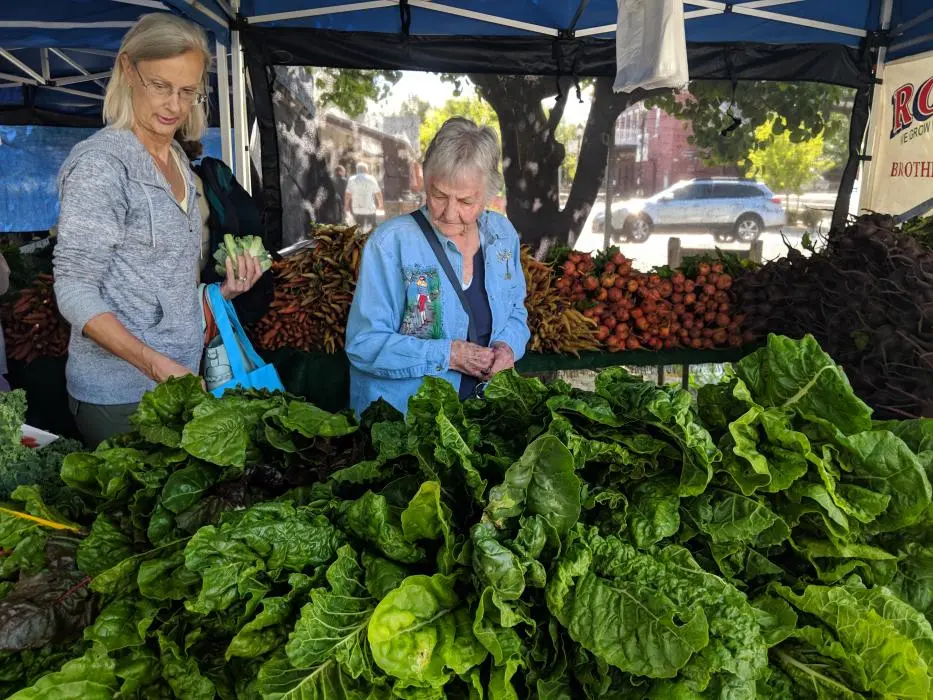
Since the market’s inception, Owens said, organizers have kept vendor fees as low as possible, though they have had to increase them over time due to inflation and cost-of-living increases.
Still, booth costs remain significantly lower than many vendor fairs in the region, which can sometimes charge as much as $200 to $250 for a booth rental. At the Carson Farmers Market, farmers are charged $50, artisans $65 and nonprofits $45 per booth, which Owens said is slightly less than or comparable to other large-scale markets such as Reno’s Riverside Farmers Market or Tahoe markets.
She said the main reason the market has been able to keep fees low is because of the annual funding the city has provided since officials first approached Marrone with the idea.
According to Owens, margins are slim for local agricultural producers, and farmers markets are often the only way smaller growers can reach consumers directly. Because the Carson Farmers Market is intended not only to serve the community but also to expand how much food is grown and sold locally, Owens said the market’s first priority is its producers.
“Farmers get a discount because our primary focus is to support them,” she said. “And because we do know how hard they work with very little return.”
She said that even with the $50 booth charge for farmers, “I feel like I’m already robbing them, and that’s just my heart.”
Raising those rates would be detrimental, she said, because costs “just add up” for producers.
“They grow for the community, not to be millionaires,” Owens said.
The first pivot to the Nugget
Owens took over in 2019 when her grandmother was ready to retire. That year, she said, the city provided $19,000 in funding as usual.
The following year, however, the market learned it would have to relocate due to the remodeling project at the Third Street parking lot.
The market moved to the Nugget parking lot for two years because it had the space to accommodate vendors. But Owens said organizers realized almost immediately that it was not a long-term solution.
With no shade, the heat made the asphalt lot nearly unbearable for both customers and vendors, and attendance dropped quickly.
“I mean, people wouldn’t come at all — to any of the markets for the entire season — simply because it was too hot on the asphalt,” Owens said. “Even by 10 a.m., it was unbearable, and we lost a lot of people.”
At the time, organizers assumed the move would last only one year, with every intention of returning to the Third Street lot once construction was finished.
But once the lot’s reconfiguration was unveiled, Owens said, it became clear the growing market would no longer fit.
Organizers discussed shutting down Second Street to accommodate the market, but that created logistical issues. The city would have had to close the street every weekend and provide additional staff to make the closure work.
The market returned to the Nugget parking lot for one more year while organizers searched for a permanent solution. By then, Owens said, they knew the choice was either finding another location or calling it quits, because hundreds of marketgoers were being lost each Saturday due to the heat.
But, in conjunction with city officials, the solution came about: Mills Park. Owens said that, initially, she was reluctant to move to Mills Park because community surveys had been split 50/50. Residents and market-goers cited concerns over the distance from downtown, the number of unsheltered individuals, and Owens said that she also had concerns about logistics as some recurring events in the pavilion would force them to relocate onto the grass.
Despite this, she said they knew it was their only real option, and as soon as they moved in, they realized it was the perfect solution.
Mills Park and the uncertain future
Opening market day is always the largest of the season, but each Saturday brings in between 1,500 to 2,000 customers, and the ample parking at Mills Park has made the parking chaos from the Third Street days — which sometimes had attendees parking a mile away on side streets — a thing of the past.
Owens said the pavilion and surrounding space also comfortably accommodates the 82+ tents the market has grown into, and provides natural cooling through shade, grass, and trees. Vendors have access to a power supply instead of being forced to bring their own generators (which she said often failed due to overheating in the Nugget lot), and customers have access to real bathrooms, train rides, and picnic tables throughout the park.

In a 2024 survey, the majority of attendees stated they would stay and utilize other park facilities and features after going to the market, such as attending other co-occurring events, the pool, train rides, playgrounds, pickleball, or simply hanging out in the shade and relaxing.
“I mean, in retrospect, we should have moved there a long time ago — it’s been perfect,” Owens said.
But now, that future is up in the air. The construction timeline has not been finalized, and she said she is not certain the market can survive another move when there are few viable options left.
Owens said she wanted to make clear that the city, and Parks and Recreation specifically, have been strong partners during the years she has been in charge of the market.
She said after moving to Mills Park at the suggestion of city officials, she had faced a surprise $13,000 estimated bill to rent it. However, she was told if she registered as a nonprofit, the city could co-sponsor the event and waive the fees. This year marked the first as the market operating as the nonprofit due to that requirement.
The city has also provided trash bags “since day one,” Owens said, along with help from deputies and, more recently, park rangers. Officials from the department have also met frequently with market organizers over the years.
She said that despite the recent cuts, Parks and Recreation Manager Jennifer Budge has remained “very supportive,” and has offered help in relocating the market to another area in town.
Except, the issue lies in confusion on the timeline — and the fact that Mills Park was already their last resort.
Parks and Recreation suggested moving them to Fuji Park, but when Owens approached those in charge of the south Carson site, she learned there are recurring events nearly every weekend, meaning the market could only rent the park for roughly two Saturdays during the season.
But what’s been hardest of all is the uncertainty about when they need to move, and for how long.
Owens said last year she was told that the upcoming Mills Park Master Plan park construction would not be affecting the market, since no work was planned for inside the pavilion.
However, when Owens reached out about something separate roughly six weeks ago, she said she was asked what her plans were for the following year.
“I said, ‘What do you mean?’ And I was told, ‘Well, we’re not allowing anyone in the park, no events are being booked at all for next year because of the construction, and because of the dog park construction in that area.’”
The dog park is slated to go into the center of Seely Loop near the Mills Park Amphitheater, according to design mockups brought forward at a May Board of Supervisors meeting.
During that conversation, Owens said she was told no events would be booked at the park for one to two years. During the board meeting, however, the project was approved with a five-year timeline, though Budge said officials believed it would take a maximum of three years total.
Owens said that while she knows Parks and Recreation is trying to help the market, the confusion and inconsistencies are making it nearly impossible to plan.
When Carson Now reached out to the city to ask whether there had been a specific determination about when the park would close and for how long, the city said that until design work progresses, officials cannot definitively say. However, the city said it now seems unlikely the park would be closed for the 2027 season.
“We want the Farmers Market at Mills Park,” Budge wrote in a statement. “The end goal is to keep it here.”
Budge said the market could remain at Mills Park in 2027 depending on how long it takes to complete design work for the Mills Park Implementation Project. She said the city is still in the early stages of outlining the timeline and has communicated with partners, including the farmers market, to help them find a suitable temporary location when the time comes.
However, as of publication, Owens said no one from the city had reached out to indicate anything other than what she was told previously: that she needs to find somewhere else for the market to operate next summer.
She said she’s been surveying other areas they could potentially host it, but the issue is they need several specific things on site that most other locations are lacking, or in the case of Fuji, cannot consistently provide due to prior events. And if no one is allowed to book space at Mills Park for several years, then all of those events will also be searching for the same alternatives.
The market needs bathrooms or the ability to bring in portable toilets, parking that does not require visitors to cross busy roads, enough space to avoid closing streets, shade, power, enough room for roughly 85 tents, walkways and tables, and, if possible, a stage for live music.
Shade, Owens said, is one of the biggest needs.
“That’s the big one, since people won’t come otherwise,” she said.
And as the list ticks on, the possibilities narrow — especially if the market has to pay out of pocket for many of the requirements at a property not owned by the city.
Owens said that for a crowd of 1,000 people, five portable toilets are required. She said she was quoted more than $5,000 for portable toilets alone for the 18-Saturday season.
She said they’ve been looking into the site of the old hospital, and have put in inquiries, as there is a shaded area, grass, a handful of tables, and parking. But it depends on whether the hospital would allow the market to set up there and whether rent would be required.
Owens said she is waiting to hear back. For now, she said, it appears to be one of the only potential options.
New event: Rooted Together, a Farm-held Community Dinner
While the relocation question remains unresolved, Owens said the market is also trying to build new sources of support that do not require raising booth fees on farmers.
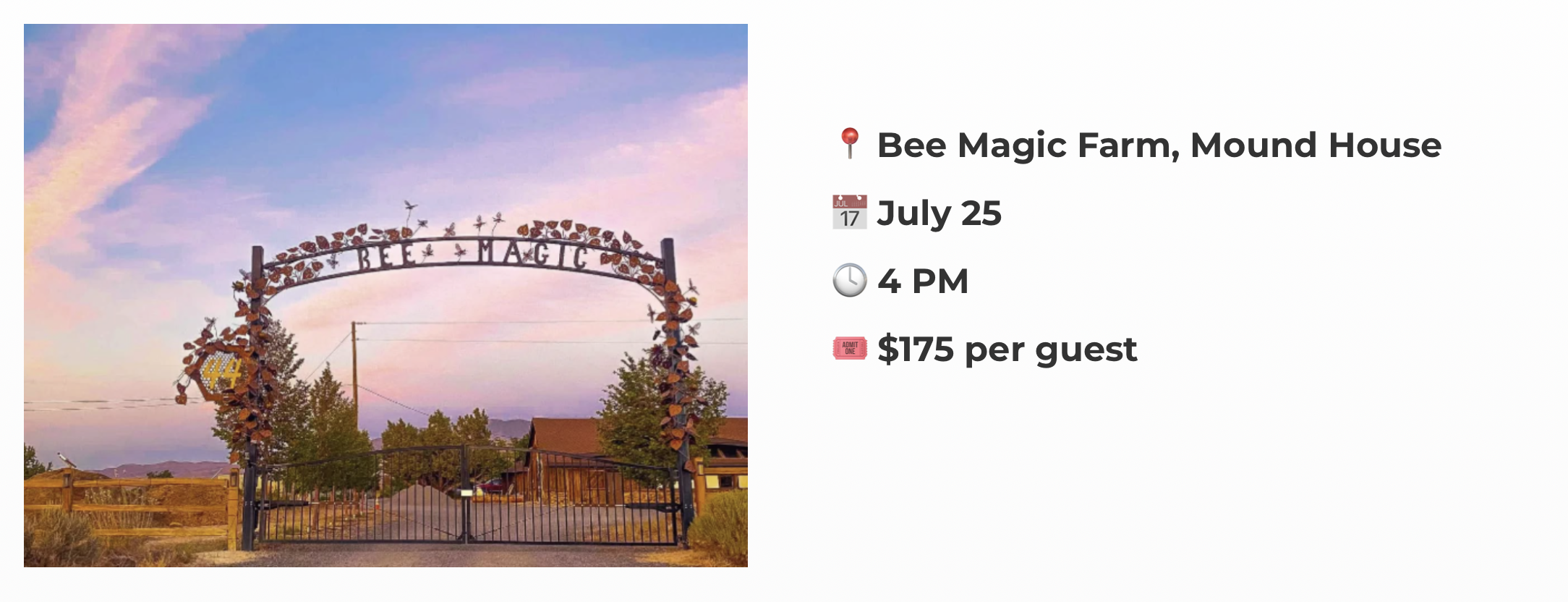
One of those efforts is Rooted Together, a farm-held community dinner planned for July 25 at Bee Magic Farm in Mound House. The event begins at 4 p.m., with tickets priced at $175 per guest.
The dinner is intended to support fresh food access for local families, local farmers and food producers, community programs connected to the market, and the long-term sustainability of the Carson Farmers Market, according to the market.
Owens said the event is meant to bring in revenue while keeping the market’s mission at the center: supporting local agriculture, keeping fresh food accessible and creating a gathering place for the community.
The dinner will include a seasonal four-course meal with ingredients sourced from market farmers and makers, served in an open-air farm setting. Owens said the meal will be prepared by local chefs using local produce and products.
The fundraiser will also include a silent auction featuring local items and experiences. The market is seeking sponsorships and auction item donations from local businesses and community partners.
For Owens, the dinner is part of a larger pivot: finding ways to keep the market alive without shifting the burden onto the farmers it was created to support.
“Farmers get a discount because our primary focus is to support them,” Owens said earlier. “And because we do know how hard they work with very little return.”
For those who cannot attend Rooted Together, the Carson Farmers Market is also accepting donations, now being a registered nonprofit, or simply stop by every Saturday now through Sept. 26 from 8:30 a.m. to 1 p.m. at the Marv Teixeira Pavilion in Mills Park, 1111 E. William St.
For more information about the market, Rooted Together, tickets, sponsorships or donations, visit carsonfarmersmarket.com.