
This story was honored with top awards in the 2026 Nevada Press Association’s Awards of Excellence contest: 2nd Place in Health Reporting. See all of our award-winning pieces here.
For many families, the first smartphone given to kids isn’t a gift; it’s a surrender. Parents often say they know screens aren’t doing their children any favors, but they feel at a loss on how to avoid them when it seems every other kid has one.
To combat that pressure, two moms have launched a local campaign under “Wait Until 8th,” a nationwide movement asking parents to pledge they will not buy their children smartphones until at least the end of 8th grade.
The Reno moms taking action
Everywhere you turn now, whether it’s online articles, social media reels or day-to-day conversations, you’ve likely heard the same story again and again: screens are harming kids. Education scores are plummeting, sleep hygiene is dead, eating disorders are on the rise in tweens and teens and loneliness has become an epidemic.
Despite this, parents often argue keeping their kids off smartphones is as good as ostracizing them from society completely when all of their peers are connected.

But two moms are advocating to tackle this issue as a community rather than battling it solo with your kids at home.
The leaders of the local movement are Brandi Vesco, a former education and technology reporter, and Larissa Viner, a registered school nurse. Both have young children in the Washoe County School District, which is what started them on their journey toward change.
“We’re both mothers of elementary school students, so I can tell you there is a lot of pressure on kids as young as 3rd, 4th, 5th grade to have a smartphone to fit in,” Vesco said. “And that pressure just ramps up and up and up as middle school approaches.”
The pair haven’t just been going door to door asking parents to sign up — they’ve been reaching out to local school districts, boards and commissions to bring awareness to their cause and to help spread the word with them.
She said their goal is to normalize the choice to delay giving smartphones to elementary and middle school children, so that “those kids can be kids a little bit longer.”
What’s sad is that parents are taking on all this guilt being laid at their feet when really, it’s the tech companies making this stuff impossible to put down … We didn’t know when we handed our kid an iPad that they were going to get addicted to it.
It’s not only due to issues with cyberbullying, or exposure to adult content — which are very important aspects — but due to the actual neurological harm new research has indicated screen time may be causing in children.
“We want them to be able to get through that really critical phase of brain development that happens between about 9 and 14 without so much online exposure and influence, and much more real-world adventure and interaction,” she said.
Vesco and Viner aren’t technophobic — Viner said that her kids, 6- and 10-years-old, already have iPads.
“We initially got them for long car rides, and suddenly it became ‘oh we want to use it during the day.’ So we gave them a limit for an hour a day. But then I started reading the book The Anxious Generation.”
The book Viner mentioned has become a worldwide phenomenon — and has even been cited as an influence in the law completely banning social media for children under 16 in Australia, the first of its kind in the world.
Viner said that after reading the book, which similarly argues for eliminating social media and smartphone use in children, she began doing her own research and stumbled upon the “Wait Until 8th” movement.
“I just realized, this isn’t right. We’re not doing the right thing here,” Viner said. “And when you give your kid an iPad and then you take it away, their behavior is just terrible. It really makes you ask: what is going on here?”

Data indicates smartphones — not just social media — are harmful
What new research indicates is that high screen exposures before the age of two are leading toward lifelong neurological issues like critical thinking and decision-making issues, increased anxiety by adolescence, among other issues. For infancy to preschool-aged children, screen time is also linked “significantly” to changes in social-emotional development.
And with 40% of infants and toddlers having their own devices by 2-years-old, and a quarter having their own smartphones by 8-years-old, that’s no small percentage of children nationwide.
What might be startling to parents is that just keeping your kids from their own personal social media accounts isn’t enough — it’s rapid-fire 10-second videos, online gaming, “influencer culture,” among other issues leading to the new wave of research.
We just want to tell parents: ‘Hey, you’re allowed to change your mind if you want. Ask yourself: is this working out for you?’
The main issue, according to Vesco and Viner, is that these platforms are addictive, and they’re meant to be.
Just recently, a massive lawsuit against tech companies was filed on behalf of multiple school districts throughout the country (including Carson City and Washoe County School Districts) alleging that tech companies intentionally addict children and teens to their platforms — as shown by the companies’ own leaked internal documents — despite knowing the negative impact it has on their mental health and physical well-being.
“What’s sad is that parents are taking on all this guilt being laid at their feet when really, it’s the tech companies making this stuff impossible to put down,” Vesco said. “It’s not parents’ fault. We didn’t know when we handed our kid an iPad that they were going to get addicted to it.”
In her own home, Viner said they’ve dialed screen use back, and they’re already seeing positive results.
This is an important aspect of “Wait Until 8th,” they said, because for many parents, it’s not a matter of waiting to get a smartphone, it’s that their children are already connected.
“We just want to tell parents: Hey, you’re allowed to change your mind if you want. Ask yourself: is this working out for you? If so, awesome, not a problem, it’s going well for your family. But if you’re starting to worry about your kids’ smartphone use, that’s probably a sign to change.”
Viner said the “Wait Until 8th” movement isn’t about going tech-free — it’s specifically about removing smartphone use, not phones or technology altogether.
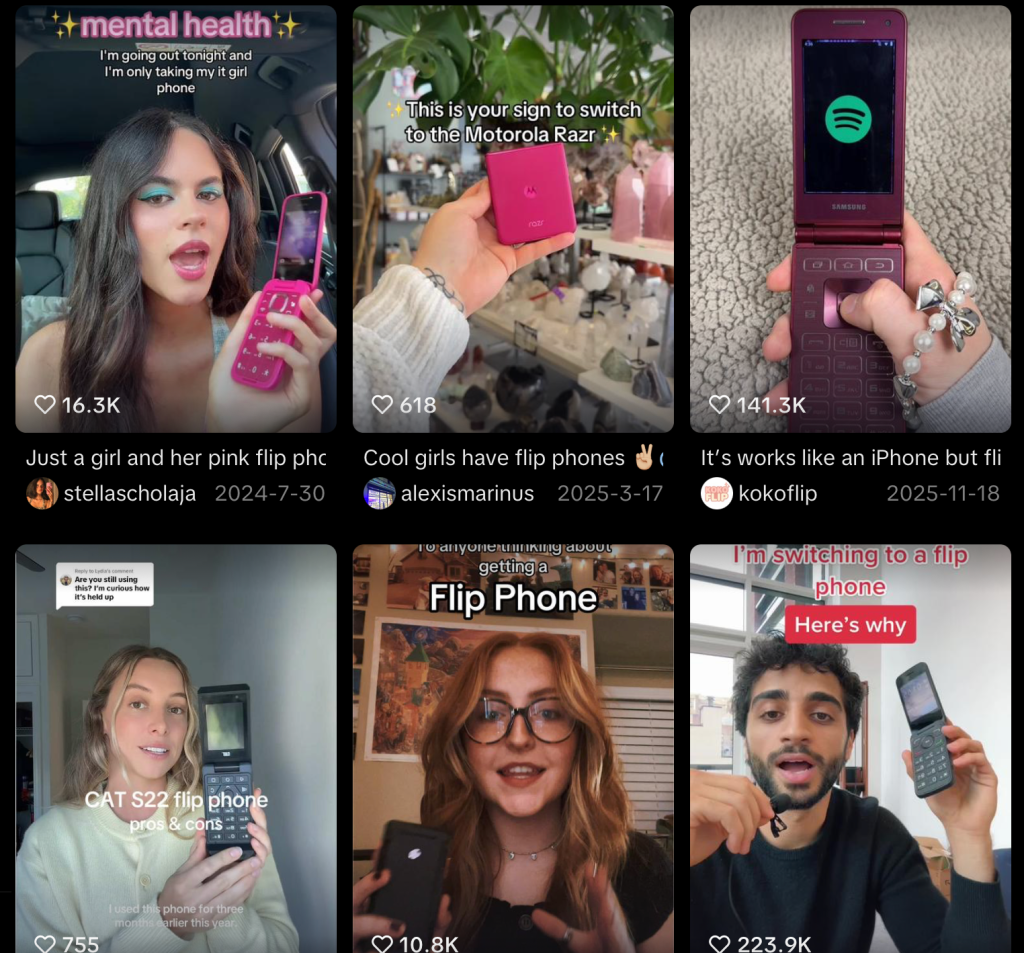
“Families can still stay connected using basic phones or smartwatches with limited features,” Viner said. “You can even buy your kid a flip phone — it’s not going to be an addictive interface. You can still use calls and texts without getting caught up in all the apps and platforms and the huge amount of adult content you can access that comes with a smartphone.”
Knowing that you aren’t alone means it’s that much easier to hold off.
The “Wait Until 8th” Reno-Sparks chapter officially launched in November and they check the numbers of pledges once a month.
In the first month alone, the movement has pulled pledges from 81 families across 21 schools in the Washoe County School District.
“If those numbers keep growing at that rate, and as more parents learn about this movement to protect childhood, that will be wonderful,” Vesco said.
Once 10 families from the same grade in one school sign up, those families will become connected with each other by the platform to form a cohort.
“Knowing that you aren’t alone means it’s that much easier to hold off,” Viner said.
They said they plan to reach out to the Carson City School District and other surrounding districts next to help spread the word throughout Northern Nevada, not just in the Reno-Sparks area.
But what comes after?
Many might ask: So what happens after you pry the smartphones and tablets from your children’s grasping hands? The moms have an answer for that too.
“We actually started what’s called a ‘Let Grow Play Club,’” Vesco said. “It’s a time and place each week for local kids to get together and just be and play without adult direction. Because we feel like, even if your kids are doing sports and stuff like that, that’s great, but it’s still not that time where you start to feel confident and manage yourself out in the world a little bit without Mom and Dad saying ‘Oh, drink some water, do this, do that.’”
Let Grow is also a similar nationwide movement, the brainchild of a psychologist studying the importance of “unstructured, mixed-age free play for kids.” The idea behind Let Grow is that children need to be able to organize themselves and solve their own conflicts amongst themselves. When adults intervene — even with the best intentions — it’s hindering their social development and problem-solving skills.
Vesco described herself as a “recovering helicopter parent,” and said the Play Club is just as much for parents as it is for the kids.
“During the first few Play Clubs, I found myself having to stop myself mid-sentence,” Vesco said. “Now, parents who come for the first time might start saying, ‘Oh, everybody try this, maybe you could do that,’ and we say ‘No — come hang out with us and play cards over here instead.’”
Vesco said the Play Club is hosted every Sunday from one to three — severe weather dependent — and all families are welcome to join.
Vesco and Viner believe that setting up social-based, non-structured events is one part of the solution to the question of “what will happen to my child socially when I take their phone away?”
Because studies show that, despite smartphones and social media having the ability to connect more people than ever before, statistics indicate teens have never felt lonelier.
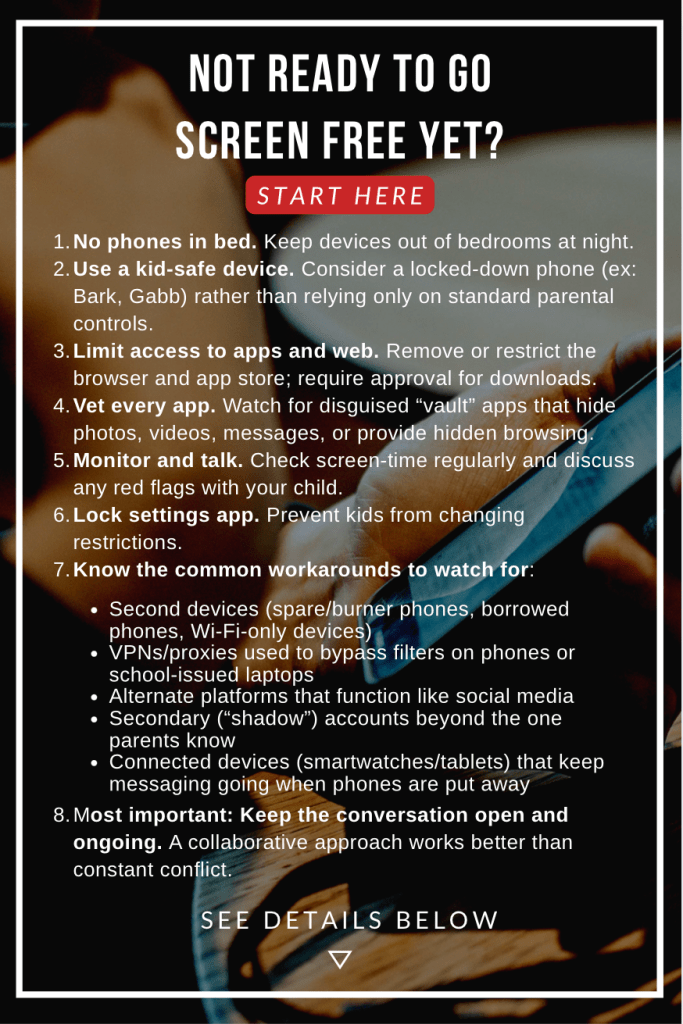
For those who aren’t ready to completely remove screens from their children’s lives, there are several things parents can do now that will help:
- Do not allow kids to take their phones to bed with them.
- Get a “locked down” smartphone like Bark or Gabb — don’t just install parental controls, which are easily manipulated by kids and aren’t user-friendly for even the most tech-savvy parents.
- Remove the browser and App Store from your child’s smartphone and block access to downloading new apps without approval.
- Research every app — there are several “vault” apps designed to look like calculators, calendars, or other utilities while actually hiding photos/videos/messages from parents, or allow access to browsers that are blocked through parental controls.
- Check screen time use often, and discuss anything that seems like a red flag with your child.
- Block access to the settings app.
- Educate yourself on loopholes kids are using to access prohibited content like:
- Bringing home Wi-Fi-enabled “burner phones” given to them by their friends;
- Installing VPNs on phones or school-issued laptops to get around parental controls/school blocks or monitoring;
- Using alternative apps/games as social media (Pinterest has long been a “secret” loophole for messaging, while pornography is largely shared on Spotify among others);
- Creating “shadow” accounts on social media in addition to their main, parental-monitored accounts;
- Using a smartwatch / tablet linked to the smartphone to continue messaging or browsing after their phone is taken or put away.
- But, most importantly, talk with your children openly and often about the dangers of smartphone addiction and social media — it’s better to be collaborative for safe screen use than to constantly be at war.
Want to learn more about Wait Until 8th? You can follow the Reno-Sparks Chapter on Instagram and Facebook.
Do you have an elementary or middle school-aged child and are ready to take the pledge? Do so here to receive your welcome email, and when enough families sign up in your grade, you’ll be connected to your cohort.