By Brett Fisher
-
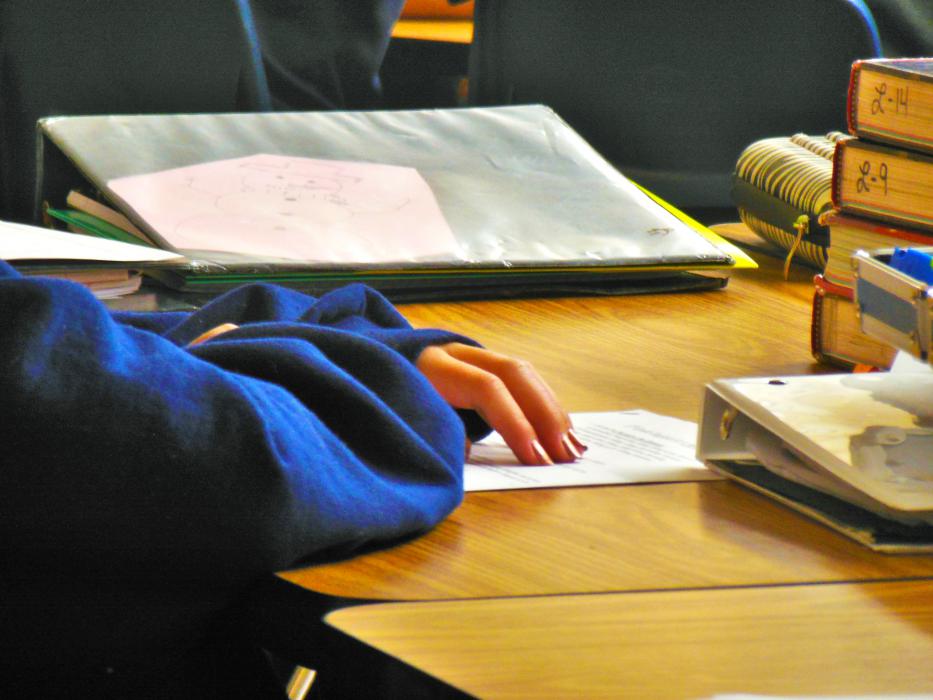
Photos by Brett Fisher. A student in Angela Fisher’s Eighth grade English class at Carson Middle School. -
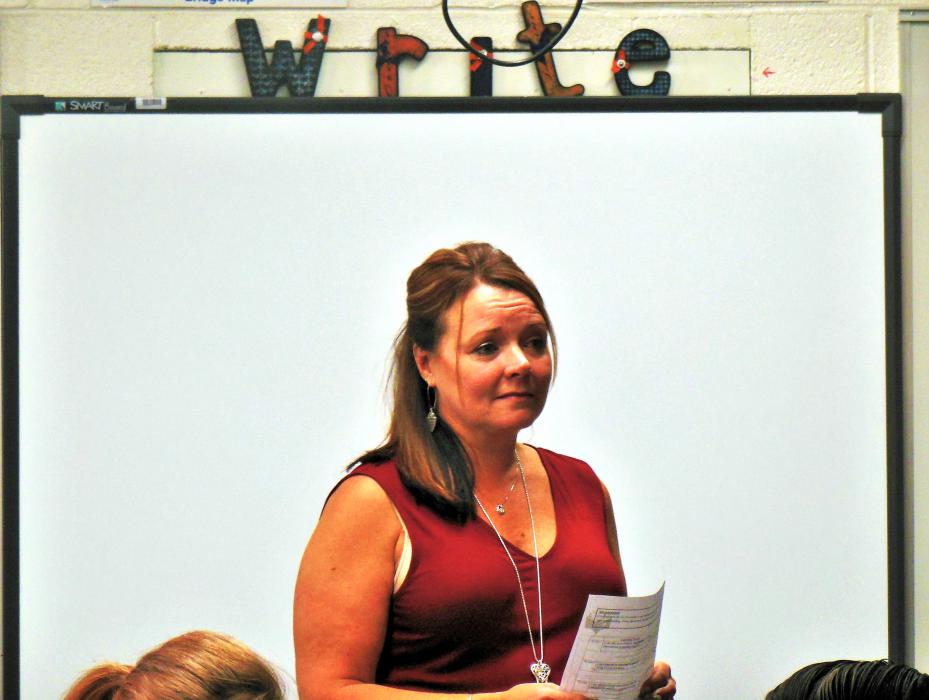
Angela Fisher teachers her eighth grade English class at Carson Middle School. -

Staff parking area at Fritsch Elementary School. -
Students listen to Angela Fisher during her Eighth grade English class at Carson Middle School.
A chronic shortage of K-12 teachers isn’t just felt in Washoe and Clark counties, which feature Nevada’s two largest school districts.
The problem is statewide, even in Carson City.
At the beginning of the 2016-17 school year, Carson City School District Superintendent Richard Stokes said the district had about 18 vacancies it needed to fill.
That number has since been revised, Stokes said in September, to 13 licensed classroom vacancies districtwide.
“These vacancies are being filled at the moment by substitute teachers and we are very grateful for their help,” Stokes said. “The shortage of teachers is affecting all subjects and grade-levels in our K-12 system.”
Other rural school districts across Nevada are also feeling the pinch, he said, because attracting teacher recruits to the less populated rural counties has historically been a challenge.
In neighboring Washoe County, however — a largely urban school district — the numbers are much steeper. Approaching the 2016-17 school year in July, Washoe County School District faced nearly 200 licensed classroom vacancies, according to a report by KUNR public radio in Reno.
The district has had to rely on long-term substitute teachers to staff classrooms that it has been unable to fill with a full-time licensed educator.
Clark County, by far the largest school district in Nevada and one of the largest in the country, still had close to 500 vacant positions for full-time, licensed teachers to fill coming into this school year, according to reports by the Las Vegas Sun and the Las Vegas Review Journal in July.
The Sun later revised those numbers to a little over 400 as August and the new school year loomed closer, indicating that the school district has been aggressively recruiting and hiring to bring those numbers down further for the 2016-17 school year.
But that number pales in comparison to the nearly 1,000 vacancies it faced at this time last year.
In February, Gov. Brian Sandoval endorsed Nevada’s teacher shortage as a statement of emergency, agreeing with Interim State Superintendent of Public Instruction Steve Canavero to issue immediate provisional teaching licenses to educators with out-of-state licenses trying to get their Nevada teaching credential.
“This emergency provision will have an immediate impact by allowing teachers to have up to one year to fulfill the final requirements of licensure,” Canavero had said.
During last year’s biennial legislative session, Gov. Sandoval approved teacher hiring incentives as well as the “Teach Nevada Scholarship” created to enhance teacher recruitment.
“Many people have been seeking solutions to the teacher shortage and I am proud to support this measure from the Nevada Department of Education which will allow the state to immediately address the needs of our schools,” Sandoval had said.
Clark County’s woes have been partially alleviated by the provisional licensing signed earlier this year by the governor, as well as the ability to offer a $6,000 increase in the starting annual salary for a first-year teacher in the district, boosting the amount from $35,000 to more than $40,000. In addition, the district approved increases in teacher pay across the board in an effort to retain is current staff of educators.
As bad as things have been in Nevada, Stokes said the chronic teacher shortage is not exclusive to the Silver State.
School districts nationwide are struggling to recruit enough licensed educators to keep up with the demand for teachers and current classroom vacancies.
“The current teacher shortage is not just a regional or state phenomenon,” he said. “Schools around the United States are having difficulty finding enough licensed teachers to fill the existing vacancies.”
Stokes said the most problematic areas, historically, have been teacher shortages in special education, math and science subjects.
But now the shortage has become universal.
“It has always been a challenge to find Special Education teachers and teachers of Math and Science,” he said. “But now we are seeing significant shortages in all areas.”
The reasons for the chronic teacher shortage are varied, Stokes said, ranging from waning interest in the profession, to its relatively low pay, as well as less teacher autonomy caused by the rising demands of government standards.
“Many colleges and universities are reporting a significant reduction in the number of students who are selecting education as their career choice,” Stokes said. “Unfortunately, potential college graduates hear about the low pay and high accountability associated with being a teacher, and are choosing other careers.”
In 2015, Gov. Sandoval helped to negotiate a partnership between Western Governor’s University — a nationally accredited online post-secondary institution — and the state of Nevada, providing students a faster-track option to obtaining their state teaching credentials than traditional brick-and-mortar programs.
But students still have to complete a student teaching internship, a whole semester of full-time — and unpaid — teaching, which can be enough to discourage some people from pursuing teaching credentials when faced with the reality of having to give up their day jobs.
Clark and Washoe counties have tried to address this issue by introducing alternative route to license (ARL) programs within their respective school districts.
The programs recruit and hire teachers to pursue licensure through formalized district training modules that satisfy state licensure requirements while being paid to work in the district.
Both county school districts continue to actively recruit people to hire into their ARL programs.
Stokes alluded that Nevada’s chronic teacher shortage, manifest lately by higher and more critical vacancies than ever seen before, may be one reason for the state’s typically low education performance marks.
“As we are seeing now, having fewer fully licensed teachers in the pipeline will have a significantly negative impact on student success and preparation,” he said.
This is why the retention and recruitment of teachers was a featured goal of the Carson City School District’s five-year strategic plan, finalized in 2012.
The district is currently working toward a new strategic plan to be implemented in 2017 — a draft of which is expected by the first of the new year — and Stokes said he wants to see the same focus on retention and recruitment efforts as part of that community education vision for the next five years.
But despite current classroom vacancies, Stokes said he sees a light at the end of the tunnel.
He said communities in Nevada are made up of workers and professionals in fields that could make them ideal teachers to the next generation of adults.
“Teaching is a tremendously rewarding field,” he said. “If there are community members who have a college degree, or have owned or had experience in a technical field and have wondered about being a teacher, now may be a good time to explore your options.”
He said the Nevada Department of Education (NDOE) has created a number of non-traditional routes to teacher licensure that could benefit the right person by helping them get into the classroom sooner rather than later.
For more information on routes to licensure, visit the NDOE web site here. For a list of vacancies currently within the Carson City School District, visit its web site here, or call human resources at 775-283-2130.