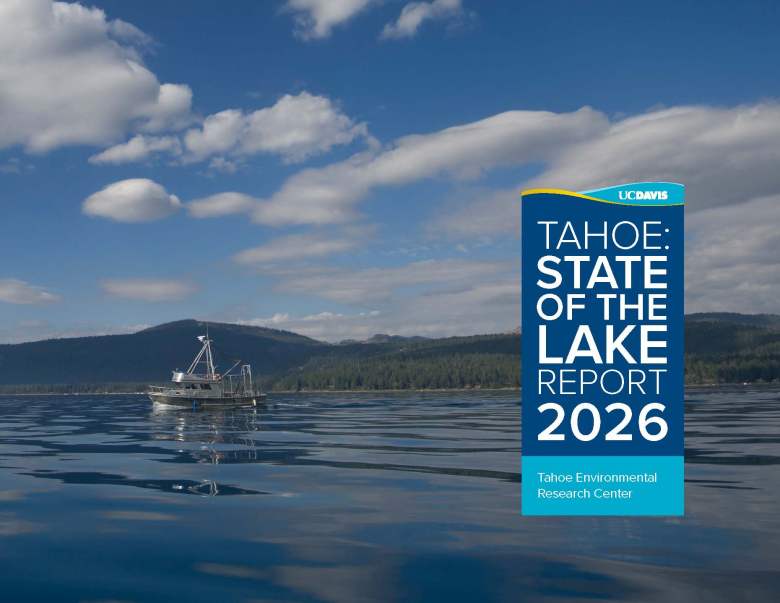
The University of California, Davis, Tahoe Environmental Research Center (TERC) this week released its “Tahoe: State of the LakeReport 2026” which presents data from 2025 in the context of the long-term record.
The report provides an annual update for non-scientists on the Lake Tahoe Basin’s ecological health. It includes data related to temperature, precipitation and snowmelt, nutrients, algae, water clarity and more.
Lake Tahoe’s climate continues to warm. Air temperatures are rising, fewer winter days remain below freezing, and spring snowmelt is arriving earlier. These changes influence lake mixing, water temperatures, and the movement of nutrients throughout the ecosystem. While 2025 saw near-average precipitation and a healthy snowpack, the long-term warming trend is evident.
Water Clarity holds steady
Lake Tahoe’s famed clarity averaged 69.2 feet in 2025, continuing the encouraging plateau that has followed decades of restoration efforts. However, scientists observed unusually high concentrations of tiny, suspended particles in the summer months that may be limiting clarity, despite relatively low inputs from streams and wildfire smoke. Understanding these particles is now a major focus of ongoing research.
Evidence suggests that microscopic algae, picoplankton, and the tiny diatom Cyclotella may play a much larger role in determining water clarity than previously understood. Understanding these particles has become one of TERC’s highest research priorities.
Expanding research into wildfire impacts

Atmospheric nutrients from wildfire smoke returned to near historical averages in 2025 following the elevated levels observed after the Caldor Fire. New analyses also show that smoke from distant wildfires regularly reaches the Tahoe Basin, reinforcing the need to understand how regional fires affect the lake. A new collaboration with atmospheric researchers at UC Davis aims to understand how smoke from fires, near or far, is affecting Lake Tahoe’s freshwater ecosystem, starting with its tiniest inhabitants at the base of the food web.
Warmer, rainier and less snow
Lake Tahoe today generally experiences higher air temperatures, more rain, less snow and earlier snowmelt than it did 113 years ago, the report said.
There are 27 fewer below-freezing days than there were in 1911. Whereas snow made up half of the annual precipitation in 1910, it now comprises 30-40% of total precipitation. The 2024 Water Year (Oct. 1, 2023 to Sept. 30, 2024) had an annual average of 28.99 inches of precipitation, slightly below the long-term average of 31.4 inches.
Meanwhile, maximum temperatures have increased. In 2024, the annual average air temperature maximum was 57.4 degrees F, which is 2.8 degrees warmer than the previous year. The average annual minimum for 2024 was 31.8 degrees F, compared to 29.4 degrees in 2023.
To learn more about the state of Lake Tahoe and ongoing research and educational outreach efforts, go here to read the full report.