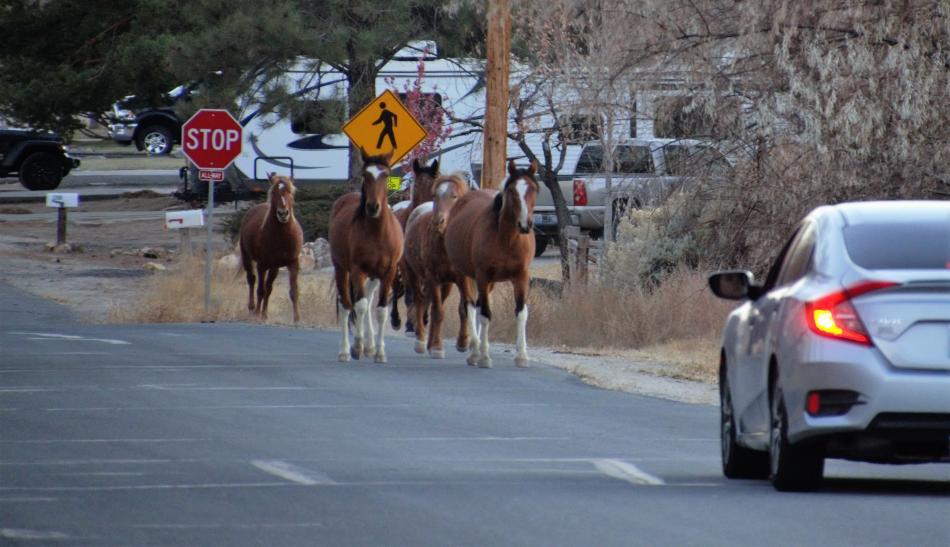
Carson Now has received many questions over the years regarding the status of Nevada’s wild horses. Developers and state agencies have been working to fence herds out of planned developments — which, unfortunately for the horses, also contain their historic watering holes, which has forced the horses out of the hills and into urban neighborhoods.
The situation recently came to a head after the federal government provided a formal go-ahead to construct fencing around Washoe Lake, the last reliable water source for the Virginia Range wild horses — bypassing standard public input and environmental assessment requirements using a technical loophole.
Protesters demanded answers from state and federal agencies on where the horses, already pushed to the valleys, are meant to go for water if they cannot access the lake.
So far, no one seems to be able to provide specific answers.
In this Carson Now Explains, we’ll be breaking down:
- Why this conflict is happening now
- How the federal government could declare the region free from wild horses decades ago despite, well, the presence of wild horses
- How developers are using a technical loophole to reneg on promises to provide water access to wild herds; and,
- Public pushback on the government now using the same loophole to bypass public input and environmental assessments
Why now?
Over the past decade, development has exploded in south Reno in what used to be a hodgepodge of open space and ranches. Up in the hills, the land is unforgiving: a landscape of steep, dry, volcanic rock dotted with sagebrush and cheatgrass, but it’s not dead; in addition to the usual suspects of jack rabbits and blue belly lizards, it is also the home to the Virginia Range wild horse herds.
As thousands of homes, apartments, businesses and major thoroughfares like Veterans Parkway are built, developers are clashing with the herd as their habitat is eaten up.
Local government leaders like the Reno City Council and Washoe County Commissioners have discussed the encroachment repeatedly over the years. This is because, as more horses are displaced from the hills, they end up in roadways and the front yards of homeowners.
Specifically, the herds have been cut off from traditional water sources such as Steamboat Creek, forcing the horses to search for artificial water sources within suburbia. Between 2019 and 2021, motorists hit 25 horses in the area, 21 of which were either killed on impact or required euthanasia, and totaled vehicles.
In an effort to stop future crashes, Reno used over $1.2 million in American Rescue Plan Act (ARPA) funds and state contributions to construct extensive fencing and cattle guard systems to block the horses from entering the urban grid.
Wild horses are no longer considered ‘wild’ — they’re designated as feral livestock … regardless if they escaped their paddock three days ago, or descend from Spanish horses brought hundreds of years prior.
However, while the project may spare horses from collision deaths, wild horse advocates fear these fences could lead to even more widespread deaths due to dehydration, as the horses are being cut off from their traditional migration routes and dependable water sources.
Many readers are asking: don’t wildlife have rights? What happened to the wildlife right-of-ways promised by many of these developments?
And the answer is: absolutely, wildlife does have rights. But due to a legal technicality, wild horses aren’t considered to be wild — they are designated as feral livestock, like a cow or a sheep on the loose, regardless if they escaped their paddock three days ago, or descend from Spanish horses brought hundreds of years prior.
Because the animals fall outside of federal lands, the state designates them as “feral” or “estray” livestock. This bureaucratic loophole has allowed developers to argue they are exempt from standard wildlife habitat mitigation rules.
There is a common misconception that the wild herds in our region aren’t wild at all, but instead are made up of horses who have been dumped by their irresponsible owners and made to survive in the “wild,” thus becoming the state’s problem.
The BLM decided Virginia Range was horse-less back in the 80s, despite the presence of, well, horses
While there are certainly horses who have been released, either intentionally by aforementioned irresponsible owners, or during wildfires as a means for them to survive, this is not the majority of the herd’s makeup.
But to understand the issues with the “wild” designation, we have to go back to the 70s, and a convoluted solution made by the federal government after they were tasked for taking care of the country’s wild horse herds.
When the Wild Free-Roaming Horses and Burros Act of 1971 was passed, the Bureau of Land Management (BLM) was tasked with managing wild horses on federal public lands. But due to the difficulty in managing the Virginia Range herds, the BLM chose to remove them instead — then designated stragglers as no longer being “wild.”
Due to the difficulty in managing the Virginia Range herds, the BLM chose to remove them instead — then designated stragglers as no longer being “wild.”
An important distinction is the “public” land aspect. The majority of the Virginia Range is privately owned, and because these horse herds are subject to these federal laws, the BLM decided the best choice would be to simply round them up off the 250,000 acre-wide range and move them to land that would be easier for their long-term management.
As Jim Barbee, the former director of the Nevada Department of Agriculture, noted, the BLM “recognized the difficulties that they were going to have in that area.”
To resolve this, the BLM instigated a series of capture program — specifically the Stockton Flat/Horse Springs and Jumbo gathers in 1983 and 1984 — to systematically depopulate the range. Following these roundups, the BLM used a land use planning process in 1986 to officially designate the Virginia Range as a “wild horse free area” — so far as the portion of public lands were concerned at least.
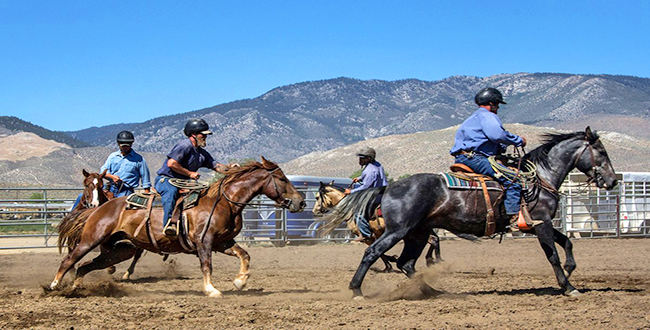
The catch, of course, is that the capture programs didn’t get every animal; horses were either left behind during the gathers or eventually migrated back into the area.
Because the BLM had officially stripped the range of its federal “wild horse” designation, any horses remaining there were no longer protected under the 1971 federal act.
By default, they became the responsibility of the state, falling under existing Nevada laws that classify the 3,000 horses residing on non-federal lands as “estray” or “feral” livestock, despite the fact that most of them had never been owned by humans.
Wild horse roundups also continue, both here and throughout the Sierra. Just today, the Los Angeles Times reported that over 450 horses are slated to be rounded up in the Eastern Sierra next month in the Inyo National forest by helicopter, then transported for adoption.
Despite the declaration of horselessness, the region’s wild herds continue to live as they have since they were introduced to the area hundreds of years ago: in the hills. But as development has continued to block their paths, the horses are being pushed further and further down to search for water and food.
Local government leaders haven’t been ignoring the issue, but even in some cases when developers agree to provide waystations like trails or watering areas for horses living in their planned neighborhoods, they later go back on their promises using the argument of the wild horses being classified as “livestock.”
Mandating water access is akin to the city taking a developer’s land

Developers use ‘livestock’ designation to reneg on water and trail promises
When Reno approved the Bella Vista Ranch Phase II project in 2013, the developer agreed to a condition requiring them to provide the wild horses with access to Steamboat Creek at the north end of the property. But when a new owner purchased the land in 2020, they returned to council asking the water requirement be removed entirely.
The developer’s attorney, Garrett Gordon, used the “feral livestock” designation to argue that under state law, it is illegal to provide regular water sources to livestock without a permit from the state engineer, which neither the developers nor the city could obtain since neither owned the animals they were proposing to provide water for.
When asked what their plan was, since the horses were unlikely to “be okay with going up to an area with no water and just dying of thirst,” developers had no answers
Gordon argued that mandating water access is akin to the city taking a developer’s land, and a direct contradiction to the city’s other requirement that they fence the horses out. Despite pushback from wild horse advocates and Reno City Council member Naomi Duerr, city attorney Jonathan Shipman sided with Gordon. He said the city couldn’t force a third party to “violate state law” by watering horses they didn’t own, and the council voted 4-3 to drop the access requirement.
As reported by This Is Reno, during a 2024 Reno City Council meeting, a similar issue arose again relating to the Canyon’s Edge development. Initially, the project proposed an 81-acre development with 71 single-family homes. However, the project was amended twice, expanding it to over 160 acres with an increased density, upping the total number of homes to 126, with multiple ADUs and a mix of housing types included.
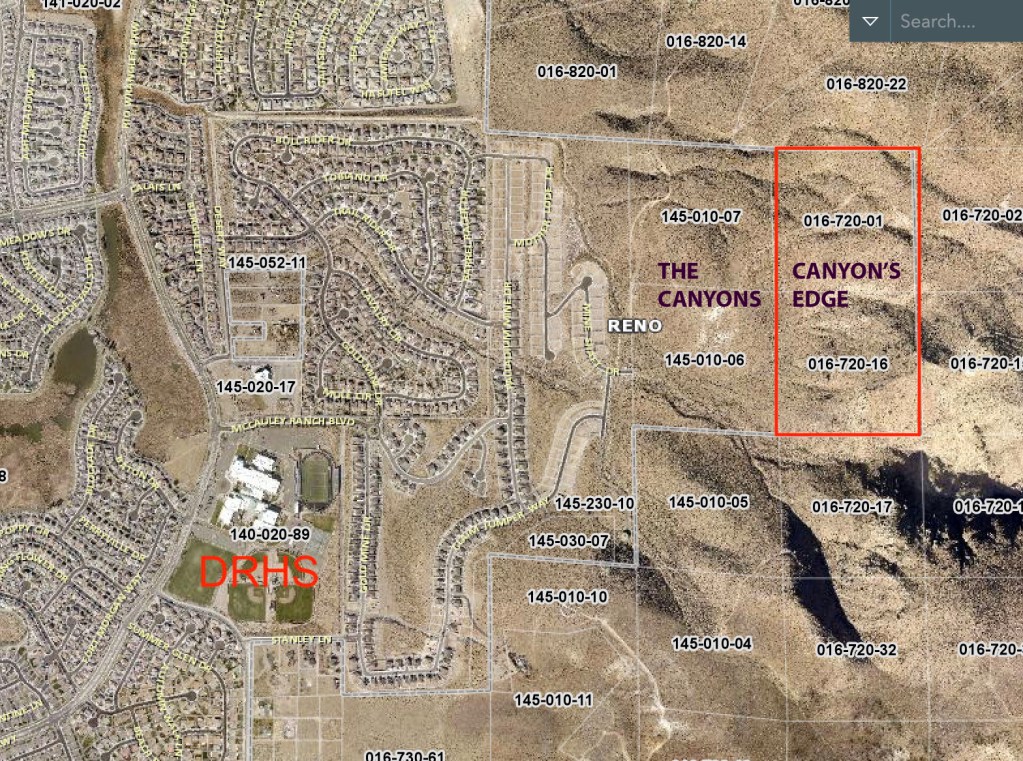
Two years prior, Developer Jim Dolan had committed to working with the wild horse advocates to provide access for diversionary feeding and the creation of a new water source east of the development, and signed a contract with the Wild Horse Connection stating this.
However, when they returned for an amendment, Dolan company representative Brook Oswald questioned if “the contract was even legal” since the horses do not count as wildlife, despite the contract explicitly included horses.
When council members asked the developers what their plan was, since the horses were unlikely to “be okay with going up to an area with no water and just dying of thirst,” they had no answers, other than they would work with the NDA.
Ultimately, Oswald stated they would only provide a wildlife management plan later in the planning process “if directed to by state agencies who deem it to be necessary.”
Except, the NDA sent a letter at the request of developers to the council on their opinion, and expressed “significant concerns over watering and establishing a horse trail.” Council members said they interpreted the message as a directive to “stay out of our business,” which left the city unable to mandate developers accommodate herds, or hold them to their prior commitments.
NDA’s further response was to round up over two dozen horses “to protect them from the dangers of an active construction zone” on a Virginia Range development property. They were transferred to an “off range holding facility” to be adopted out, according to NDA spokesperson Ciara Ressel in 2024.
Public pushback today: Nevadans say fencing approval without public input is prime government overreach
While these discussions have been ongoing for nearly a decade, the public recently took to the streets in the hundreds demanding a stop to the fencing proposal.
It’s not that the public didn’t care about the horses until this year; there were public comments of concern throughout the fencing process and development approvals, as well as the ongoing wild horse protests at the legislature in Carson City.
While state agencies are fencing horses out, they are simultaneously acknowledging there is nowhere else for them to go.
But the public outcry recently took a larger turn after the fencing debate sparked a new flashpoint: Washoe Lake, one of the last remaining consistent water sources accessible to the horses, which has now received the green light to be fenced in as well.
The conflict moved out of the hills and into the valley alongside shifts in herd behavior. According to a public notice by the Nevada State Parks department, fencing around Washoe Lake is not new; it’s a remnant of historic ranches maintained by the department for years.
The department confirmed the horses have only been using the lake as a water source within the last decade — caused by the deteriorating fences, they say — which aligns with the timeline since they’ve started being pushed down from the hills due to the developments.
Now, however, this fencing project will keep the horses off state land, in addition to the private development land in the range.
While the NSP spokesperson said that the NDA “and its partners are monitoring Virginia Range horses and evaluating alternative water sources available throughout the range,” the NDA and developers have stated on the record the majority of historic water sources are now virtually nonexistent.
The decision to bypass public input brought together not only the wild horse advocates … but residents who argue the government overstepped by dictating public land use without public input.
According to an NDA-commissioned rangeland assessment, the interior of the Virginia Range suffers from a “general scarcity of live water.” While some springs and ephemeral creeks exist in the higher western elevations, the NDA reported these “have a history of going dry during periods of prolonged drought severely limiting water availability.”
The state’s assessment acknowledged that the only reliable water sources — such as the Truckee River, Carson River and Steamboat Ditch — are located along the borders of the range. However, the NDA’s report highlighted the very problem advocates are protesting today: “Residential and industrial development is encroaching on water sources in the lower elevations, further limiting access.”
So while state agencies are fencing horses out, they are simultaneously acknowledging there is nowhere else for them to go. Advocates say this is leaving the herds boxed inside an arid interior with no known reliable alternatives.
Federal government gives formal go-ahead for lake fencing
This issue came to a head on May 6, 2026 when a federal Record of Decision was signed allowing 14 miles of fencing across Carson City, Storey and Washoe counties. In doing so, the BLM bypassed an environmental assessment and public comment period by utilizing a “Categorical Exclusion.” This environmental law provision may be used for projects deemed not to significantly impede wildlife.
The state has argued that since the 4-strand wire fence uses a “wildlife-friendly design,” it will not restrict wildlife movement or migration. However, they’re not arguing that it won’t impede horses, rather they’re relying on the technicality that wild horse herds are excluded from the designation.
We don’t know of a water source right now. There are a lot of challenges on how to do this.

Residents say they feel that this decision intentionally shuts them out of the process, as they learn about the project only after irreversible administrative actions had been taken.
In response to the protests, the NDA stated no active construction is currently taking place, but protest organizers like Monica Ross said that with the BLM Record of Decision already signed, the installation of the 14-mile barrier could legally commence at any moment without any further public notification or discussion of humane alternatives, such as wildlife crossings or speed-calming measures.
They also said that they posted the proposal to a federal webpage, and notified local Native American tribes. However, they said that because they received no comments, they declared that “no other public involvement was necessary for this [Categorical Exclusion] project.”
It was this Record of Decision that pushed the conflict out of government council chambers and into the streets (or, in the case of rural protests, onto the dirt embankments of the two-lane roads in Washoe Valley). The decision to bypass public input brought together not only the wild horse advocates, but residents who argue the government overstepped by dictating public land use without public input.
According to Reno council member Duerr, who provided a presentation to the Washoe County Citizens Advisory Board, the general public favors protecting horses — which she noted is especially important as half the country’s herds live in Nevada. She also reported recent polling showing that 76% of Nevadans agree wild horses are a “defining symbol” of Nevada and the American West, and only 13% of Nevadans support helicopter roundups.
When it comes to the future survival of the wild herds, agencies tasked with caring for them continue to lack specifics. Instead, the response made by Oswald, the Canyon Edge’s representative, to the question of “where are they supposed to go?” in 2024 appears to be the most honest reflection of the situation at present:
“Well, we don’t know of a water source right now. There are a lot of challenges on how to do this.”