My fruit tree expert friend, Michael Janik, recently sent out his June 2026 Fruit Tree Care and Gardening Newsletter. I’m always interested in what Michael reports on. He mentioned aphid damage on stone fruits, which are plums, cherries, peaches and the like. Damage shows up as curled leaves on the ends of twigs and as a shiny sticky residue. Aphid damage is also possible, but less likely, on apples and pears. Aphids are also showing up on sand cherries, spiraeas, roses and many flowers, as well as trees such as ash.

A great way to deal with aphids is to use a forceful spray of water from the hose to knock them off. Once on the ground, they can’t get back up, but their predators, such as lacewings and ladybugs, can. These natural aphid enemies will fly back up into the plant and eat remaining aphids. Michael says that “Spraying at dusk will bring in beneficial insects (including wasps); they will stay overnight and breakfast on the aphids.”
If you have planted young fruit trees, Michael advises that “Training fruit trees is one of the most important things to start early in the tree’s life.” In the second year of growth, you will see side shoots develop on the young trunk. These will become the branches. Select four to five of these shoots and remove the others. Pick those that are pointing outward from the trunk. Michael says to “Look at the angle between the selected shoots and the trunk; this angle should be approximately 70 to 80 degrees from vertical. Generally, the angle is much less; so…when the shoot is about 4-6 inches long and still green, attach a clothespin to the trunk above the shoot so the shoot is near horizontal. Leave the clothespin on until the stem is woody in the late summer.”
Since Michael is an expert at fruit tree training and pruning, when he suggests a book, I listen. He recommends Pruning and Training, by Christopher Brickell, American Horticultural Society, DK Publishing, New York. There are pruning instructions for (almost) all American plants.
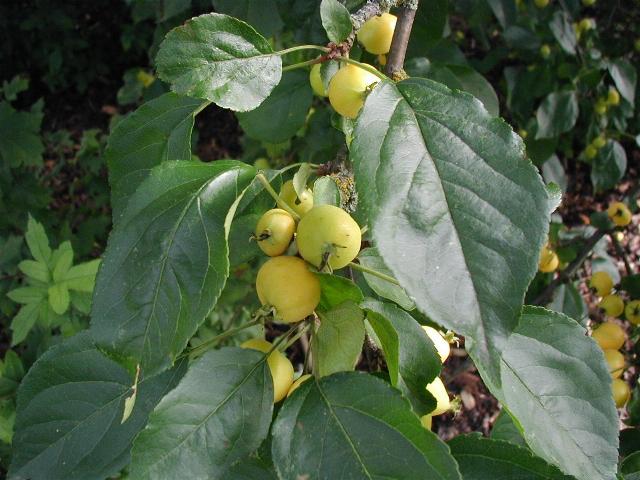
I pruned my crabapple trees last week. The water sprouts, which are the branches that rise straight up in the canopy of the tree, were starting to get quite long. I have trained these trees to form an umbrella shape, so those wild stems reaching up to the sky have to go. I used loppers and a pole saw. I disinfected between trees by spraying the tool blades with isopropyl alcohol.
Many thanks to Michael for his knowledgeable advice.
— JoAnne Skelly is an Associate Professor and Extension Educator, Emerita, University of Nevada Cooperative Extension. She can be reached at skellyj@unr.edu.