A decade ago, a study revealed public perception was being skewed by the prevalence of American cop shows such as Law & Order: SVU on how often crimes are solved and the “bad guy” ends up in prison. That study (and several that followed) found that perceptions were skewed not only on how often crimes are solved, but how many result in jury trials, and the suspects sentenced for their crimes.
That skewed perception still holds today, though whether it has anything to do with cop shows is anyone’s guess.
Readers are advised this series includes content some may find upsetting relating to domestic violence and other crimes.
When Carson City resident Lindsey* (name changed for victim privacy) was attacked in her home by her then-boyfriend in January 2024, she thought working up the courage to report the incident would be the hardest part of seeking justice. But what she didn’t know at the time was that, at least in Carson City, the chances of having her day in court were almost zero.
In Carson City in 2023 (the most recent data available for courts statewide) 479 criminal cases were filed, with 360 of those being felonies cases.
An informal survey of around 30 community members was conducted to see what local perceptions of the court system were. When they were asked how many of those 2023 cases they believed went to trial, average answers typically fell between 85 and 100.
All but one person polled was shocked when the true answer was revealed: only one trial was held in Carson City in 2023 according to court records.
The only person who came close to the accurate number by guessing two trials is an attorney practicing law within the region. She said she wasn’t surprised by the number; while most cases result in plea deals, she said Carson City seems to utilize them more than any other court in the state.
She isn’t completely wrong; while nationally, only 2-3% of criminal cases make it to trial, Carson City is far lower.
Statewide in 2023 the percentage of cases that received non-trial dispositions (judgements/rulings) was 98.83%, reflecting a total of 14,669 dispositions.
However, Carson City is among the highest in the state when it comes to settling out of court, with 99.49% of 2023 cases resolving outside the court room.
Using a standard adjusted ratio to compare counties, Carson City came in very low, with only 5 cases out of 1000 making it to trial. The only counties with a lower adjusted ratio were those with much smaller populations (Mineral and Lander), or those with limited court systems (Churchill).
By comparison, similar sized municipalities like Lyon and Douglas had ratios of 24 per 1000 and 21 per 1000 respectively.

When it comes to settling out of court, most prosecutors will say a plea deal ensures victims will receive some sort of justice, when the alternative could be no justice at all if a trial does not go in their favor.
However, for many victims, these plea deals often feel like no justice at all.
Lindsey
For Lindsey, Jan. 17, 2024 was one of the worst days of her life.
According to the police report she filed with the Carson City Sheriff’s Office, her then-boyfriend Arnold “Franky” Flores-Estrada was doing drywall work in her bathroom, and became more and more frustrated, and called for her to help him.
Lindsey worked from home, and wasn’t able to help immediately. Eventually, she entered the bathroom to see what was going on, and found Flores-Estrada “irate” at how long she’d taken. She told deputies he shoved her to the ground and kicked her in the stomach before trying to pin her to the ground, but she was able to briefly get away.
Typically, it is a challenge to prosecute domestic violence cases. Unless law enforcement was on scene to watch an attack happen, there is significant physical evidence present at the time of the investigation, or they get a confession from the perpetrator.
Lindsey came forward about the attack about three months after it had occurred. In her case, though, she had something many victims of domestic violence only wish they could provide: 4K video evidence.
After the attack in the bathroom, Lindsey was able to flee to the hallway, but Flores-Estrada followed. In the video captured by Lindsey’s Furbo dog camera, it shows the two arguing. Flores-Estrada grabs Lindsey by the throat, shoves her up against the wall, and begins to strangle her. Lindsey fights back, screaming “Get off of me!” until she goes silent. She is eventually able to get Flores-Estrada off of her and pushes him away, with the entire ordeal lasting about 15 seconds.
We are including an edited version of the video which trims the footage to hide the victim’s face, and we’ve removed the audio for privacy. However, our team has seen the videos and listened to the audio undoctored.
Unfortunately, Flores-Estrada knew about the camera. Lindsey said he made her sit at her desk where he could see her while he logged onto the system to delete them. However, she was able to download and email herself two of the videos before they could be erased.
Lindsey said she feared for her life, not only because of the abuse, but because Flores-Estrada had threatened to shoot and kill both Lindsey and himself on multiple occasions if she ever went to law enforcement, which she had audio recordings and text messages to prove.
This also was not the first time Flores-Estrada was arrested for strangulation of a romantic partner. He’d been arrested ten years prior for allegedly breaking down a door and strangling his then-girlfriend while she was attempting to leave him.
During the 2014 arrest, he repeatedly told deputies they should just ignore what happened, and that he was going to get out of the charges. He said he was “going to become a cop, too.” He also owned a number of guns, including guns that were illegal to possess, especially because he was under 21 at the time.
Despite the violent nature of the charges, Flores-Estrada had been right: his felony charge was reduced to a misdemeanor, and he was able to later seal the case entirely.
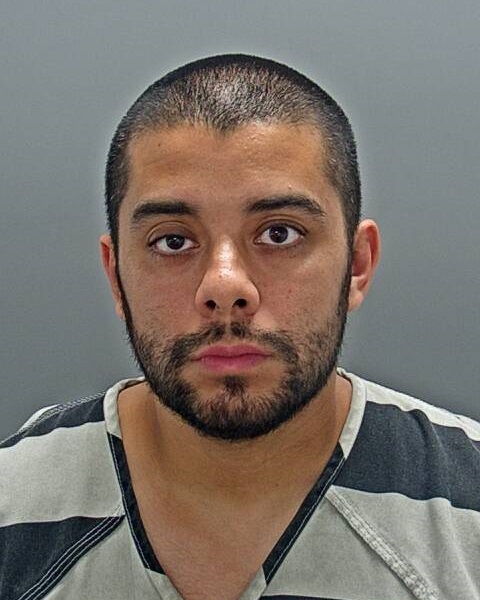
Lindsey knew about this prior attack, and said that Flores-Estrada often told her about his violent fantasies of killing and assaulting his ex-girlfriend and her children.
Because of this, she knew she’d have to extract herself slowly from the relationship.
Once they were broken up three months later, Lindsey filed a restraining order against Flores-Estrada after another incident occurred in March. She went to the Sheriff’s Office with video evidence of the January attack, as well as audio of him threatening to kill her which she’d recorded on her smartwatch, as well as a slew of text messages.
She was terrified to do so, she said, but had been told that because she had video evidence, Flores-Estrada would see justice. The Carson City Sheriff’s Office deputy who took the report seemed to believe so: in their investigation report, they wrote:
[Lindsey] provided me with a flash drive containing video of the strangulation, audio of Arnold threatening [Lindsey] and text messages of him threatening suicide. I observed the video that was dated Janaury [sic] 17, 2024, and observed a large, Hispanic male choking [Lindsey] with both his hands. The male approached [Lindsey] who backs away. The male then grabs [Lindsey’s] neck with both his hands as [Lindsey] screams and grabs the males’ hands. [Lindsey] then gets the male off and pushes him away.
Her case was assigned to Peter Smith, Senior Deputy District Attorney with the Carson City District Attorney’s Office. According to Lindsey, Smith also told her that because of the video evidence she’d provided, he felt “completely confident” going forward to prosecute the case on its original charge of domestic battery by strangulation, a category C Felony.
Smith’s assertion of confidence and intention to move forward with the felony was confirmed by a witness to that meeting, and Smith filed a criminal complaint for Domestic Battery by Strangulation on May 7, 2024.


However, before Smith could prosecute the case, he retired, and a second prosecutor took over the case: Leslie Butori.
On Nov. 8, 2024, Butori filed a criminal complaint also charging Flores-Estrada with felony strangulation identical to the previous charge with the first pre-trial hearing set for Nov. 20.
Nov. 8 was a Friday, and Monday a holiday. Lindsey was called in to meet with Butori to discuss the case on Tuesday, Nov. 12 — the next business day after the complaint had been filed.
According to Lindsey, she had asked for a friend to be allowed to join her, but was told no. Butori confirmed this, saying when preparing a a witness for preliminary hearing, prosecutors don’t want other witnesses present because they want to preserve the individual’s own recollection of events.
Lindsey met with Butori alone, and was told that despite the investigator’s conclusion she had been strangled, along with the criminal strangulation charges filed by Smith indicating the same, Butori said she didn’t believe it was a tight enough case.
“She said she couldn’t tell that I was being strangled based on the video,” Lindsey said. “She said because I was screaming ‘Get off me!’ it meant I could breathe, even though in the video it shows I stop being able to speak because I’d run out of air.”
When asked why Butori had filed a complaint for strangulation, but then amended it soon after to domestic battery, Butori said she had done so at first to fix an error: Smith had used the word “choked,” when it should have said “strangled,” she said. But after reviewing the case, she said, she believed it would not be able to stand up in court on the original charge.
Victim threatened with ‘false imprisonment’
Lindsey was distraught by the possibility of the case being downgraded, but was soon given another reason to be afraid: Butori allegedly threatened Lindsey with her own criminal charge for “false imprisonment” as part of her ordeal.
Immediately following the attack, Flores-Estrada repeatedly told Lindsey if she went to the police he would kill her and himself according to the investigation report.
He said he was going to go home, where Lindsey knew he kept the guns he was threatening to shoot her with. Lindsey said she was focused on calming Flores-Estrada down, rather than letting him leave in an agitated state to return with weapons.
“I told him, ‘I can’t let you leave when you’re like this,’” Lindsey said. “I told him if he did I’d have to call the cops because I was afraid of what he would do. I never put my hands on him, or blocked the door, or took his keys. I just told him that if he left to get his guns after threatening to kill me I’d have no choice but to call the police. [Butori] told me I should retain a lawyer since I’d falsely imprisoned him.”
Lindsey said to this day she is still terrified of facing a false imprisonment charge.
“There was never any kind of physical restraint and in one of the recordings, you can hear him open a door and step out, then come back in and threaten me,” Lindsey said. “I think it’s reasonable self defense to try to redirect someone from leaving to go get their firearms after they just threaten to shoot and kill you.”
Butori offered Flores-Estrada a deal: plead guilty to misdemeanor domestic battery, and misdemeanor violation of Lindsey’s protective order, and they’d drop the felony charge against him.
One day before the trial was set to begin, Flores-Estrada’s felony charge was downgraded to domestic battery, first offense.
While Flores-Estrada had been arrested previously for strangulation, which was then also downgraded to misdemeanor domestic battery, state law allows misdemeanor charges to be sealed after a certain amount of time. For domestic battery, that’s seven years.
Because his case was sealed, even though there were records of the arrest and conviction, legally it could not be used against him to apply a domestic battery second offense charge.
Flores-Estrada agreed to the charges — even though Lindsey herself did not.
Plea deals
Within the justice system both here in Carson City and nationwide, plea deals are the most often used form of disposition, which happen behind the scenes instead of in a court room.
For example, what may happen is an individual is arrested for possessing drugs, and is facing three felony charges.
They have three options: go to a jury trial, in which 12 members of the community will listen to arguments on whether or not this individual’s actions are found to be a violation of the specific laws they are accused of breaking, and will decide if they believe one argument over another.
The second option is to go through what is called a “bench trial,” in which a defendant foregoes a full jury and instead the judge acts as the jury and decides whether or not the defendant is found guilty themselves.
Then, there are the plea deals.
In this hypothetical, the prosector assigned to the case from the DA’s office might instead offer to remove two of the three felony drug charges, or downgrade them all to misdemeanor charges, in exchange for the defendant agreeing to plea guilty to them.
Then, the defendant will go before the judge for sentencing.
In Lindsey’s case, this is precisely what happened to Flores-Estrada in both of his strangulation cases. He was offered instead to plea guilty to misdemeanor charges instead of the felonies, and he agreed.
With felony trials having the potential to take weeks — even months — it would be physically impossible to try every single case brought forward while adhering to a suspect’s constitutional right to a speedy trial. This is especially true in Carson City, which has been working to expand their court for several years.
However, Carson City District Attorney Garrit Pruyt said that this is not a factor in deciding which cases go forward or are plead down.
“We don’t classify [pleading cases] within some sort of number. The types of crimes that come in the door are fairly standard. You’re going to have a number of cases that are on the simpler level, the mid-level, and the more complex level. Crime in its own way fits that natural rubric and we will apply all the resources that we can at each and every level.”
He said some cases resolve quicker, and not because the DA’s office has provided extra leniency to reach a speedy resolution.
“You went in, you stole this, we’re going to offer you to plead to a theft, and it may resolve in less than a few weeks,” Pruyt said. “Other cases are much more complex and take more time and they naturally kind of balance themselves out, but we’re going to do the very best we can with every resource that we have to prosecute each case on an individual level in the best way possible.”
Deputy District Attorney Tyson League said that everyone within the DA office works 90+ hour weeks and “do what we have to to get it done.”
“I don’t care about that,” he went on. “I care that we’re going to do what’s right for people and try to make a bad situation as good as we can.”
When asked if their office is understaffed, Pruyt said every DA’s office in the country will say they can always use more prosecutors, because “There’s always work, unfortunately: there’s crime. Carson City’s a lot safer than other communities, it’s a great place to live. But if more resources are available, will we use them? Of course we will.”
Pruyt said despite not yet having the new court room, or lacking staffing, they’re going to get the cases done, and it does not affect which cases are pled out.
“The effect is that everybody on the team works more to get it done until deficiencies get filled up.”
Butori said she told Lindsey she wanted to hold Flores-Estrada accountable, and the next best option is domestic battery — a misdemeanor charge.
“So the only next charge I have is potentially domestic battery,” she said. “Unfortunately, [the way] the law is, domestic battery is a misdemeanor. We have either a serious felony or a misdemeanor, which I don’t think is right, but there’s no in between for us. There was nothing else I could use to alter the charges to make them something else.”
However, Lindsey did not want to have Flores-Estrada’s case downgraded to a misdemeanor, even if that meant a jury may find him innocent. Because, for Lindsey, the option of a misdemeanor was no more than a slap on the wrist — especially because he had already been through the process before with his previous girlfriend.
“I [told Butori] that I would rather it go to trial and give it an honest effort than [downgrading it to a misdemeanor] because a slap on the wrist wasn’t going to teach him anything,” Lindsey said. “I was stuck with this guy for years and knew how he felt about his prior DV case.”
Lindsey said after she told Butori she disagreed with the proposed plea deal, that’s when Butori suggested Lindsey should retain a lawyer because she might be charged with false imprisonment.
The Ethical Burden
When asked why Butori did not want to take the case to court if that was what the victim wanted, even if they might lose, Butori said she has an ethical burden on whether or not she can prove a case beyond a reasonable doubt.
“If I don’t believe that I can prove it beyond a reasonable doubt, I ethically should not and could not be taking that to trial,” Butori said. “So the push and pull that we have is: I may believe wholeheartedly this happened, and obviously it’s on video. I can wholeheartedly believe that this incident unfolded how she’s telling me it unfolded. But just because I believe it, does not mean I can prove it beyond a reasonable doubt, and that is a very hard thing for people outside of this office to understand.”
The issue for Lindsey, however, is the fact that when her case was under Prosecutor Peter Smith, he did believe that he’d be able to prove the felony strangulation beyond a reasonable doubt because of the video.
Attempts to contact Smith have been unsuccessful, as he no longer works for the DA’s office.
When asked why there was a difference between their opinions, and who broke the tie, District Attorney Garrit Pruyt said he’d been the tiebreaker prior to taking on his new appointment as District Attorney.
“On all those serious types of cases, multiple prosecutors are going to review them, especially if they’re going to get up to the trial process to ensure that we don’t have those kinds of issues,” Pruyt said. “I believe [Butori’s] assessment was proper and correct based upon what could be proved and what could not be proved at trial. So even if [Smith] had stayed with employment in the office, it would have come to the same point of reaching me anyway, because we talked about all cases that go to trial and we would have ended up in the exact same spot we are today.”
According to Butori, she did not believe that she could prove beyond a reasonable doubt that Lindsey was strangled because she “couldn’t see where his hands were” within the video.
“So the requirements of strangulation require the hands — well, it requires some sort of hindering of somebody’s breathing that can be done or shown by putting your hands on someone’s neck, on their windpipe, something to that effect,” Butori said. “In the video, I couldn’t tell that. […] Ultimately, based on what the video showed, I couldn’t prove beyond reasonable doubt it’s strangulation. It doesn’t meet the criteria for strangulation from what I was seeing.”
She said that she also made her determination based on further audio recordings provided by Lindsey that were taken on her smartwatch a few minutes after the attack occurred. Butori said that because Lindsey’s voice was not raspy, and that she wasn’t incapacitated or having a hard time breathing, strangulation could not be proven.
Lindsey disagrees, however, based on how the law is written.
The law states that a person who intentionally applies sufficient pressure to a person’s neck, throat, or windpipe to make it difficult for them to breathe or stop blood flow to the brain is guilty of strangulation.
NRS 200.481
(i) “Strangulation” means intentionally applying sufficient pressure to another person to make it difficult or impossible for the person to breathe, including, without limitation, applying pressure to the neck, throat or windpipe that may prevent or hinder breathing or reduce the intake of air, or applying any pressure to the neck on either side of the windpipe, but not the windpipe itself, to stop the flow of blood to the brain via the carotid arteries.
When it was pointed out that NRS only stipulates there needs to be an intention to apply sufficient pressure, restrict someone’s breathing or blood flow, and does not mention incapacitation or aftereffects, Pruyt agreed.
However, he said prosecution will often look at aftereffects as evidence of whether what occurred could be considered strangulation, and whether or not their arguments would be strong enough to stand up in court.
“The NRS does not require incapacitation, or discuss aftereffects, however it does require ‘applying sufficient pressure to another person to make it difficult or impossible for the person to breathe’,” Pruyt said. “When there is a question, as there would be at a trial, of whether there was sufficient pressure to make it difficult or impossible to breathe, we often look at aftereffects as an indication that breathing was impaired.”
When it was argued that restricting blood flow to the brain would have no effect on breathing or how someone’s voice would sound, and that Lindsey reported that after the incident she felt dizzy, Pruyt said:
“At trial, defense’s role is to take every opportunity to discredit the victim and exacerbate any inconsistencies in front of a jury who also has to process the complexities of the case. Additionally, not all information received in an investigation can be used in a trial to prove the case. Our assessment and evaluation of a case necessitates that we consider all admissible evidence, expected inconsistencies in testimony, perceived bias of all witnesses, and how testimony and evidence will be received by the jury.”
Despite Butori’s statements to both Carson Now and Lindsey that she could not see where Flores-Estrada’s hands were within the video, which is why she had to downgrade the charge, Butori later said during sentencing “There was a verbal dispute that ultimately turned into a physical dispute … he ultimately did grab her by the neck and push her against the wall — that portion is recorded.”
When the contradictions between the language of the law and Butori’s interpretation of it, as well as her contradicting statement said during sentencing were brought up with her and Pruyt later, Pruyt said:
I can tell you without reservation that Ms. Butori is an excellent prosecutor. I am sure your research has revealed Ms. Butori’s extensive qualifications and long list of felony trial prosecutions and convictions. Ms. Butori at all times was looking out for the victim in this case. She is invested in helping victims and securing justice on behalf of our community. If I or a member of my family were to be a victim of a crime, I could only hope that the case would be assigned to a prosecutor like Ms. Butori.
[…]
The statements you reference below are not a contradiction once you add the requisite context. One is arguing to the Court what we believe evidence shows and the second is telling a victim the issued associated with the evidence which could create reasonable doubt at trial.
Butori herself did not respond to any further questions.
Ultimately, Flores-Estrada agreed to plead guilty to misdemeanor domestic battery, as well as one violation of Lindsey’s protection order, which was also not prosecuted until the plea deal was arranged, despite being reported months prior.
He was sentenced to 30 days of jail, 15 of which could be served on the weekends, so long as they were served by a certain date.
However, he did not meet his deadline; he missed one of the weekends he was meant to be in jail, and asked for an extension, stating he was sick.
An extension was provided, moving his due date to an additional weekend — without notice being given to Lindsey, or allowing her the opportunity to argue against it, which she believes constitutes a violation of victims’ rights laws.
When Lindsey said she had issues with the results of her case, she said she was told, “That’s why it’s called a criminal justice system, not a victim’s justice system.”
This is the first part of a three part series. Next, check out our deep dive into the issues with bail, and how it allows a tiered system for offenders — one for those with money, and one for those without.
Then, we’ll take a look at the issues of accessing the court system, especially for Lindsey, whose access to her case experienced a significant number of hurdles in ways she believes constitute violations of Marsy’s Law — the Nevada Victims’ Bill of Rights.