By Brett Fisher

The Carson City Fire Department has requested that the Board of Supervisors apply for a grant that would pay for a new ladder truck and a new ambulance for the department’s new Community Paramedicine Program concept.
The agenda from the Feb. 4 Board of Supervisors meeting shows requests were made by the fire department to apply for a grant that would fund the cost of a new ladder truck for its fleet, as well as an additional ambulance used for a new service delivery program the department hopes to launch.
Both requests for grant applications were approved by the Board of Supervisors, Deputy Fire Chief Tom Tarulli said.
Carson City Fire Chief Robert Schreihans said the funding request will be made to the Assistance for Firefighters Grant. If approved, the grant would provide matching funds through the city.
He said the department is about a year or more away from getting the new ladder truck, equipment it hasn’t had in its fleet since 2009.
Schreihans said the last ladder truck Carson City had was purchased in 1989 as a demo model.
“But it was constantly out of service,” Chief Schreihans said. “It outlived its usefulness.”
Since then, the Carson City Fire Department has had to borrow ladder trucks from neighboring counties, including Douglas and Washoe, when the need has arisen.
Adding a ladder truck to its own fleet will significantly reduce the fire department’s dependence on interagency equipment that can take a half hour or more to arrive on scene, Schreihans said.
Besides being capable of integrating digital technology, the ladders will be made of a lighter-weight material and they will have more sophisticated maneuverability.
The new ladder truck will also come equipped with a water pump, Schreihans said, something the old unit didn’t have.
Schreihans said having the water pump attached to the truck means the unit can not only supply its own water, but stream it, too.
“It changes the way we do operations,” Schreihans said. “It definitely increases our ability to be flexible.”
Chief Schreihans acknowledged that Carson City does not have very many tall buildings, but a ladder truck’s usefulness goes way beyond vertical reach.
There’s the matter of horizontal reach and angle to consider between a building and where the truck can be positioned, he said. Sometimes units aren’t able to park as close to a building as they need to, and the ladder truck’s reach increases accessibility to a building.
“It does so much for height, for reach, and for rescue,” agreed Tarulli, who added that hoses can be pulled up the ladder in a more linear fashion, cutting down the time it takes personnel to climb through a building to reach a fire.
“It’s fast and efficient, and you can put the fire out before you get to the top of the stairs,” Tarulli said.
The new ladder truck, which will be no more than 47 feet in length from bucket to bumper so it will fit in the bay at Station 51, comes with a price tag of around $1.2 million dollars, Chief Schreihans said, and it will be manufactured by one of only two fire truck manufacturers in the country.
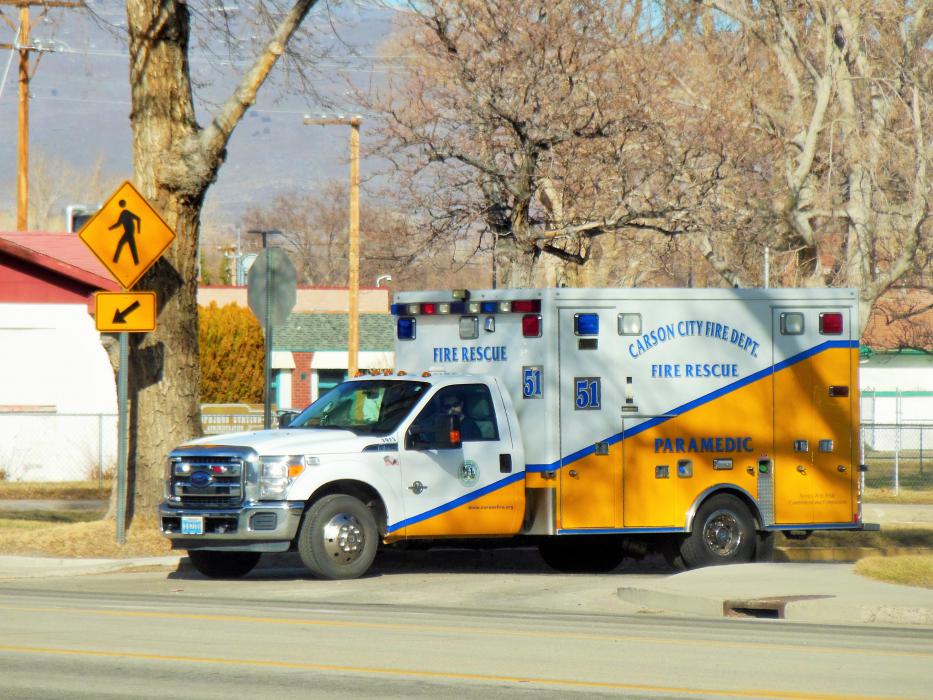
In addition to the ladder truck, the Carson City Fire Department is also requesting a new ambulance be put into service for a brand-new service delivery concept the department calls its Community Paramedicine Program.
The purpose of this program, Chief Schreihans said, is to reduce the number of emergency calls that don’t turn out to be emergencies, and alleviate emergency personnel of those kinds of responses.
“Right now our only mode of taking care of someone is transporting them to the hospital,” Schreihans said.
The Community Paramedicine Program would increase and improve the levels of care that the fire department can provide to people, he said.
The new ambulance will feature equipment designed for non-emergency medical care, such as taking lab values, the chief said. It will also feature technology that allows first-responders to talk with doctors or nurse practitioners who advise on medical treatment.
Cost of the new ambulance is estimated to be about $205,000, according to the Feb. 4 Board of Supervisors agenda.
Chief Schreihans said there are multiple benefits to the new Community Paramedicine Program, not the least of which is the reduction in cost of delivering services.
This includes the cost of the ambulance ride and the cost of hospital emergency room treatment, both of which can run into the thousands of dollars for one case.
Then there is the impact on the 911 service. Community Paramedicine would free up the lines by taking a proactive, preemptive approach to non-emergency situations that start out as emergency calls.
Community paramedicine would reach out to residents who require non-emergency medical attention by visiting them on a regular and frequent basis, Schreihans said, making house calls to check on the health of a resident, assisting with medication, or even removing fall hazards for residents.
“It’s an alternative method of treatment when you don’t need to go to the hospital,” Schreihans said.
The program would also partner with the hospital by providing regular follow-up checks on patients within their first 30 days after discharge, Schreihans said, and this would be key in reducing the number of return trips to the hospital.
“The idea of the program is to keep those who don’t need to go to the emergency room from going,” Tarulli said. “It will cut the cost all around, and is a win-win for everyone.”