
The Carson City Board of Supervisors approved a tentative subdivision map for Blackstone Ranch, advanced a major public safety technology overhaul, introduced new inmate rehabilitation programs, and proclaimed January as National Radon Action Month Thursday.
You can also watch the meeting here:
Development & Housing
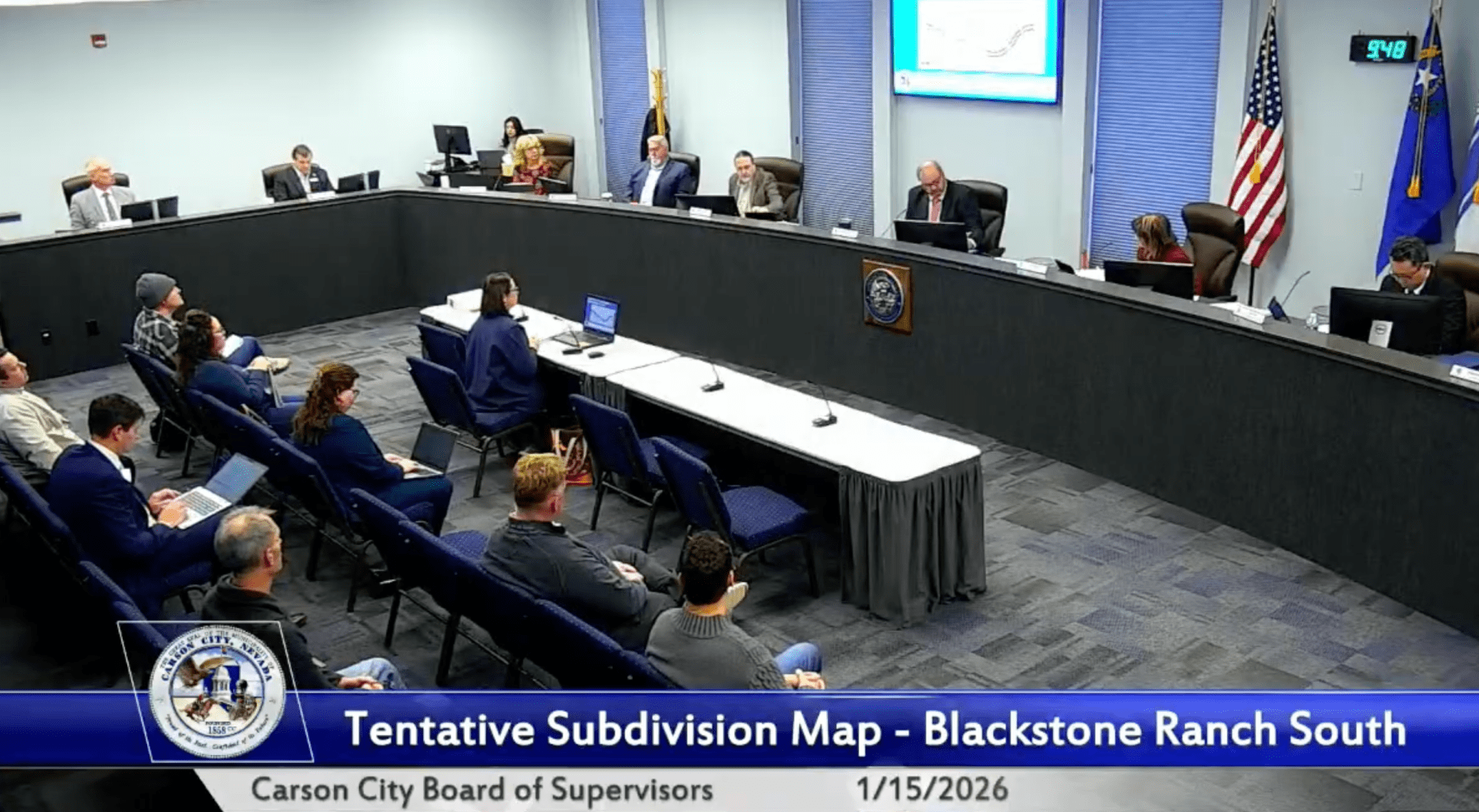
The Carson City Board of Supervisors gave the green light on Thursday for the development of more than 100 new homes, approving a tentative subdivision map for Blackstone Ranch South near East Fifth Street.
The project, managed by KDH Builders, consists of 103 single-family residential lots. Associate Planner Heather Manzo noted that the development is a continuation of a plan the city originally reviewed several years ago.
“This request is one that the board had seen maybe about six or seven years ago,” Manzo told the board. “This project is essentially the same as it was before except we have moved much further along in the process in terms of establishing right-of-way alignment.”
A primary focus of the approval was protecting existing neighborhoods from heavy construction traffic. Manzo highlighted that conditions from the original approval were carried forward to ensure construction vehicles do not utilize local streets like Railroad Drive.
“There was a lot of concern back when this project was originally approved that… neighbors didn’t want construction traffic and a lot of unnecessary traffic going through Railroad Drive,” Manzo explained. “Construction traffic will come from East Fifth Street and not from Railroad [Drive] as a part of the recommended conditions of approval for this project.”
The board also formalized conditions regarding the linear park and multi-use pathway on the site. Manzo confirmed that the alignment of Railroad Drive has been adjusted to line up directly with Matterhorn Boulevard to the north when it intersects with East Fifth Street.
Mayor Lori Bagwell sought clarification regarding the developer’s financial obligations for road improvements, specifically regarding the “pro rata share” of costs. Staff confirmed that the developer has not yet paid these fees and that the 10-year timeframe for those funds will begin once the final map is submitted.
While the project moved forward, the vote was not unanimous. Supervisor Maurice White voted against the item, citing his recurring objection regarding how the city handles roadway adoption.
“Just to voice my usual consternation over accepting private roads into the Carson City street inventory,” White said regarding his opposition. “That’s the only comment that I have on this project; otherwise, I want to thank staff for taking on a whole bunch of questions from basically two years ago.”
Supervisor Stacey Giomi moved to approve the map, noting the project met the required findings and conditions. The motion passed 4-1, with White voting no.
Also in the realm of development, the board finalized changes to the Silver Oak Planned Unit Development on Thursday, unanimously adopting two ordinances that modify setback standards for new residential phases. The board approved the second reading of Bill 107, which adjusts front yard setbacks to accommodate a side-loaded garage option for cluster housing in phases 25 and 26 of the development
New bill aims at reducing financial barriers to conserving historic buildings
The Carson City Board of Supervisors moved to simplify historic preservation efforts on Thursday, advancing an ordinance that would allow a resident to relocate a historic garage rather than see it demolished.
The board voted unanimously to introduce Bill 102, which amends zoning codes to allow historic structures to “transfer” their original setbacks when moved to a new location within the historic district, facilitating the rescue of a building that the Historic Resources Commission had previously sought to protect.
While the Planning Commission had originally recommended requiring a Special Use Permit for such relocations, the Supervisors opted for a less expensive administrative review process after Mayor Lori Bagwell and the Historic Resources Commission argued that high fees would deter preservation.
Mayor Bagwell noted that saving a building in this manner is a rare event and argued that the city should not charge excessive fees to someone willing to salvage a historic structure, leading the board to strip the $2,200 Special Use Permit requirement from the bill in favor of a standard review.
The measure was prompted by resident Darren Berger’s offer to move the threatened structure to his own property, a solution that required flexibility regarding zoning setbacks to fit the building on the new lot.
To address safety concerns raised by Supervisor Maurice White, the board ensured that the final ordinance will still mandate adherence to sight-distance regulations at intersections to prevent traffic hazards, clearing the way for what officials jokingly suggested could lead to a future “garage ribbon cutting”.
Sheriff’s Office Modernization
Sheriff Ken Furlong and project leaders presented a status report on the implementation of the Tyler Technology system, a massive software upgrade replacing the department’s aging Tiburon system. Undersheriff Jerome Tushbant, leading the implementation, told the board the project is currently “on track and on budget”.
The department expects to transition the jail to the new system by late April, with dispatch and records management systems going live in June.
Tushbant highlighted that the cloud-based system will improve redundancy and data connectivity. He noted the potential for future “CAD to CAD” connections, which would allow instantaneous communication with dispatch centers in neighboring counties like Douglas, Lyon, Storey, and Washoe, improving emergency response times.
“This is the backbone of public safety in Carson City,” Supervisor Maurice White said regarding the project. “None of what happens in the field can happen unless this is right.”
Jail Report and Recidivism
During the biannual report on jail conditions, officials confirmed there were zero in-custody deaths over the past six months. A key focus of the presentation was the installation of new communication tablets for inmates, scheduled for completion later this month.
The tablets will provide access to educational courses, GED preparation, and parenting classes aimed at reducing recidivism.
“We’re trying to make sure we can try to keep them out,” Captain Matthew Smith stated regarding the goal of the new programming.
Sheriff Furlong also addressed immigration statistics in the jail report, clarifying that 2025 data should not be compared to 2024 figures because that specific data was not being collected for the full year, and the data in the board packet is not an accurate representation of 2024 arrests.
Radon Action Month & UNR Extension Annual Update
Mayor Lori Bagwell issued a proclamation declaring January 2026 as “National Radon Action Month” in Nevada. The proclamation noted that radon exposure is the leading cause of lung cancer among non-smokers.
The University of Nevada, Reno Extension also presented its annual report to the Carson City Board of Supervisors on Thursday, highlighting a year of significant community outreach while emphasizing urgent public health initiatives for the new year.
Following the proclamation declaring January 2026 as National Radon Action Month, Adam Carpenter from the Extension urged residents to test their homes, noting that Carson City is “more at risk” for the radioactive gas than many other counties in the state,. To support this effort, the Extension is offering free radon test kits at their Fairview Drive office throughout January and February, building on a successful campaign last year that saw over 5,500 kits distributed and 3,500 utilized by residents,.
Beyond public safety, the report detailed extensive youth and educational programming for the 2024-2025 fiscal year. Carpenter reported that the 4-H youth development program reached nearly 2,000 young people, including 300 students in after-school programs and 160 active club members. The Extension also made strides in nutrition education through the SNAP-Ed program, which reached over 600 students and introduced a hydroponic project at Fremont Elementary School that allowed children to grow leafy greens for their own school lunches.
Although Carpenter noted that federal funding for the SNAP-Ed program is scheduled to end on May 31, he expressed a commitment to finding local partners to continue the nutritional work.
The Extension’s influence also extended to environmental stewardship and fire safety. The “Living with Fire” program partnered with Carson City High School on an art contest to engage students with wildfire science, while the Master Gardener program sold over 750 plants and hosted monthly community talks,. Carpenter, who has served in his position for just over a year, told the board he anticipates participation numbers will continue to rise as the Extension increases its presence in local classrooms and community events in the coming year.
Financials & Length of Service Awards
City Treasurer Andrew Rasor presented the annual investment policy review, reporting that the city’s investment portfolio is performing well with a total of over $235 million as of Dec. 31. Rasor noted that the city has benefited from high interest rates and has not had to liquidate strategic investments to fund recent construction projects.
The meeting opened with service awards for city employees, including a recognition of 10 years of service for board counsel Dan Yu and five years for Library Director Joy Holt.