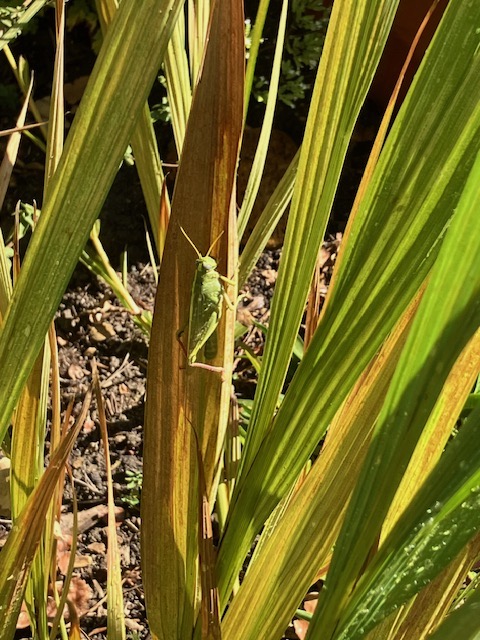
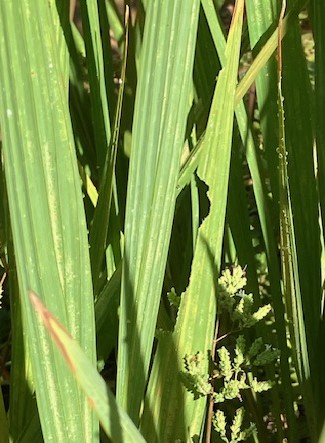
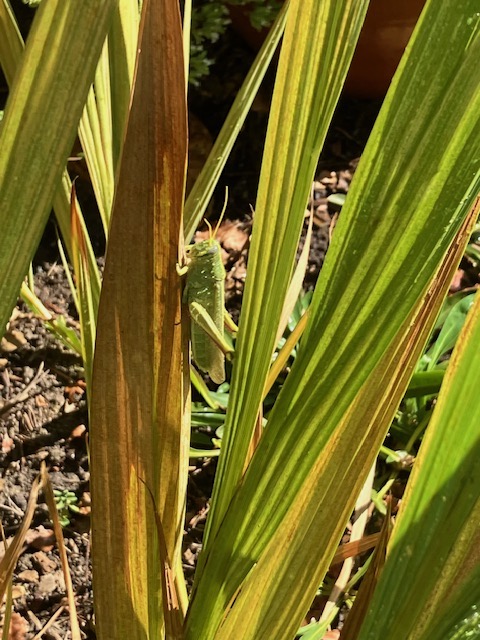
One day I was startled by a bright green monster, three inches long, chewing away at crocosmia leaves. I had seen a few small brown grasshoppers for the last month or so, but never yet a large green one. It had eaten big chunks out of many leaves. I had forgotten how much damage one grasshopper can do, especially one that big.

Fortunately, being the end of the season, I’m not worried about losing plants to grasshopper appetites. Early in the season I would have been more concerned about actively controlling them. At this time of year, a little pest tolerance is the answer rather than chemical controls, at least for me.
Grasshoppers start from eggs laid in the upper two inches of soil in elongated pods of 20 to 120. The eggs overwinter and once the soil warms, they hatch into nymphs, which closely resemble adults, but without wings. They may molt five to six times before becoming an adult. They soon mate and start laying eggs. A long mild summer like the one we just had can extend the period of egg laying and may lead to increases in grasshopper numbers next year.
High population outbreaks occur every eight to 10 years and may last two or three years. However, a warm spring followed by an extended period of cool damp weather after the grasshoppers have hatched can devastate their populations. There is only one generation per year. They die out after two to three months or when the weather gets cold.
Grasshoppers, starting with the nymphs, eat just about anything, but prefer young green plants, often vegetables. They move on as they deplete food supplies. According to University of California, Davis (UC Davis IPM), “Adults may fly 15 or more miles a day in large swarms during migrations.”
They are difficult to manage. They will eat through row covers, both plastic and cloth, if they are hungry enough. Sometimes planting a lush trap crop around a garden can help divert them from veggies or flowers. When populations of migrating grasshoppers are high, “there is almost nothing you can do to protect plants once the invasion has reached the garden” (UC Davis IPM). I usually try to catch them and squash them, leaving their bodies for the birds. Birds, especially chickens, will eat the live grasshoppers too. Blister beetles feed on the eggs. There are also diseases and parasites the kill these pests.
Oh, more joys of gardening!
— JoAnne Skelly is an Associate Professor and Extension Educator, Emerita, University of Nevada Cooperative Extension. She can be reached at skellyj@unr.edu.