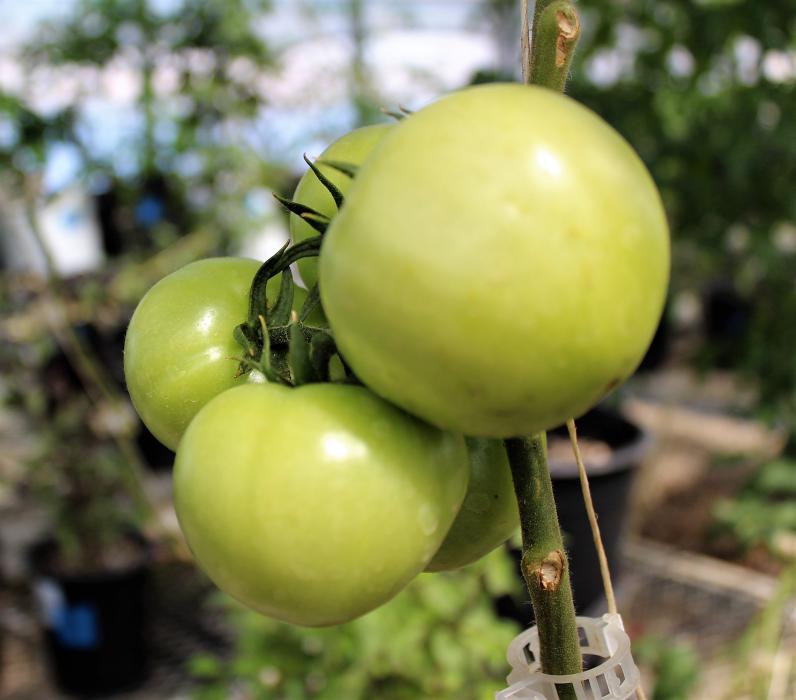
When our tomatoes aren’t thriving, we worry. Are you noticing issues on the bottom of your tomatoes such as blackened leathery spots or lumpy crevices and puckering? The first is blossom end rot (BER). The second is called catfacing. Or are you seeing cracks or splits at the top of tomatoes?

BER is not a disease, so, although ugly, the unaffected parts of the tomato are still edible after cutting away the blackened part. This fruit disorder is directly related to soil moisture and the delivery of soil calcium from the soil water. BER is common when plants grow rapidly early in the season.
It is exacerbated by our windy, dry weather. As plants grow, they need more water, especially while the fruits are developing. If soil gets too dry or too wet, roots can’t absorb the water or nutrients they need because moisture fluctuations reduce calcium uptake. This means plants can’t grow properly. Hoeing too close to the plants may also contribute to BER because it can damage or cut shallow feeder roots preventing them from absorbing adequate moisture.
While the addition of lime (calcium carbonate) is often recommended for BER, Nevada soils are already high in calcium so adding lime is NOT the answer. Lime makes soil more alkaline, and most Nevada soils are too alkaline to begin with. Foliar applications of calcium are of little value.
Catfacing disorder is where the fruit is deformed and distorted particularly on the blossom end. It may look like a cat’s face. There may be dark scar tissue, possibly with holes in it. It can be caused by cold weather (below 52 degrees) during early stages of growth and blossoming, by extreme fluctuations in day to night temperatures, or even by extreme heat during growth and ripening. Excessive nitrogen often increases this problem.
Cracks and splits on the top of a tomato are due to rapid or extreme changes in soil moisture. This causes the fruits to expand more quickly than the tomato skin can grow. It can also occur when there have been wide differences in temperatures from day to night. When cracking occurs in green tomatoes, fruits are likely to rot before they fully ripen. A solution is to harvest fruits before they begin to rot, then let them ripen indoors. Although unsightly, fruits are edible.
Keep plants evenly watered from planting to harvest. Avoid underwatering. Mulch two feet around the plant to conserve soil moisture. Use slow-release or organic fertilizers. And pray to the gardening gods!
— JoAnne Skelly is an Associate Professor and Extension Educator, Emerita, University of Nevada Cooperative Extension. She can be reached at skellyj@unr.edu.