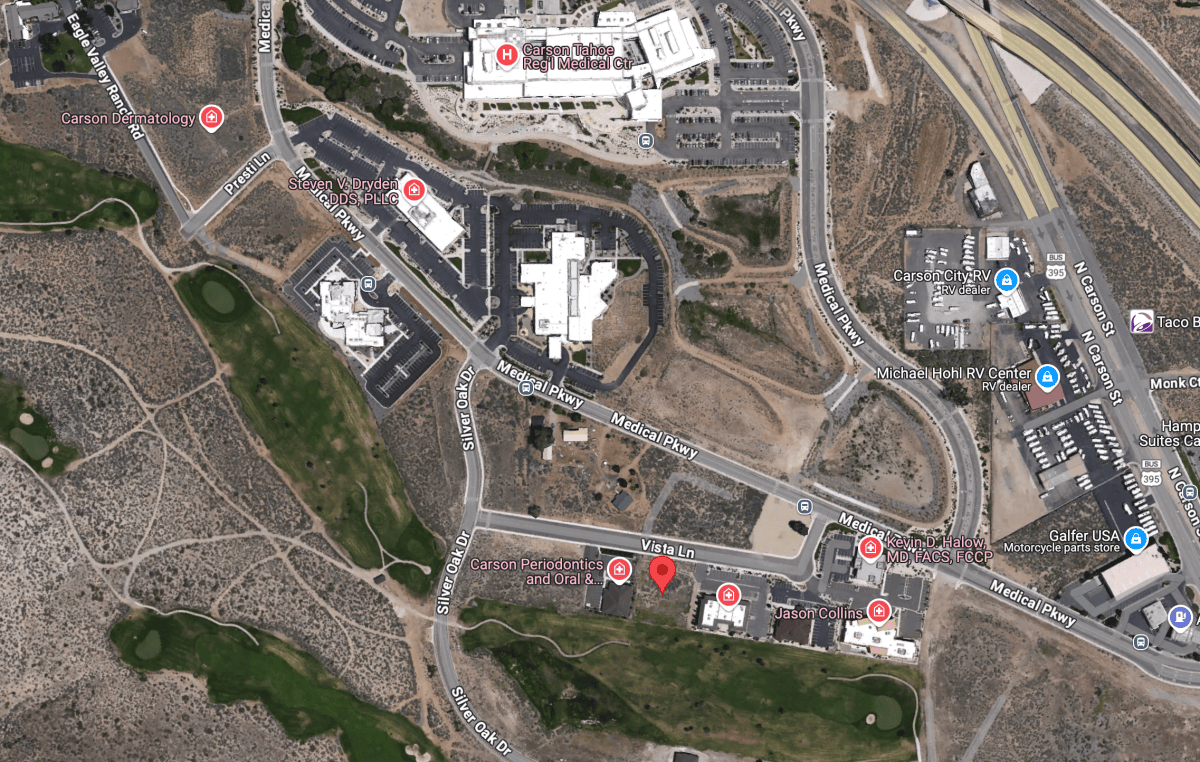
In October, the Carson City Planning Commission approved an application by Vitality Unlimited to construct and operate a residential substance abuse treatment facility in the north end of town at 1625 Vista Lane.
Following its approval, three parties submitted appeals to the Board of Supervisors stating the approval was made in error, as the categorization of the facility as “congregate care” does not meet the state law definition, and it could have potential detrimental effects on nearby businesses.
At 5:30 p.m. Thursday, Carson City Supervisors will convene to discuss three appeals on the Planning Commission’s approval of a proposed congregate care housing facility on a property zoned Retail Commercial at 1625 Vista Lane.
Vitality Unlimited applied for an SUP to construct and operate a 36-bed, 9,200 square foot residential substance use and co-occurring disorder treatment facility on the property. Per Carson City code, congregate care housing is a conditional use in the RC zoning and requires an SUP. On October 30, 2024, the Planning Commission approved the SUP and following that approval, three appeals were submitted from: (1) Michael Hartman; (2) Bauerle Syndergaard Wilcox Periodontics & Oral Surgery PLCC; and (3) Emerald Farms LLC, LTE 1525 LLC, and Edward and Roxy Benoit.
In his appeal, Michael Hartman argued that a residential substance use facility should not be allowed at the property because the surrounding offices are typically medical in nature, which would probably have “controlled substances such as painkillers,” and a substance use facility in the area will also be a deterrent for visitors and residents who wish to visit the “high-end golf course which brings visitors to our city and allows our residents to engage in a challenging course.”
He also said that residents enjoy engaging in outdoor activities, which he believes will “decrease dramatically” if the facility is allowed to operate. He believes that allowing the facility will lead to an increase in crime, the “inevitable migration of individuals loitering near the facility, used needles littering the nearby areas, and a general refuse from this increased activity.”
In the second appeal from Bauerle Syndergaard Wilcox Periodontics & Oral Surgery PLCC, an attorney retained to represent the business argued that a treatment center is “not actually a ‘congregate care housing’ under [City Code], and is therefore not a permitted use” for the zoning. The attorney went on to say that because Vitality states they operate a comprehensive treatment program it does not count as congregate care housing. They also argue that the facility would not be compatible with the integrity of the neighborhood, and would be detrimental to surrounding properties.
According to Carson City Municipal Code:
“Congregate care housing” means a dwelling providing shelter and services for people, which may include living and sleeping facilities, meals, eating assistance, housekeeping, laundry services, dressing, room cleaning, medication reminders, nursing care, related medical services and personal care. Such facilities may also provide other services, such as counseling and transportation for routine social and medical appointments.
However, according to the attorney, under state law Congregate Care does not include a recovery house for persons recovering from alcohol or other substance use disorders.
The attorney further argues that the facility should be referred to as a halfway house, which is not an approved use for RC zoning and, therefore, commissioners made an error in approving it for the zoning.
In the third appeal, an attorney retained on behalf of Edward and Roxy Benoit similarly argued that a facility treatment center is not the same as a congregate care facility and therefore, the SUP was approved in error. They similarly argue that the facility will be determinate to nearby properties and residential homes.
The applicant responded to the appeals, stating that Vitality Carson City (VCC) “level of care and operations are in no way equivalent to either Mallory Behavioral Health Crisis Center or a ‘halfway house’.”
They state that VCC already operates a 25-bed residential treatment center on the second floor of the Carson City Health and Human Services Building, and does not advertise that they are a substance use treatment facility, which would be the same at the new facility. They have operated there since 2012.
Applicants for the facility are screened for “appropriateness for the level of care VCC provides,” and that individuals must apply. Any applicant with a history of violence or arson is not admitted.
The Carson City Sheriff’s Office has reported no increase in crime or disruption associated with VCC. Carson City Health and Human Services Director Nicki Aaker stated she has no concerns for residents who utilize the clinic, and staff for VCC said they have never felt concerned for their personal safety.
They said clients are not allowed to have visitors during their stay, and that the facility is non-smoking and if they need to leave the facility, such as for a medical appointment, must undergo drug testing.
The proposed facility is a closed-campus, meaning residents are not able to leave the facility. The plans include an enclosed courtyard.
Supervisors will hear from the appellants as well as the applicants, and will need to decide whether or not the Planning Commission erred in their approval. They cannot hear any evidence that was not presented to the Planning Commission at the time of their approval.