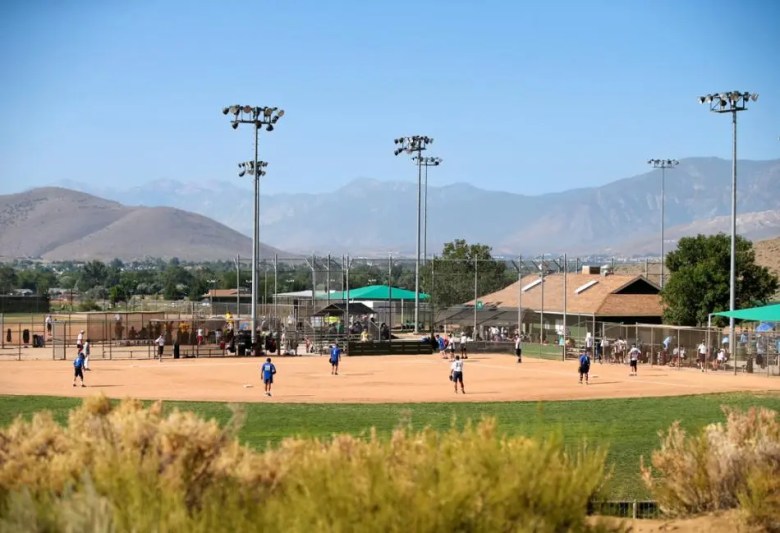
Carson City Supervisors approved a contract Thursday to convert grass fields to artificial turf in the upper softball fields within JohnD Winters Centennial Park.
The decision to swap turf for grass has been controversial in the past due to the heat turf can absorb and put off, but staff also believes it could save around 8 millions of water each year currently used for irrigation. However, for this contract approval, there was little input from the community according to supplemental meeting materials.
The planning for Centennial Park changes have been ongoing for a few years now, as has the plan to swap for turf: back in March, supervisors also approved encapsulated rubber to use as infill material beneath the artificial turf over safe shell, olive pits, tumbled wood, cork, tire crumb rubber, and coconut.
At that time, concerns were raised over the heat element of both the turf and the rubber infill beneath.
According to the National Recreation and Park Association, studies have found that the surface temperature of turf was on average 37 degrees higher than asphalt and 86.5 hotter than grass fields, and that any temperature over 120 degrees can cause skin burns with skin contact in two seconds.”
A Utah-based investigation by KSL news showed that in 83-100 degree weather, the turf at nine parks and high schools ranged from 146 to 186 degrees. At one park where the outside temperature was recorded at 112 degrees, the play area turf reached 190 degrees.
However, across the nation more and more school districts and parks are switching to turf for a number of reasons: you can play on it year round as opposed to real grass that may get muddy or need seasonal recovery; it provides an optimal surface that (typically) isn’t subject to bumps or divots; and it saves significantly on both irrigation and maintenance costs.
With a warming climate and hotter spring and summer seasons, however, many school districts across the US adopted rules or general guidance for student athletes relating to heat exposure from turf fields.
The Utah High School Activities Association developed a specific day-by-day requirements regarding heat-acclimatization to allow students to develop heat tolerance for practice and games.
A Maryland district developed heat guidelines for all of its artificial fields including:
- Anytime the outdoor temperature exceeds 80 degrees, coaches exercise caution in conducting activities on artificial turf fields.
- When outdoor temperatures exceed 90 degrees, coaches may hold one regular morning or evening practice (before noon or after 5 p.m.).
- When the heat index is between 91–104 degrees between the hours of noon and 5 p.m., school athletic activities are restricted on artificial turf fields to one hour, with water breaks every 20 minutes.
City departments such as those in New York and Connecticut placed signage on their artificial turf parks warning of heat and heat exhaustion, and in the case of Westport, Connecticut prohibited all eating and drinking on or near the fields and encouraged players to immediately shower after contact with the fields due to concerns over “dust” consumption, listed as plastic microfibers.
While artificial turf seems as popular as ever for many municipalities and districts, In the past few years, there has also been a complete 180 for multiple cities.
According to the Sierra Club, a grassroots environmental advocacy group, cities from California to Massachusetts have begun complete ban on all synthetic turf installations after reports began coming in that all artificial turfs contain high levels of toxic PFAS—also known as “forever chemicals.”
The EPA said PFAS exposure is linked to “harmful health effects in humans and animals” and is giving states and cities until 2029 to come into compliance with limiting PFAS exposures in drinking water.
In 2023, Supervisors approved an agreement with Visit Carson City to provide a percentage of room tax revenue which will be used to repay $5 million in general obligation park bonds for the project over a 21 year time period.
The park project also includes a new maintenance yard shade structure, a shock absorption underlayment mat, 35 trees on the south and southwest permitter, and a retaining wall.
Construction is slated to begin in October.