Flock cameras were first approved in Carson City in July 2023 for an initial subscription cost of $148,000 per year. There has been relatively little commotion about the cameras that can be spotted on poles throughout town — until recently, that is.
What you’ll find below:
In this Carson Now Explains, we examine what Flock cameras do (and what they don’t), what information the system collects and who can access it, why residents have raised privacy and data-handling concerns, and what safeguards Carson City says it is putting in place. We also look at documented cases of misuse elsewhere, changes Flock is making nationally, and the lack of statewide rules governing license plate readers in Nevada.
Carson City Sheriff Ken Furlong has little trouble explaining why his office values automated license plate readers. They can alert deputies to stolen vehicles, help investigators find missing people and provide leads when police are trying to identify a vehicle connected to a serious crime.
But Furlong also acknowledges that the same technology can create a different concern for the people driving past its cameras.
“The value is there,” Furlong said. “But that value is impacted by trust.”
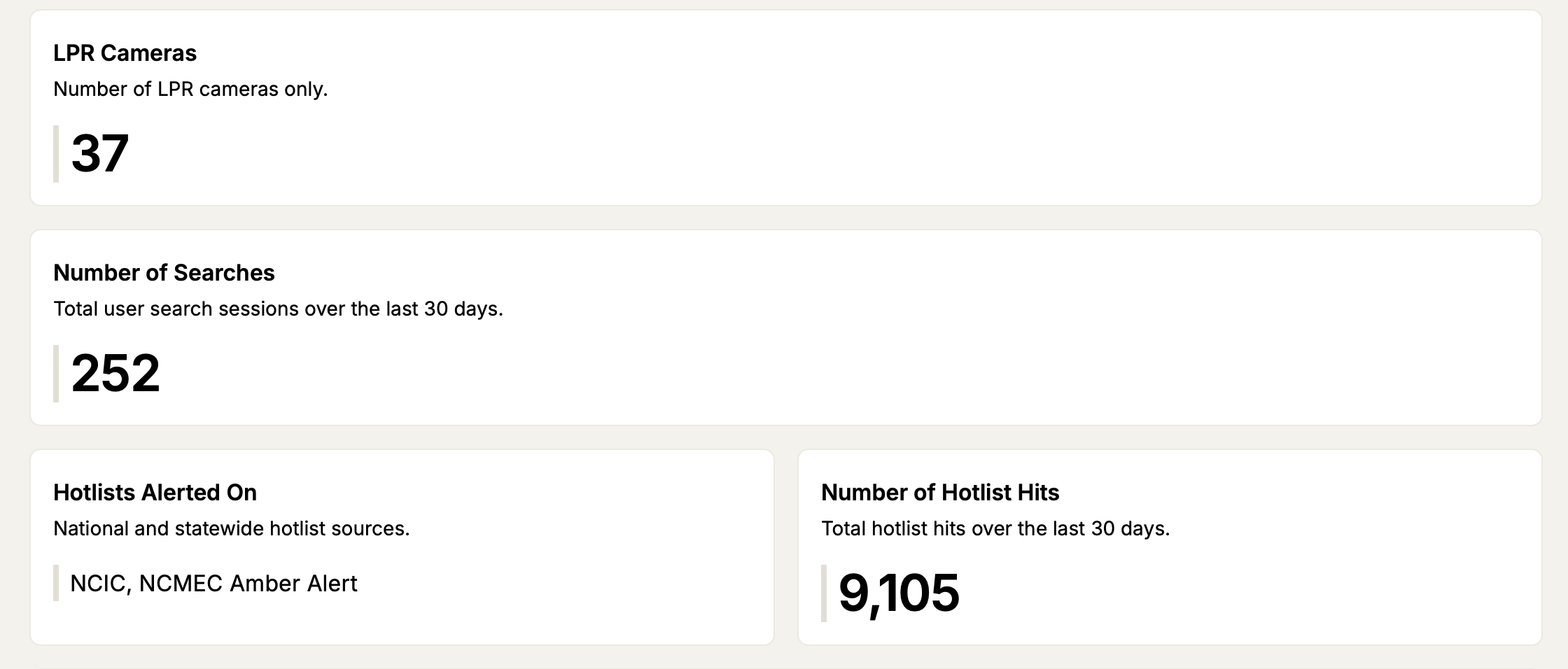
That tension between a technology law enforcement says can quickly produce investigative leads and a system critics say can create a searchable record of ordinary people’s movements is playing out both nationally and in Carson City, where 37 Flock Cameras currently operate.
As of Friday, the Carson City Sheriff’s Office’s newly public Flock transparency portal listed a 30-day data retention period and 252 user search sessions over the previous 30 days. The portal also reported 822 camera alerts during that period and 9,105 “hotlist hits,” a figure that represents detections against alert lists rather than a count of arrests or solved cases.

The Sheriff’s Office announced the transparency portal Friday, aiming to show residents how cameras are used, how long information is retained, what policies govern searches, and how data can be shared with other law enforcement agencies.
The move comes as Flock faces heightened scrutiny around the country over the reach of its network and documented cases of law enforcement personnel using license plate reader systems for unauthorized purposes. Coincidentally, on Thursday, Flock also announced a series of new privacy and security controls, including a shorter default retention period, mandatory case codes for searches and automated efforts to identify unusual search behavior.
What Flock cameras actually do
Automated license plate readers, commonly called ALPRs or LPRs, are not unique to Flock, who is a vendor providing the ALPR cameras, technology and its searchable database.
The technology itself has been used by law enforcement for years — including in Carson City.
Furlong said ALPR technology predates the city’s Flock contract and has been used in some form by his agency since around 2010.
At its most basic, an ALPR system uses cameras and software to photograph vehicles, uses technology to read license plates, record information such as the time and location of the sighting, and compare plate numbers against databases or “hotlists” of vehicles of interest to law enforcement.
Flock’s system can also classify visible vehicle characteristics, including make, model and color.
In Carson City, cameras can generate real-time alerts when a vehicle is associated with sources including the FBI’s National Crime Information Center or a National Center for Missing & Exploited Children Amber Alert.
That can change how quickly an officer becomes aware of a vehicle.
At its most basic, an ALPR system … photographs vehicles, uses technology to read license plates, records information such as the time and location, and compares plate numbers against databases or “hotlists” of vehicles of interest to law enforcement
Instead of a deputy manually entering plate after plate into a police database, the camera does the initial reading continuously. If a passing plate matches a hotlist entry, the system can notify law enforcement.
But according to Sheriff Furlong, the policy in Carosn City requires deputies to verify an ALPR response through the Nevada Criminal Justice Information System before taking enforcement action based solely on the camera alert. The transparency portal similarly says a human must verify a hotlist alert before police act on it.
What the cameras are not
The Carson City system is also more limited than some residents may assume when they hear the terms “AI camera” or “surveillance camera.”
According to the Carson City Sheriff’s Office, Flock cameras do not use facial recognition, collect cellphone records or device information, or classify people by race or gender. The cameras collect images and information about vehicles and license plates.
However, it’s important to note that this does not mean humans are never caught on the cameras — if an individual is walking past when the camera snaps a photo of a vehicle, then that individual could also be in the photo.
They also are not red-light or speed-enforcement cameras. According to Carson City’s published policy, using the system for traffic-infraction enforcement, along with harassment or intimidation, personal use and searches based solely on protected characteristics such as race, sex or religion is prohibited.
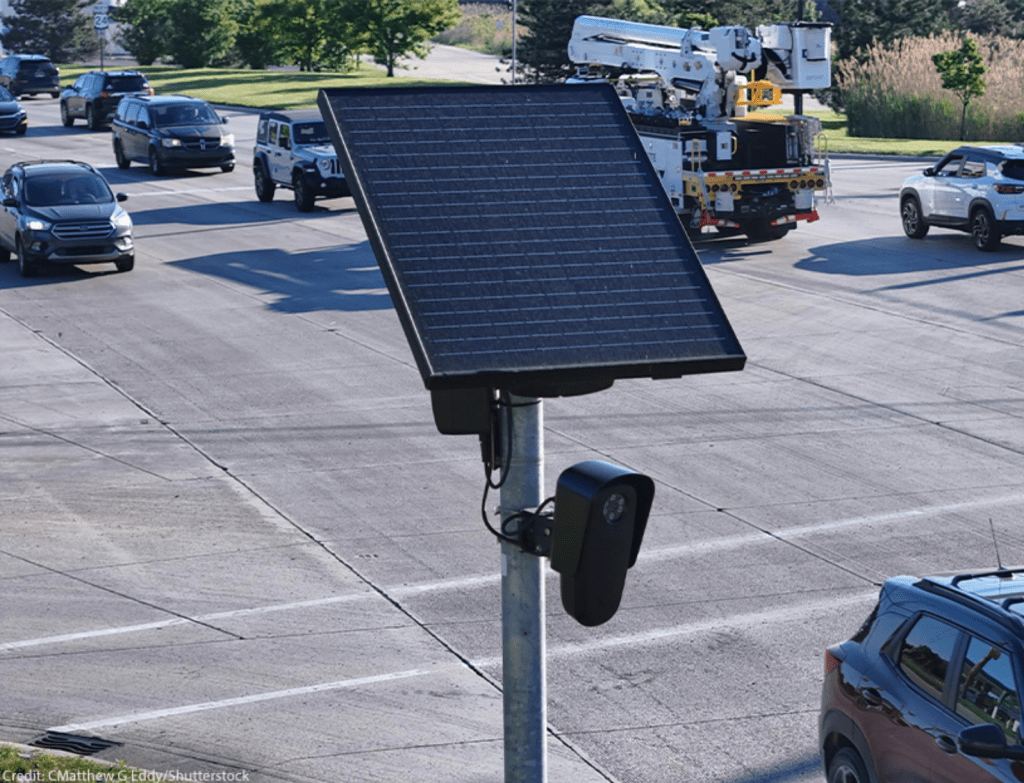
And a license plate image, by itself, does not contain the registered owner’s name, address or other information typically found in law enforcement or motor vehicle databases.
At an April Board of Supervisors meeting, Sgt. Brett Bindley of the Sheriff’s Office Investigations Division told supervisors that obtaining additional identifying information requires a separate law enforcement query.
However, that does not mean ALPR data is anonymous in a broader sense.
A plate number can be connected through other government records to a registered vehicle owner. And because each camera sighting is associated with a place and time, repeated sightings can show where a particular vehicle has been.
That ability to turn many ordinary observations on public roads into a searchable history is at the center of the privacy debate.
Furlong drew the same distinction in his interview, emphasizing that the Flock camera is recording the vehicle and plate, while access to other law enforcement systems can connect that information to a person.
He said the technological capability is not his primary concern: “It’s the human side.”
Why some residents are concerned

License plates are displayed in public, and a police officer standing alongside a road could see and write down a plate number.
ALPR systems change the scale of that observation.
Flock operates more than 120,000 cameras nationally, according to the company, and thousands of police agencies across 49 states can use the system to search or share data across jurisdictional lines when agencies enable those permissions.
The American Civil Liberties Union (ACLU) argues that the scale and searchability of those records can allow law enforcement to reconstruct patterns in a person’s movements, even though the technology does not use facial recognition.
The organization has called Flock’s system a “form of mass surveillance” and has advocated for substantially tighter limits on ALPR collection, retention and access.
The dispute is … more about what can be learned from a large collection of vehicle captures, who is allowed to search those records, and what prevents an authorized user from doing so for nefarious means.
Flock has rejected arguments that it is designed to monitor individuals. The company says agencies own their data, decide who can access it and control which other agencies may search it. Carson City’s portal likewise says the city owns its data and does not sell it to third parties.
Since Flock was first approved as a vendor a little over three years ago, representatives of the sheriff’s office have maintained that the data is Carson City’s, not Flock’s, and that Flock is merely a vendor. If Flock as a company became ineligible as a vendor in Carson City, there are multiple other vendors who provide nearly identical services that could be contracted with instead.
The dispute, then, is less about whether the cameras secretly recognize faces — Furlong says they do not — and more about what can be learned from a large collection of vehicle captures, who is allowed to search those records and what prevents an authorized user from doing so for nefarious means.
What data does Flock collect, and who does it share it with?
Flock states publicly that customer data is owned by the customer (in this case, Carson City) and data is not sold to third parties. However, that does not provide the full picture of what data Flock has access to, and who it shares it with.
According to Flock’s legal documents, its system collects license plate photos, vehicle descriptions, dates, times and locations, and it records who searches the system, when and why.
Carson City owns the data collected on its behalf, but Flock’s agreement gives the company a perpetual license to use and disclose that data to provide its services and to improve its products, permission which continues after the contract ends.
Flock’s terms list its associated property to include its algorithms, data models, machine-learning methods, derivative works, analyses, reports and other results generated through its services.
Flock states it does not sell or disclose data for commercial purposes, but outside companies still process data as part of providing contracted services to Flock. Who these companies are, or what data they are granted access to, is not disclosed publicly.
Flock’s privacy policy also states Personal Data may be shared with affiliated and unaffiliated service providers, including companies providing information technology infrastructure, cloud storage and analytics. Flock’s vendor agreements allow those companies to use additional subcontractors, or “subprocessors,” under data-protection requirements imposed by Flock.
The agreements restrict vendors from selling data for their own purposes, combining it with unrelated information or using Flock Personal Data to train their own AI models.
Flock also says some photos — less than 1% — are used to train its AI, though they are stripped of metadata. Policies do not state how long that training data is kept or whether customers can opt out.
What Carson City says it is doing about privacy
Furlong said the national debate and the concerns raised locally have shown him that simply telling the public to trust law enforcement is insufficient.
“No one can escape the concern that the public has over their privacy,” he said. “That’s at the top of my list: I believe we must protect people’s privacy.”
The Sheriff’s Office says only authorized, trained personnel may use the system for legitimate law enforcement purposes. Its policy requires approved training before accessing ALPR data, restricts use to official law enforcement business and requires access to be logged.
The public portal says an investigative reason must accompany a search and is recorded in the system’s audit function. Access records are retained indefinitely. The Sheriff’s Office says misuse can result in internal discipline and potentially civil or criminal consequences.
At the April meeting, Bindley told supervisors that Carson City already requires a case number, an underlying crime, a lawful purpose and training before a user could search the system.
He said the agency conducts regular audits and that detectives, dispatchers and real-time information personnel are among the regular users, while patrol access is more limited and generally tied to time-sensitive circumstances.
‘The people have entrusted us to enforce the law, they did not entrust the system to be abused.’
Prior to Carson Now reaching out for an interview regarding Flock, Furlong and his team were already months into a plan to roll out an additional internal audit of the system to improve public transparency.
“We must protect people’s privacy, period,” Furlong said. “The people have entrusted us to enforce the law, they did not entrust the system to be abused. For me, there is zero tolerance when it comes to privacy violations.”
Furlong said that this concept is not unique to Carson City, but that all of Nevada’s Sheriffs and Chiefs are in agreement about the need for additional safeguards when it comes to the privacy of Nevadans.
The most immediate change was, by default, Flock allows the selection of “other” as a justification for why someone has utilized the system. During their review, Furlong said they removed it immediately.
“’Other’ is not transparent; it’s not a justification,” he said. “It shouldn’t even be in there [Flock’s default system].”
In addition, they have been working to bring in a volunteer outside auditor to independently review the systems periodically and make sure the agency’s use of the technology meets the standards of justification.
“I believe we need added safeguards,” he said, particularly against “humans acting inappropriately.”
Furlong said that they would not be publicly releasing the name of the individual for the sake of their privacy, but Carson Now confirmed the individual and their affiliation. Or, more importantly, their lack of affiliation with law enforcement.
‘Policing the police’
When bringing in an independent auditor was discussed, Furlong said what was the most critical aspect of the review was that the auditor should have no affiliation with the sheriff’s office or law enforcement in general.
He said what’s needed most is to establish a true, independent layer of accountability, describing the role as “an auditor policing the police.”
“I think that there would always be some level of distrust if it’s ‘cops looking at cops’,” Furlong said. “This is a great opportunity to really look at what we’re doing and to ask, ‘are we doing it right?’”
Furlong said when it comes to building public trust, it all boils down to removing ego, not having arrogance, and being open to listening.
That doesn’t mean that the loudest citizen in the room will get their way, but it means that it’s every public servant’s duty to hear what the public’s concerns are and evaluate them.
“I’m doing things because I know they’re right, otherwise I wouldn’t be doing them,” Furlong said. “But that doesn’t mean we can’t improve. That’s why it’s important to have outside perspectives — there might be a better way of doing things, we just haven’t seen it yet.”
In addition to the independent auditor’s role, the Flock Transparency Portal also recently launched on the Carson City Sheriff’s Office website, which gives the public the opportunity to see how often the Flock system is being utilized, and what the listed justifications are.
Alongside the camera count (37) and retention period (30 days), the portal contains agency policies regarding Flock, usage statistics, descriptions of prohibited uses and information about data-sharing relationships. It also provides a downloadable spreadsheet of recent searches.
Local concerns and arrests for tampering
Data and access concerns have been raised publicly in Carson City, both to local leaders as well as across multiple social media forums.
When supervisors considered renewing the Flock contract in April, a resident questioned whether the city could justify privacy concerns through evidence of the system’s effectiveness. He also raised concerns about tracking vehicles belonging to people who were not suspected of crimes.
Another commenter, Lucia Maloney, told supervisors her own vehicle had been photographed 265 times in a 30-day period.
The Board of Supervisors ultimately voted 5-0 to renew the agreement for two years at $122,500 per year, or $245,000 total. During that discussion, Mayor Lori Bagwell and supervisors also raised their own questions about privacy, data ownership and auditing.
While Flock has been operating in Carson City since 2023, over the past several months, a negative public sentiment nationwide has been growing — including in the capital city.
Across a number of social media platforms and posts, resident sentiment is almost entirely negative towards the cameras with many comparing them to “Big Brother” in the famous dystopian novel 1984.
These concerns have also lead to a number of residents who, like Higson and Maloney, want to determine firsthand how many times their vehicle has been captured by Flock, and have filed record requests to do so.
Those commenters in favor of Flock have defended the cameras as a useful tool for finding stolen vehicles, investigating hit-and-runs and locating wanted or missing people.
Those against Flock call the cameras invasive and voice concerns over who can access the data — especially when it comes to the romantic partners or neighbors of individuals with access.
Backlash has occasionally gone beyond online debate. Three 20-year-old Carson City men were recently arrested in for shaking a pole supporting a Flock camera until the camera fell to the ground.
Just two days ago, This Is Reno reported another Flock camera had been taken down in Reno.
These incidents come amid a broader national anti-Flock movement in people have vandalized or disabled cameras, often posting their exploits online.
Furlong said that he has seen many of the concerns being expressed online — and that he, too, shares many of the same concerns about individual privacy himself.
National cases show why access controls matter
While Furlong says the Carson City Sheriff’s Office is preemptively working to create safeguards, concerns about human misuse of Flock systems is not a hypothetical.
The Associated Press reported Thursday nearly 50 instances in which police officers were charged with or accused of unauthorized use of license plate reader cameras were recently tallied by the Washington Post, many involving efforts to track current or former romantic partners or family members.
Six Savannah Police Department employees, including four officers, were fired just this week alone after accusations that the system was searched for friends and family or improperly accessed by an outside officer.
Cases of misuse are just one of the reasons why audit trails and restrictions on users have become central to the national discussion.
Furlong said he does not believe internal confidence in employees is enough on its own. You need to make the rules, searches and review process more visible.
“I’m never going to convince people that their [privacy’s] not being invaded,” he said. “What I am saying is that I am listening. We are all paying attention here, and we needed added safeguards to prevent humans acting inappropriately. So we upped our ante, we’re reviewing everything we have so that trust is built with the community.”
Flock is changing its rules, too
The company announced Thursday that it plans to make several safeguards mandatory nationally by the end of the year.
Flock said law enforcement searches will have to be tied to case codes, with emergency overrides flagged for review. Its “Audit Assistance” system is intended to detect abnormal search patterns, and users whose activity meets certain criteria can be automatically locked out pending review.
The company also said agencies will have more ability to determine which categories of investigations other jurisdictions may use to search their camera data.
Flock also announced that it is changing its recommended and default data retention period from 30 days to seven days. Specific records can be preserved as evidence for an active investigation.
That change will not automatically reduce any current customer’s retention period, however, including Carson City’s.
Flock says existing customers will keep retention periods already approved locally unless those communities decide to change them.
The ACLU said the shorter default could be a positive development but argued that Flock’s other changes do not resolve its fundamental objection to large-scale collection and police access to location records. The group also questioned how Flock’s new evidence-preservation feature will work, and whether agency-controlled restrictions will be sufficient.
Nevada has largely left the rules to local agencies
The debate is particularly relevant in Nevada because there is no comprehensive state framework specifically governing automated license plate readers.
The Nevada Independent reported in March that Nevada was not among 16 states with laws specifically addressing ALPR technology. Lawmakers from both parties had begun discussing concerns surrounding retention, sharing and the ability to follow vehicles across increasingly large networks.
At Carson City’s April meeting, Bagwell said she supported exploring legislation to create privacy protections across jurisdictions. Furlong said he had discussed the subject with Assemblymember P.K. O’Neill, and Supervisor Stacey Giomi raised the possibility of working through the Nevada Association of Counties.
During his interview with Carson Now this week, Furlong said that he would prefer common protections rather than radically different standards depending on which Nevada jurisdiction a driver enters.
“The protections should be the same no matter what county you’re in within the state of Nevada,” he said.
Until statewide rules are adopted, much of the practical protection surrounding the technology comes from individual agencies deciding who can search the systems, how long data is kept, what other agencies can access it and how misuse is detected.
Through their new transparency portal, audit systems, and justification requirements, the Carson City Sheriff’s Office is aiming to remove the potential for abuse, while still being able to utilize a system that has shown to be useful in their work as a law enforcement agency.
“All of these things,” Furlong said, “are critical to the public’s trust in law enforcement.”