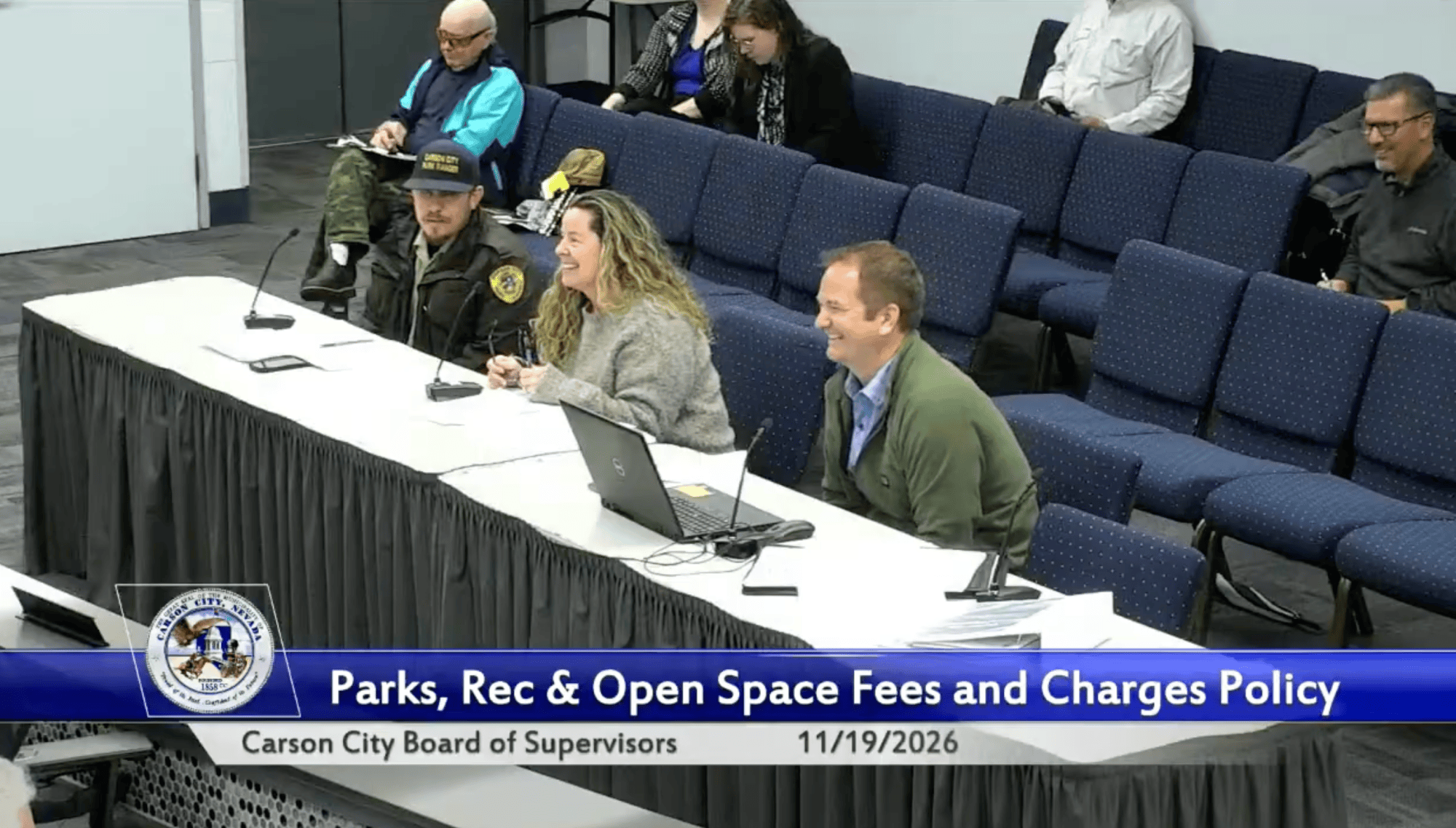

Carson City Supervisors heard two significant policy change requests from the Parks, Recreation and Open Space Department on Thursday. The first related to not only increasing program fees, which have failed to keep up with rising costs, but adjusting who is authorized to change the fees going forward.
The changes requested authorization to be shifted from the Board’s oversight to either the Parks and Recreation director, city manager, or staff to modify certain fees relating to recreation facilities, youth programming, rentals, and more.
The board ultimately continued the item and directed staff to revise several provisions of the policy, and to provide a full financial analysis when they return.
However, it was not a flat denial: Supervisors agreed that, if the department establishes entirely new programs, they should be able to also set whatever fees were associated.
“That way it doesn’t tie your hands if something the next pickleball phase comes along, or whatever that may be,” Supervisor Stacey Giomi said. “We don’t want to not allow our citizens to participate in it.”
They were also not against increasing fees — so long as they could provide evidence to the public showing the need.
Supervisors discussed bringing the policy back as early as next month, with proposed increases at the Carson City Rifle and Pistol Range addressed separately during the upcoming budget process.
Proposed fee changes
Pool: Among the proposed changes, adult daily admission at the Aquatic Facility and Multi-Purpose Athletic Center would increase from $5 to $6, while adult annual memberships would rise from $315 to $378. Family daily admission would increase from $14 to $17.
Camp Carson: Camp Carson’s weekly summer camp fee would rise from $125 to $170. The Capital Kids before-school program would increase from $25 to $30 per week, while after-school care would rise from $50 to $60. An eight-lesson group swimming session would increase from $44 to $56.
Rentals: The proposal also establishes new fees for certain pool rentals, park activities and outdoor equipment rentals, along with a 10% asset management fee incorporated into most services to support future repairs and preservation of recreation facilities.
The rifle range and Lone Mountain Cemetery would be excluded from that provision because they have separate funding mechanisms.
Direct cost increase: Supervisors also questioned a proposed 10% markup on certain program purchases, including camp shirts and field trips. Staff said the additional charge was intended to cover administrative work associated with those purchases.
However, supervisors said they’d rather pass along direct costs instead — with reasonable rounding permitted — rather than apply a percentage markup.
Definition of a ‘Family’

Another point of discussion was how the city should define a family for discount purposes.
Staff suggested creating a city-wide singular definition of “family” for the purpose of qualifying for a discounted family pass. Their proposed definition was two adults and three youth under the age of 18 (children 3 and under are always free).
Currently, there are different definitions of “family” when it comes to discounts, which is what staff hopes to streamline.
At the pool and the MAC, family passes cover four individuals, which is not limited to any adult vs. youth ratio. Currently, a family pass is $14, versus a single adult drop-in cost of $5 and a youth drop-in cost of $4.
The rifle range defines family as two-adults and three-youth; $75 per year for in-state residents, and $150 for out-of-state residents.
However, Earp and Budge said that staff is either struggling currently with individuals taking advantage of the current language to secure group discounts, as well as trying other get ahead of situations in which it could be taken advantage of. The end goal, they said, is to create consistency and efficiency.
Earp did not provide specifics on the issues they are facing, but said that it is “mostly at the rifle range” versus at the pool/MAC, and that people have been “very creative” while attempting to secure group discounts at the range.
In a follow up, Earp explained that because there are inconsistencies between city departments on the definition of “family,” it has caused been a source of confusion for staff, leading to the current policy not being enforced consistently across sites.
“We’re proposing to extend [the Rifle Range’s] definition to our other facilities so that we are consistent across the board,” Earp wrote. “We aim to correct [inconsistencies with enforcement] while being consistent at all our facilities.”
Supervisors initially suggested a definition of adults and their children living in the same household, but staff voiced concerns over significant amount of staff time being dedicated to verifying addresses, whereas setting the limit to a specific number of adults and children would have a streamlining effect. They explained that a numerical limit also helps prevent unrelated groups, or large families who do not live in the same household, from using family discounts.
Other supervisors also said that leaving it defined as adults and their children could open it up for seniors and their adult children all living in the same home (though this has been and is the current policy conditions for the pool and MAC).
“I would still suggest an age limit, whether you live in a mom and dad’s house in the basement in your pajamas, if you’re thirty years old, you’re not eligible for the family discount,” White said.
However, supervisors questioned why larger families would have to pay separately for a fourth child, and while they generally supported the number of adults being limited to two, they did not settle on a maximum number of children.
Prioritizing Carson Kids

The discussion extended to how Carson City residents should receive priority for popular youth programs without imposing higher fees on participants from neighboring counties.
Staff noted that some families living outside Carson City use its programs because their parents work locally, including city employees who depend on summer camp for child care.
Rather than creating separate nonresident fees, supervisors supported exploring an earlier registration period for city residents, which has been piloted successfully for the popular ski program.
Earp said Carson City residents received first-priority registration, while non-Carson residents could sign up four days later for any remaining spots. Supervisors generally thought this a good solution, especially for programs that quickly fill up like Camp Carson.
Possible discounts for seasonal recreation employees with children enrolled in city programs were also discussed, but no agreement was reached.
The “Why”
According to Parks and Recreation Director Jennifer Budge, the existing fee policy was adopted in 2020 and last revised in 2023. The latest proposal follows a December 2025 joint discussion by the Parks and Recreation Commission and Open Space Advisory Committee and a February recommendation from the Parks and Recreation Commission.
Budge said the department put “a lot of time, effort, thought, and market analysis” into the proposed changes.
According to the staff report, the proposed increases are intended to help programs meet established cost-recovery goals and offset rising operating expenses, including credit card processing and registration software fees. Although the packet lists the proposed rates, it does not provide a breakdown showing how staff calculated each increase.
“Cost recovery” in this context means the share of a service’s cost paid by the direct user through fees or charges rather than by the general public through taxes.
Different cost-recovery targets are set depending on the service provided. General public amenities receive greater taxpayer support, while specialized recreation programs and services benefiting individual users are expected to recover more of their operating expenses through fees.
Recreation Superintendent Dan Earp said the Aquatic Facility currently recovers approximately 26% of its costs, which is within its established target of 10% to 49%. Certain sports and youth programs, however, are operating below their goals.
Supervisors requested a more complete breakdown of how programs are performing against those targets and how the proposed increases were calculated.
Earp said staff also considered whether higher prices could discourage participation. Although the department does not have a detailed economic analysis predicting that effect, Earp acknowledged that higher fees could potentially discourage participation, but said past increases have not produced a noticeable decline.
“When we have changed our fees in the past, we haven’t seen a decrease … significantly that’s come to our attention,” he said.
Who can change fees?
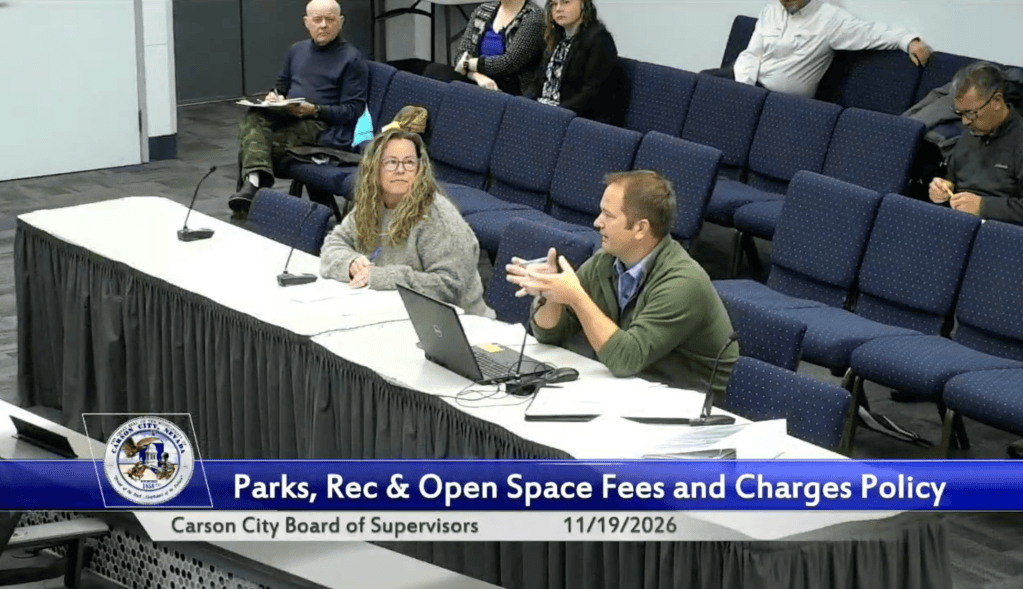
The discussion also focused on proposed provisions allowing department administrators to establish or modify charges without returning to supervisors.
Supervisors Giomi and Maurice White questioned language giving varying degrees of authority to the parks director, city manager and other staff, arguing that changes to board-approved fees should remain subject to board approval.
They supported allowing administrators to establish fees for new programs and adjust charges when outside providers increase costs, such as American Red Cross certification fees, ski trips or contracted sports officials.
“You can consult with the city manager, come up with a fee, implement it, but if you change anything that we’ve approved, it has to come back to us,” Giomi said.
White added there needed to be consistent procedures throughout the policy, rather than provisions assigning similar decisions to different officials.
“When you read this, sometimes it would come to the board, sometimes ‘the city.’ I mean what is the city? Sometimes it says the city manager, sometimes it says director and sometimes the language simply says staff will make adjustments,” he said. “I think a consistency of process is just as important as consistency in language.”
Staff agreed to revise the language and clarify the distinction between establishing new program fees and changing existing charges.
Supervisors said that as the public body, they want to retain oversight over any changes of fees that were implemented by the body, since they are the ones who will have to answer to the public.
“I don’t want to have a policy that I think I’ve approved, and I know what’s in it. But then somebody calls me about something and I say no, this is what we do, but they say, ‘no, you guys changed it,” Mayor Bagwell said. “And we don’t even know it’s changed.”
She added: “Any policies that we approve, it’s difficult when we just give that authority away to somebody else to change it, and then we as the board don’t see it again.”
Rifle and Pistol Range

Proposed increases at the Carson City Rifle and Pistol Range drew additional scrutiny after supervisors questioned whether current revenue justified higher admission charges.
Under the proposed schedule, daily admission would increase from $5 to $7 for Carson City residents, and $10 to $12 for nonresidents.
Annual resident passes would rise from $50 to $60, while resident family passes would increase from $75 to $90.
The proposal would also replace current pricing tiers for Nevada and out-of-state residents, to Carson vs. non-Carson residents.
Senior Park Ranger John Costello said the range has not increased its fees since 2020, despite rising operating expenses and most importantly: difficulty recruiting staff.
Costello reported more than $37,000 in expenses associated with the range’s automated payment kiosk over the past three years, including software maintenance, electricity, credit card fees, supplies and passcards. Costs for target stands and other materials supplied to users have also been increasing.
Staffing is another challenge. Costello said the range employs one full-time and five part-time staff members, with part-time range safety officers earning between $14 and $17 per hour.
The department hopes additional revenue could help support higher wages and improve recruitment, although those compensation changes would require consideration through the city’s budget process.
Costello provided a financial analysis, reporting the range recovered 50% of its operating costs in fiscal 2024, 47% in 2025 and approximately 48% in 2026, placing it at or near the upper end of its established cost-recovery range.
Mayor Lori Bagwell questioned raising fees to support possible future wage increases when the range was already meeting its current financial targets.
“I just don’t want one class or group treated differently,” Bagwell said.
She commended bringing the financials, but requested more detailed revenue and expenditure figures to determine whether proposed increases were necessary to maintain operations, or were primarily intended to support future personnel costs.
The discussion also addressed whether admission charges should remain unchanged while increases were considered for annual passes and group reservations.
Supervisors acknowledged the department’s recruitment difficulties but favored considering proposed ranger compensation increases alongside the corresponding fee changes during the budget process.
However, when Supervisors discussed postponing fee decisions until the budget cycle, Budge expressed concerns about postponing the entire recreation fee schedule until the budget is finalized.
“My concern about waiting for this whole thing to be approved, it’s already been a year since we did all this analysis, and we did this public outreach, then we’re putting it off again, and I’m worried about raising rates at the last minute, especially for the summer camp,” Budge said. “I don’t want to do that to families.”
Supervisors ultimately discussed removing the rifle range increases from the revised fee schedule for now, then reconsidering them alongside the department’s staffing requests during budget deliberations.
The board closed the item without a motion or vote. Staff was directed to return with a revised policy clarifying fee-setting authority, family and residency definitions, pass-through charges and other provisions, along with additional cost-recovery information.
You can view the full item during the meeting below:
(Rough time stamps: 27:00 – 1:30:00)