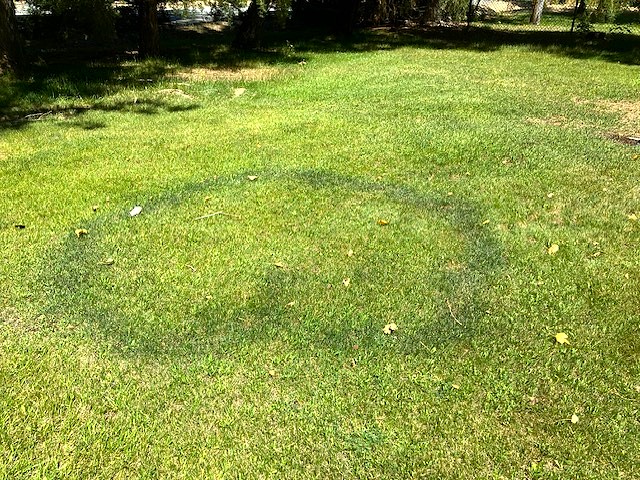
According to an old folk tale, a band of fairies has been dancing in my yard! They danced so vigorously they left a ring of dark green grass. Maybe you don’t believe in fairies, but isn’t that a more romantic notion than the fact that these rings are caused by fungi breaking down rotting organic matter?

Yes, there is a fairy ring in our lawn. I haven’t seen one here in a decade. The outside of the ring is dense, and a deep green, while the interior is thinner, shorter and much lighter. I’m glad it’s the green kind of ring rather than the brown, dry version that looks dead. No mushrooms in the ring at this point, but that may happen when the weather is cooler and wetter.
Fairy rings are caused by fungi feeding on decaying organic matter such as tree stumps, roots, or even leaves in the soil. Type one fairy ring makes the soil hydrophobic, preventing water from penetrating the soil. The grass dies from lack of water. Type 2 is the kind I have with efficient fungi breaking the organic matter down into nitrogen and feeding the lawn, at least temporarily. Type 3 is the kind with mushrooms, causing little damage or change in the lawn.
Connoisseurs of lush green turf are often offended by the fairy ring abnormality. “How could my perfect lawn be defaced like this?” they might ask. Basically, a fairy ring is a cosmetic problem until they become too big or too many. Ring sizes vary from a few inches to dozens of feet in width. Waiting for small ones to disappear may be the easiest management option. If a ring really bothers you, try core aeration to reduce the buildup of thatch (organic matter) that harbors the fungi. Or, in my case, I could finally apply that lawn fertilizer I keep writing about. That would help the overall grass match the green ring color. With the mushroom type remove the mushrooms by hand (with gloves on) or rake them up. Toss them in the trash.
Fungicides do not control fairy rings, so don’t waste your money, or poison beneficial fungal organisms. At Extension we used to suggest spraying a surfactant such as a biodegradable soap on the hydrophobic type of ring to help the soil absorb water.
I suspect the fairies dancing in our yard and thrilled and delighted with all the old tree roots and remains of stumps. Go here and here for more information.
— JoAnne Skelly is an Associate Professor and Extension Educator, Emerita, University of Nevada Cooperative Extension. She can be reached at skellyj@unr.edu.