By The Nevada Independent
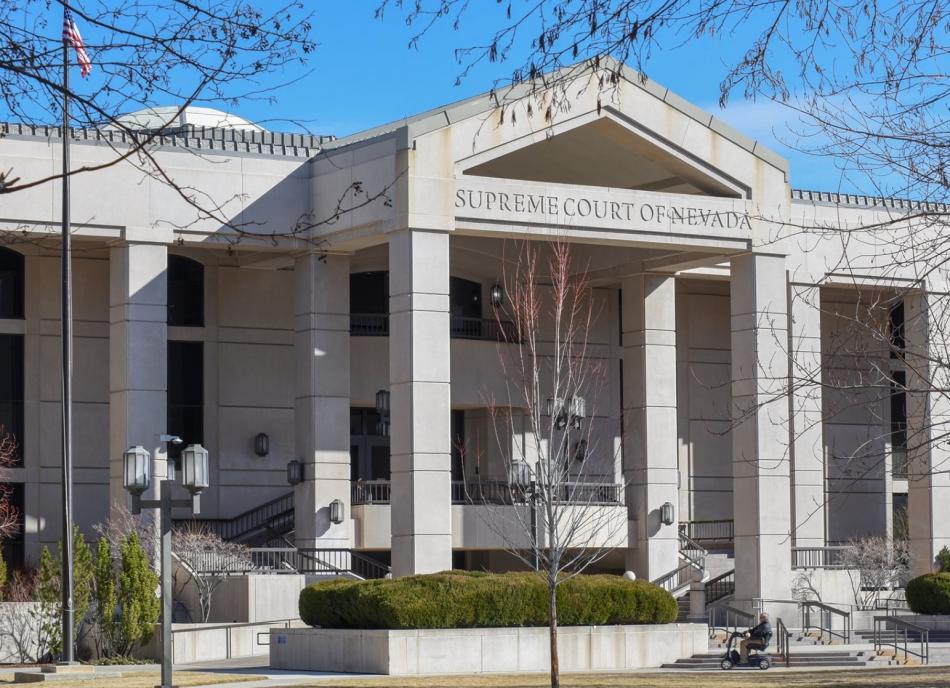
The Nevada Supreme Court has ruled in favor of state Senate Republicans in a 2019 dispute over extended payroll taxes and DMV fees, setting clear limits on legislative efforts to avoid the constitutional two-thirds majority requirement for tax increases while also blowing a substantial hole in the state budget.
The order issued Thursday affirmed a lower court ruling, finding that the bills were unconstitutional and the District Court was correct to bar their enforcement.
The ruling came just 10 days after attorneys squared off in oral arguments over the case, but more than 21 months since the initial lawsuit was filed by state Senate Republicans.
In the order, members of the court wrote that the broad language of the Constitution would “plainly encompass” a bill that brought more revenue into the state than it would have realized without it.
“Because both bills create, generate, or increase public revenue such that the plain language of the supermajority provision applies, the district court correctly determined they were unconstitutionally passed in the Senate with less than a supermajority vote,” the decision read.
The court also wrote that it found arguments made by attorneys for the Legislature “unconvincing,” saying that adopting their arguments would result in a part of the Constitution being rendered “superfluous, as it would require us to ignore the constitutional provision’s use of the word ‘any’.”
“…Accepting the state’s argument that the provision only applies to bills that directly bring about new or increased taxes would require us to read language into the provision that it does not contain — a task we will not undertake,” the order states.
Sen. Keith Pickard (R-Henderson) said he thinks the state budget will be able to absorb the hit because of higher-than-expected revenue projections from the Economic Forum and a coming influx of federal money, but he said he was disappointed in the lawmakers involved in passing the original bills.
“I’m mostly saddened. We knew this was coming. We knew that what they did was wrong. They knew what they did was wrong. And they did it anyway. And I think that speaks volumes as to their attitude,” he said in an interview on Thursday. “They swore an oath to defend and protect the Constitution. And they jettison that for political purposes, and deliberately. Personally, I think they should be removed from office for it. But that’s not how we do things.”
Pickard’s razor-thin, 24-vote victory in 2018 is what blocked Democrats from securing two-thirds supermajorities in both the Assembly and Senate.
Beyond answering a constitutional question, the decision will have substantial ramifications for the state budget, with just days to go before the end of session. Senate Minority Leader James Settelemeyer (R-Gardnerville) in a recent interview on Nevada Newsmakers estimated that the state would need to pay back around $107 million in unconstitutionally collected payroll tax, and wipe out a similar amount off the books for the coming two-year budget cycle.
In a statement, Gov. Steve Sisolak said his office will “continue to work with legislative leadership on budget implications and State officials will analyze the decision to determine next steps.”
The legal dispute emerged when the Democrat-led Senate passed a bill in the 2019 session that extended a higher rate for the modified business tax (payroll tax) that was otherwise set to revert to a lower level. The proposal initially failed to garner a two-thirds majority when all Republicans opposed it, but Democrats then amended the bill by removing the two-thirds requirements and passed it.
Tax increases in the state require a two-thirds majority vote, and Democrats were one member shy of that threshold in the Senate in 2019. Attorneys with the Legislative Counsel Bureau had issued an opinion beforehand saying a two-thirds majority was not required to nix the scheduled payroll tax decrease.
A Carson City judge sided with state Senate Republicans in a 2020 decision.
When the payroll tax rate was implemented in 2015 as part of a tax package backed by then-Gov. Brian Sandoval, it included a provision that automatically reduced the rate if tax revenues overperformed projections. Republicans said preventing the mechanism from working would effectively increase revenue and thus should be subject to a two-thirds vote.
About 22,000 businesses pay the levy, which is a 1.475 percent tax on businesses with more than $50,000 in taxable wages per financial quarter, and a 2 percent tax for businesses in the finance and mining sectors.
Republicans also pushed back when Democrats extended a $1-per-transaction “technology fee” at the Department of Motor Vehicles without two-thirds support. The proceeds of the fee support a modernization project that has been taking longer than expected.
The court’s decision also denied a request by the plaintiff Republican senators for attorney’s fees and costs, finding that the defendant lawmakers were broadly protected by the principle of legislative immunity — a doctrine that protects legislators from being sued for actions taken “within the sphere of legitimate legislative activity.”
— This story was written by Riley Snyder, Jazmin Orozco Rodriguez and Michelle Rindels. It was used with permission of The Nevada Independent. Go here for updates to this and other stories.