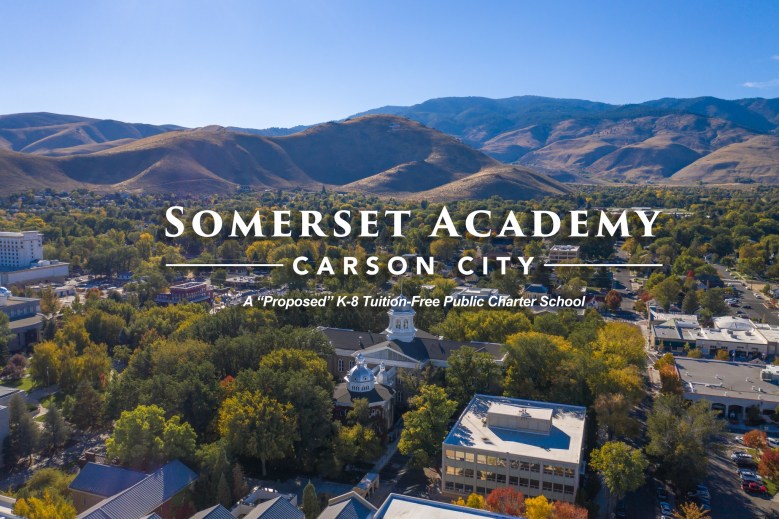
While a few different charter schools have come and gone in Carson City, one well-known charter “brand” is proposing to open a school in the capital city.
Somerset Academy, an Academica brand, is proposing to establish a K-8 public charter school on Mountain Street in Carson City and will be hosting an informational session at the Carson City Community Center Wednesday, April 16, from 5 p.m. to 7 p.m.
Public charters are a hotly debated issue throughout the US — especially in “charter friendly” states like Nevada, Texas and Florida — but one aspect that a K-8 charter could affect in Carson City specifically is the dire need to alleviate overcrowding at the middle school level.
Over the years, while parents have been calling for a second high school, the real issue of overcrowding appears to be at the intermediate level, with schools “bursting at the seams” only a few years ago.
In 2020, Fremont Elementary School was rezoned for Eagle Valley after it was determined that Carson Middle School’s population strains were so pronounced that it could not continue taking the Fremont students without negatively impacting education.
A year prior, trustees had offered to purchase the old Capital Christian Church property on Snyder Avenue for $5.67 million, where among other ideas it was floated to create a school just for sixth graders to take pressure off the crowded middle schools, or even to create a third middle school altogether.
However, negotiations did not result in the school obtaining the property, and it was eventually leased out to another church — which, as it happens, established their own private Christian school on the property later on.
Carson City is also home to Carson Montessori, a public independent charter school within the Carson City School District, but their education only ranges from Kindergarten to 6th grade.
How do Nevada’s Somerset Academy schools stack up?
Somerset Academy was founded in 1997 in Florida and operates schools in Arizona, Florida, Las Vegas and Spain.
As of 2022, it counted 80 schools in its portfolio, though most include combination campuses. Fifteen of those operate in Nevada.

There are 15 Somerset Academy schools in Nevada as of 2024 across seven campuses: Somerset Stephanie, Somerset Skye Canyon, Somerset Sky Pointe, Somerset North Las Vegas, Somerset Losee, Somerset Lone Mountain and Somerset Aliante. Each campus, with the exception of North Las Vegas, includes elementary and middle schools, with two offering high school levels as well.
Of the 15, seven are 5-star schools, three are 4-star schools, two are 3-star schools, three are 2-star schools. There are no 1-star Somerset schools. Four schools have Title 1 Status.
Eleven have over 50% proficiencies in ELA, and seven over 50% proficiencies in math. Five report over 50% proficiencies in science.
Compared with state numbers, chronic absenteeism is lower, with all schools reporting under 20% of their students are defined as chronically absent (missing 18 or more days in a 180-day school year). Nine of those schools report under 10% chronically absent students.
Somerset Elementary
Of the seven Somerset Academy elementary schools, the average proficiencies and scores were:
- ELA 54.7% (State: 42.8%; Carson City: 38.5%; State Charters: 54.6%)
- Math 49.4% (State: 38%; Carson City: 33%; State Charters: 51.2%)
- Science 25.3% (State: — ; Carson City: — ; State Charters: — )
- Chronic Absenteeism rate: ~11.4% (State: 25.9%; Carson City: 27.6%; State Charters: 21.1%)
- Average Index Score: 63.3
- Average Star Rating: 3.375
Somerset Middle
Of the five Somerset Academy middle schools, the average proficiency and scores were:
- ELA: 65.2% (State: 39.1%; Carson City: 35.9%; State Charters: 54.2%)
- Math: 50.8% (State: 26.8%; Carson City: 23.8%; State Charters: 39.8%)
- Science: 60.2% (State: — ; Carson City: — ; State Charters: —)
- Chronic Absenteeism rate: 7.02 (State: 25.9%; Carson City: 27.6%; State Charters: 21.1%)
- Average Index Score: 90.98
- Average Star Rating: 5 (All Somerset Academy middle schools have a 5 star rating)
The argument for charters
Charter schools traditionally outperform public schools and parents and teachers who rally for them say they offer a better education, smaller class sizes, more opportunities for students and additional safety.
There is local evidence to support their claims: charter schools in Reno outperform the public schools, and are able to offer electives that aren’t typically offered at district schools such as yoga, publishing, ballet, public speaking — even wilderness survival courses.
Charter schools are also able to have specific focuses, like science, Career and Technical Education (CTE), literature, performing arts, college prep and more.
Students in charter schools also show greater academic gains than their peers at traditional schools, and typically have higher proficiencies in ELA and math.
Schools under the State Public Charter School Authority (SPCSA) noted an 83.82% graduation rate across 84 schools, with over half of all students proficient in ELA and over half of all elementary students proficient in math.

In addition, around 73% of SPCSA-sponsored charters have a 3-star or higher rating.
By comparison, Carson City’s graduation rate is at 80.56%, with ELA proficiencies in the 35 – 40% range, and math proficiencies in the 17 – 33% range.

Washoe County fares slightly better than Carson, but their reporting still lags behind state charters.

While charter schools outperform public schools, there are a number of controversies surrounding them — especially when they are managed by for-profit corporations known as Educational Management Organizations (EMOs).
Charters are exploding — as are controversial private management portfolios
In 2016, around 30,500 Nevada school students were enrolled in SPCSA-sponsored charter schools. Three years later, that number grew to nearly 48,000, and in 2024, state charters saw nearly 62,000 students enrolled — not including district-sponsored charters which, at least in the north, make up the majority of charters.
It’s important to note the differences between charters, however: there are district-sponsored charters, and state-sponsored charters.
The difference is SPCSA-sponsored charter schools are directly sponsored by the state who oversees their performance and accountability measures, which also tends to allow for a more flexible operational autonomy.

By comparison, district-sponsored charters are overseen and accountable to local school districts, and are evaluated for compliance with the district’s standards and goals instituted by their school board.
In addition, while district-sponsored charters are funded through the districts, state-sponsored schools are funded directly from the SPCSA without district pass through.
All public charter schools are funded by taxpayer dollars, regardless of who sponsors them.
Due to being funded directly, SPCSA-sponsored charters have more flexibility in how they manage their operations — or, in many cases, who they hire to manage them.
Unlike academic frameworks such as Montessori, Waldorf, Reggio Emilia, or religious-based schools, Academica isn’t an educational philosophy, it’s an EMO: a for-profit management company.
EMO involvement varies by school; while some provide simple administration like website, bookkeeping and marketing, others can even provide facilities, teachers, and instructional materials.
Academica is the largest EMO operator within Nevada, with more than half of all SPCSA charter students (34,000) attending Academica-supported school networks under CIVICA Academy, Doral Academy, Somerset Academy, Pinecrest Academy, Mater Academy, SLAM Academy, Young Women’s Leadership Academy, and Oasis Academy.
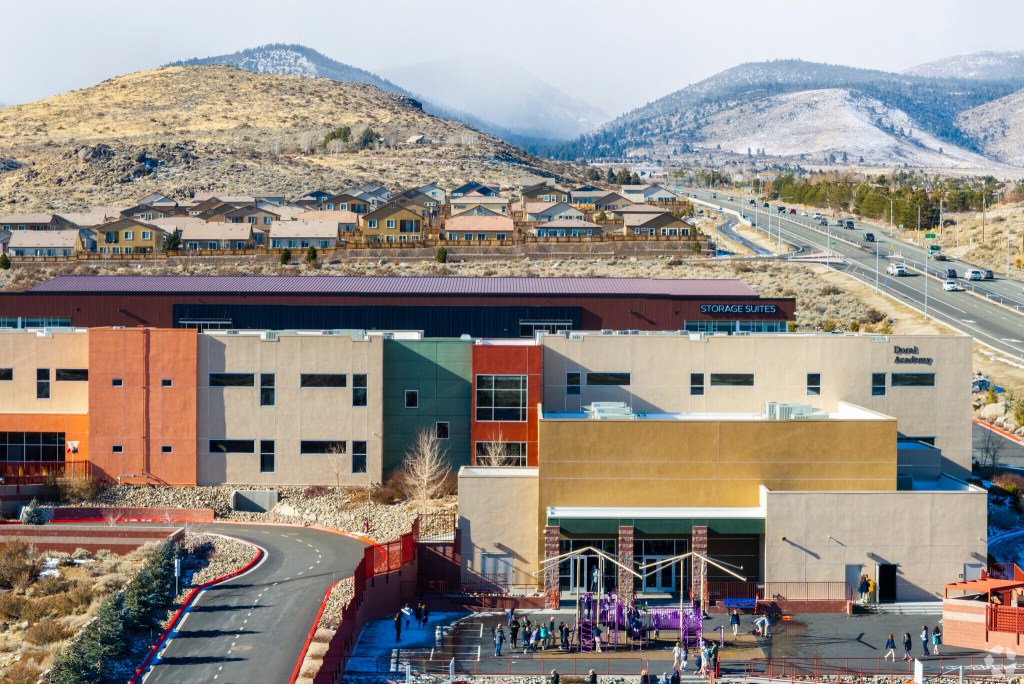
The majority of Academica schools operate in the south, with just three in Washoe County: Doral, Pinecrest and Mater.
In the 2023-24 school year, a whopping $25.5 million of taxpayer dollars went to EMOs managing Nevada charters, with $12 million paid to Academica alone.
Of that amount, $1.4 million was used to pay rent at their Las Vegas office — a rent set by Stephanie Development, the real estate company also owned by Academica.
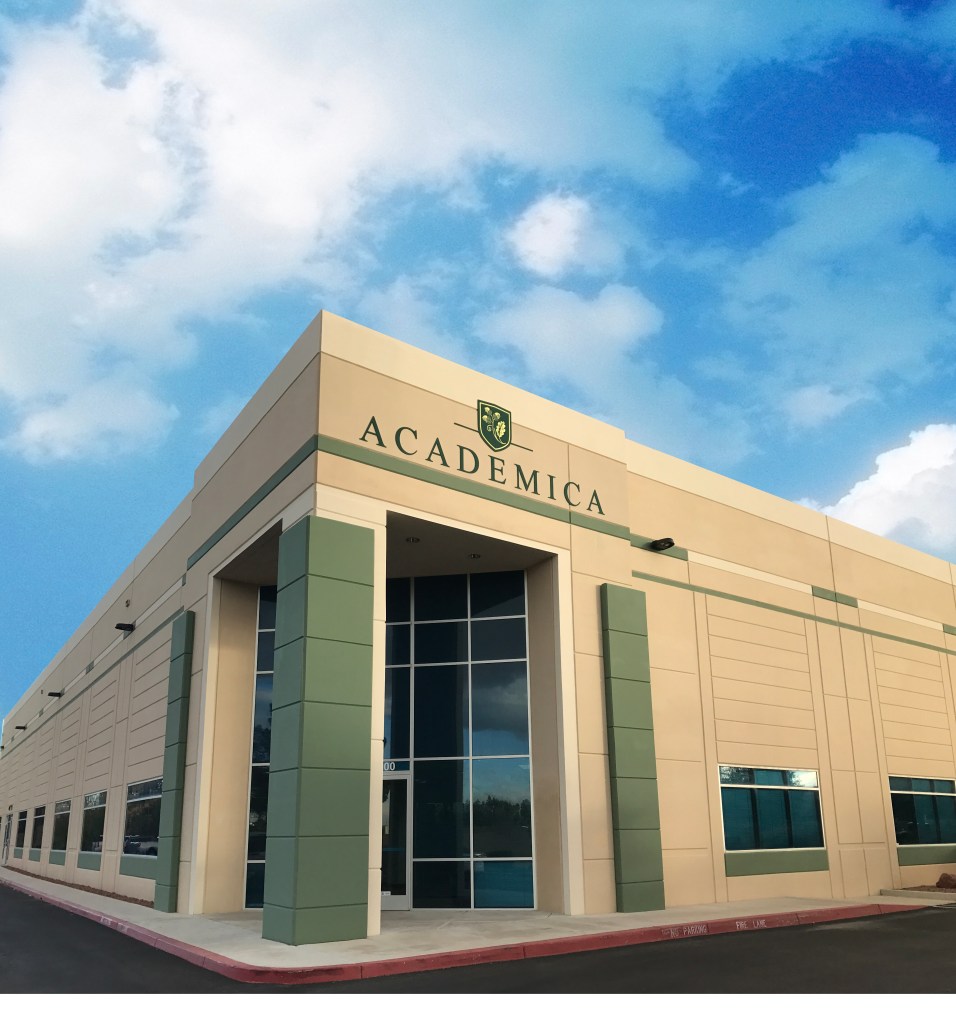
Photo credit: Academica Nevada LLC
This is where the majority of Academica’s controversies are sourced nationwide: Academica has been accused of purchasing school or administrative facilities and leasing them at above-market rates — paid for exclusively by tax-payers — to fill their pockets. Their business practices even led to a federal inquiry into the Florida-based parent company among dozens of other state and municipal level issues.
In addition, there were several audit issues found with Academica Nevada-supported schools, all of which utilized Academica for their bookkeeping and accounting.
Lawmakers are also taking a look into whether or not they even want to allow EMOs to operate within the state with Senate Bill 318.
If it passes (though at this time as it has no future hearings scheduled), it would eliminate the ability for schools to enter into or renew contracts with EMOs to run day-to-day operations. It would also require schools to enter into competitive bidding process to construct, repair or reconstruct school facilities, and pay prevailing wages — which, currently, they are not required to.
However, while Academica might be profiting from taxpayer money, proponents of their schools argue whatever Academica is doing behind the scenes is worth it — Academica Nevada schools rank amongst the highest in the state.
According to Academic Nevada, 31 of their schools ranked in the top 10% statewide when measured by their Star Rating score, and 63% of their elementary and middle schools are ranked at four or five stars. They also reported their schools account for seven of the top 10 middle schools and three of the top 10 elementary schools in the state.
If approved, a Carson City location would become the first under the Somerset banner in the north — the network also includes Somerset Academy schools in Las Vegas, operating 15 schools across seven campuses.
Numbers Dive: Are charters truly performing better, or just curating students better?

When it comes to charters outperforming district schools, proponents often say it’s because they aren’t shackled to outdated educational systems, bloated administrative budgets and overburdened districts.
However, those critical of charters allege it’s because of tactics that falsely inflate scores due to enrollment strategies by picking and choosing their students, thereby artificially inflating their scores.
While charters take on students at the beginning of each academic year based on lotteries, rating skeptics claim students who would decrease ratings — like those with special needs, behavioral issues, or are chronically absent — are given the boot.
Ratings are based on academic achievement, growth, graduation rates, and chronic absenteeism rates among other standards, but only students enrolled a certain number of days can be counted in school ratings.
However, SPCSA charter dates refutes this allegation: transiency rates (the number of students who unenroll from their school) shows state charters at only 14%, compared with the total state percentage of 25.7%.
In addition, the available data doesn’t show massive gaps between traditional schools and charters when it comes to general population, special needs, and discipline, although the numbers do vary in each topic.
Charter vs. public statistics
Average daily attendance for state charters (94%) is only slightly above the 92% range the state, Carson City and Washoe County each fall into.
For special needs populations, though, there are somewhat larger gaps. For example, data shows 32.6% of Washoe County IEP students and 32.9% of Carson City IEP students are chronically absent compared with charter rates of 24%.
In Clark County, where a majority of state charters operate, around 14.5% of students have IEPs. In Washoe County that number increases to 16.2%, while statewide (14.3%) and Carson City (12.8%) rates are lower. Meanwhile, state charters report 10.8% of their students have IEPs.
Numbers are also lower for English Learners: Only 10% attend state charters compared to the state average of 14.9% and 16.3% in Clark County.
However, the number of children who receive qualify for free or reduced lunch is mostly on par at with Carson City and Washoe schools in the 60% range, Clark County is an outlier with over 95% of their students qualifying, which could be argued as a significant gap with those charter students living in the same area.
When it comes to discipline, state charters also aren’t wildly different across the board from public schools, but the reasons their students are getting in trouble do vary.
For example, while statewide, Carson City, and Clark and Washoe counties have an average ratio of incidents involving weapons at 2.81 incidents per of 1000 students, charters are much lower, with only 0.87 per 1000 reported last year:

Violent incidents reported in state charters are on par with Clark County, but significantly lower than statewide numbers. Carson City and Washoe County boast much higher ratios than either statistic.
Charter students are also getting in trouble less for alcohol and controlled substances, but do have a rate higher for students designated as habitual discipline issues.
Expulsions from battering school employees is low across the board, but what varies widely are suspensions from battering school employees. In this, charters still remain relatively low compared with the other districts (barring Washoe County at only 0.16 per 1000).
Verified reported bullying incidents also vary between districts, with charter schools falling somewhere in the middle.
Carson City Somerset Academy
As of May 2024 the Carson City board for the prospective Somerset Academy is made up of five members:
- Tyson League: Chief Deputy District Attorney with the Carson City District Attorney’s Office (Law/Professional Seat living in Carson City);
- Wendy Koch: Carson City resident of 25 years, retired Management Analyst with the State of Nevada (Seat Unknown)
- Audria Hernandez: Carson City resident, Branch Manager of Umpqua Bank, mother of four-year-old son with IEP (Parent Seat)
- Brenda Cruz: Florida resident; Principal of Mater Academy Cutler Bay School in Cutler Bay, Florida, advisory board member for Doral College School of Education in Florida (Seat Unknown)
- Shannon Manning: Las Vegas resident; Principal at Somerset Academy of Las Vegas – Aliante Campus (Seat Unknown)
The Somerset Academy information session will be held April 16 from 5 to 7 p.m. at the Carson City Community Center in a “come and go as needed” style with a question and answer period throughout.
A short presentation will be held at 6 p.m. According to a spokesperson, they are looking at a location near Mountain Street, but no other information has been provided at this time.
Looking for more information? Email info@somersetcarsoncity.org