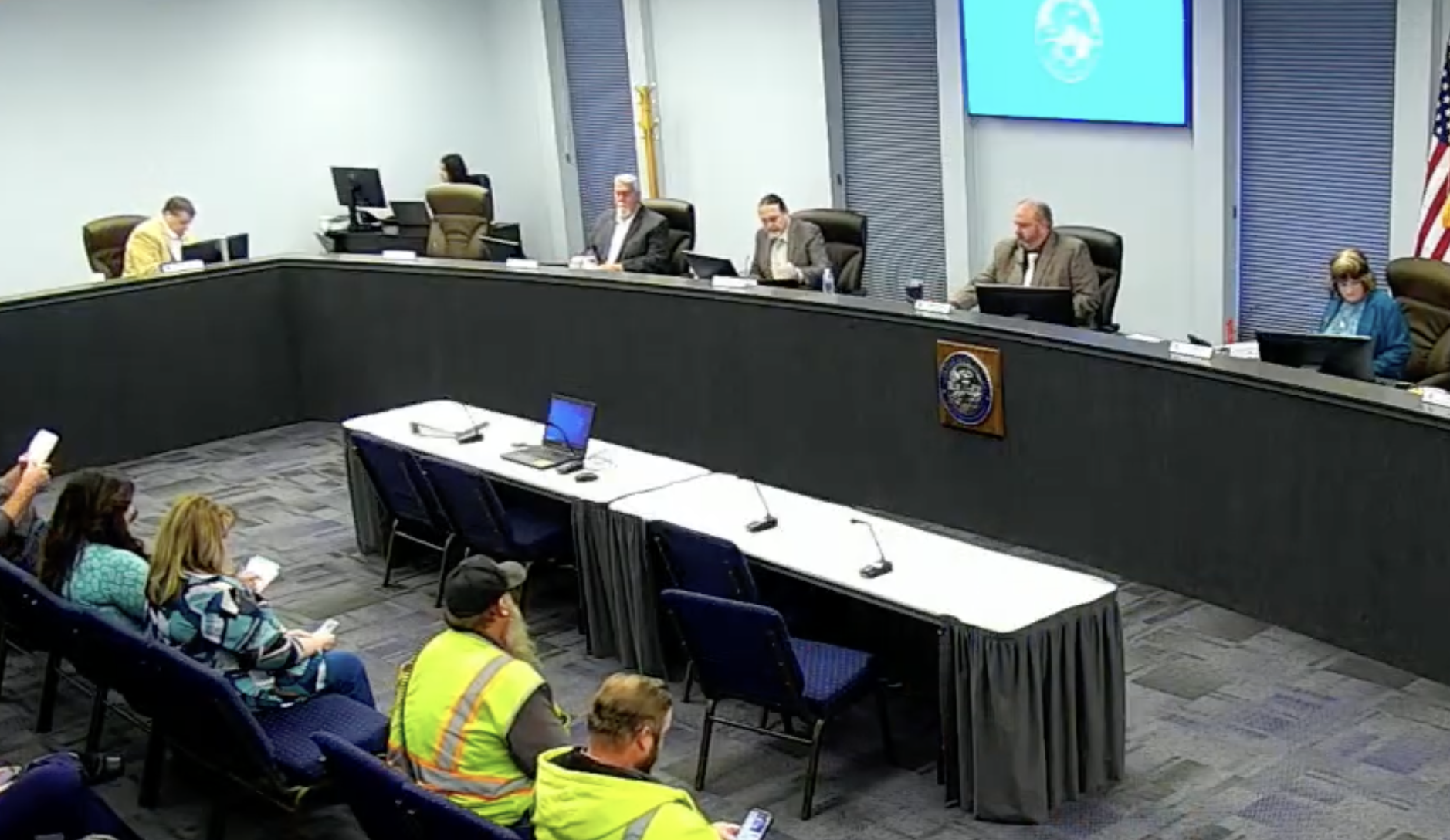

The Carson City Board of Supervisors tackled a number of issues Thursday, approving a major collective bargaining agreement, greenlighting a controversial sewer expansion and clearing the path for courthouse renovations.
The April 2 meeting was marked by recurring debates over the city’s fiscal future, with one supervisor repeatedly warning that local government is approaching a financial “tipping point.”
“Battle Royale” Ends in Five-Year Labor Contract
Following extensive negotiations, the board approved a new five-year collective bargaining agreement with the Carson City Employees Association (CCEA), the city’s largest labor union. The contract runs through June 30, 2031.
City Manager Glen Martel reported that the new agreement will cost the city an estimated $4.66 million above its previous five-year budget projections, bringing the total projected personnel cost for the unit to over $161 million.
Uriah Wise, representing the CCEA, thanked the city’s negotiating team, describing the process as a “battle royale.”
“I feel that with our group through the process that this is a good contract that will tackle a couple of problems that we’re seeing on our end with employee recruitment and retention,” Wise told the board. “Hopefully this will get us across that field goal for getting good employees and keeping them for the long road.”
While the contract passed 4-1, it faced staunch opposition from Supervisor Maurice White, who cited looming financial constraints across neighboring counties and the local school district.
“I think it’s time that we start looking at where we’re at in the city finances in regards to that level of wage and benefits that we are providing,” White said. “It is my personal opinion … that we are far too close to that tipping point to support this contract.”
Sewer Project Squeaks By Despite Efficacy Doubts
Financial scrutiny spilled over into a debate regarding Phase 9B of the Southeast Sewer Conversion project, a decades-long initiative to mitigate high nitrate levels in local groundwater caused by residential septic tanks.
The board voted 3-2 to award a $678,876 contract (with a 10% contingency bringing the total to nearly $750,000) to Rapid Construction to connect 14 homes to the city sewer.
Supervisor White, who voted against the measure alongside Supervisor Stacey Giomi, questioned the project’s return on investment. White noted that out of the 626 properties originally identified, 423 have already been moved to the city sewer system over the years — yet nitrate levels in local wells have continued to trend upward.
“This project amounts to 14 homes for $750,000,” White said. “If 423 homes has not shown an improvement in these wells, what’s the point of spending another $750,000 on what’s obviously something that’s not working?”
Public Works Director Darren Schultz defended the project, explaining that the high nitrate levels forced the city to take a local well offline because it cannot be safely blended into the drinking water supply.
“It took decades to create this problem and it’s going to take decades to fix the problem,” Schultz said. He noted that treating the water at the wellhead is cost-prohibitive due to nitrate levels approaching 10 milligrams per liter, well above the acceptable limit of five.
Vitality Unlimited Agrees to Vacate for Courthouse Shuffle
The board unanimously approved a notice of lease termination for Vitality Unlimited, an addiction treatment nonprofit operating out of a city-owned building at 900 East Long Street.
The eviction is the first domino in a logistical shuffle required for the Carson City Courthouse Renovation Project. Health and Human Services (HHS) staff will move into the Long Street building, allowing the Department of Alternative Sentencing (DAS) to move into the current HHS Annex, thereby freeing up space at the courthouse for the construction of new judges’ chambers.
Sarah Adler, project manager for Vitality Unlimited, assured the board that the nonprofit is actively constructing its new “Vitality Vista” treatment facility and will vacate the city premises by the mandated deadline.
“Regardless of whether we can open the door on January 1st, we will be out of your door by December 31st,” Adler confirmed.
Later in the meeting, the board passed the second reading of an ordinance officially creating a third department in the Carson City Municipal Court, a move triggered by the city’s population surpassing 60,000. The ordinance will take effect Jan. 1, 2027. Supervisor White was the lone dissenting vote.
Alternative Sentencing Stretched Thin
During an annual review, DAS Chief Marlina Stone painted a picture of an agency struggling to keep up with surging caseloads. In 2025, the department processed over 18,000 drug test specimens, though only about 8% returned positive.
To manage the volume, the department relies heavily on electronic monitoring, including a remote breathalyzer that links to a smartphone. “It takes a photo of them while they’re actually doing the test,” Stone explained, assuring the board that offenders “cannot use their dog” to fake a clean test.
Despite technological aids, Stone admitted her staff is stretched thin. “There are weeks where we’re literally just putting out fires,” Stone said. “We’re more of a reactive department instead of a proactive department … I don’t know that we have enough people to really manage the volume of work that comes through our doors right now.”
You can watch the meeting in its entirety below: