As Nevadans begin spring travel, the Nevada Department of Transportation is reminding motorists of new daytime headlight requirements on certain northern Nevada highways in advance of an updated traffic law requiring daytime headlight use on rural two-lane roadways.
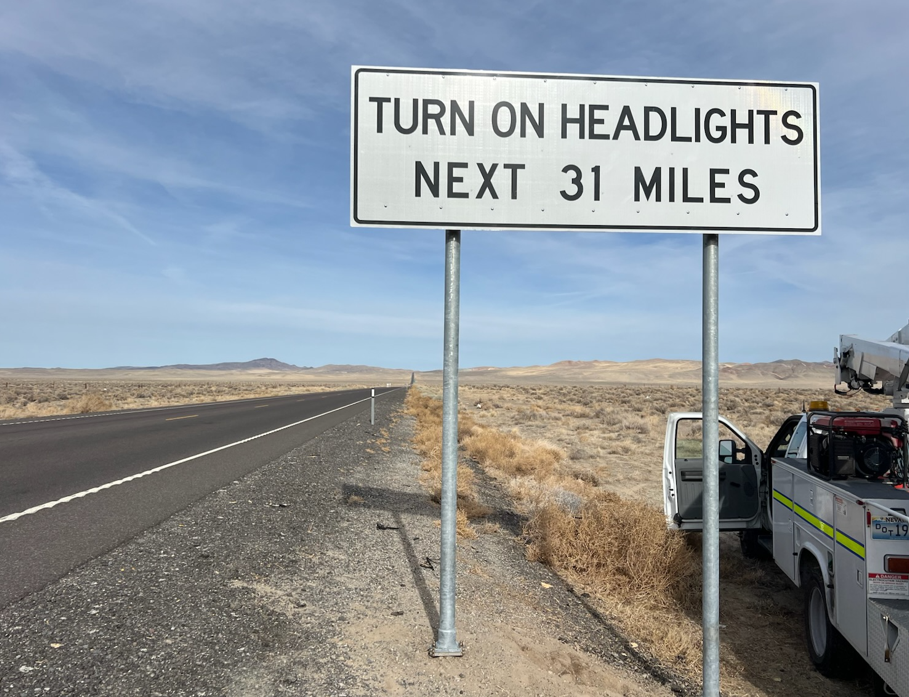
Since last year, NDOT has installed “Turn On Headlights” signage on certain rural two-lane sections of northern Nevada highways, including the following:
- U.S. 395A Washoe Valley
- U.S. 395 Gardnerville to Nevada/California state line at Topaz Lake
- U.S. 95A Fernley to Silver Springs
- U.S. 95 I-80 to Hawthorne and Winnemucca to McDermitt
- U.S. 6 U.S. 6 in central Nevada
Future daytime headlight signage will also be installed on U.S. 50, U.S. 93, U.S. 93A and other rural highways.
The 108-by 36-inch tall signs read “Turn on Headlights,” noting the distance to the next major city where headlights are not required.
Nevada state law requires vehicle headlights to be on from 30 minutes after sunset to 30 minutes before sunrise, when raining or during other limited visibility and when directed to do so by traffic signage.
Effective July 1, 2028, headlights will also be required to be on at all times while driving two-lane rural highways in the state (NRS 484D.100). The law does not apply to two-lane urban streets or highways with more than one lane in each direction.
In preparation, NDOT is phasing in the daytime headlight required signage to raise driver awareness and enhance roadway visibility.
NDOT reminds motorists that using daytime running lights can provide enhanced visibility of your vehicle, even in areas where daytime headlights are not required.
With head-on crashes being one of the most frequent crashes on rural roads nationwide, the requirement is a safety precaution to enhance visibility for drivers on two-lane Nevada highways.
With safety as top priority, NDOT has put the following safety enhancements in place for safer travel on two-lane roads across the state:
- NDOT’s Speed Management Action Plan outlines strategies to manage speed on all roadways in Nevada and save lives.
- NDOT is prioritizing additional passing lanes statewide to enhance safe passing opportunities.
- NDOT has installed rumble strips on thousands of miles of state roadways. Consisting of parallel grooves cut into the centerline of a roadway, tires running over the strips produce sound and vibration to alert and allow motorists to correct their vehicles and avoid crashes.
- NDOT grades and flattens roadside slopes and edges, helping drivers to safely correct their vehicle if they unintentionally leave the road or have to pull off in event of emergency.
SAFETY ON TWO-LANE HIGHWAYS
- Drive attentively at all times, including on two-lane rural roads.
- Speed continues to be a primary factor in fatal traffic crashes, and the best way a driver can reduce their risk of crash is to reduce their speed. Follow posted speed limits, and be ready to slow below speed limit for adverse conditions such as weather. The faster you go, the less time you will have to react if anything happens.
- Pass only when safe to do so, and only in designated passing areas.
- Do not tailgate.
- Maintain your lane control. Stay to the right enough so that passing vehicles in the opposite lane can clear you. Watch for vehicles entering or passing on the roadway ahead of you.
- Continually scan the roadway in front of you. Be aware at all times of the road ahead, including the potential of wildlife, access roads and more.
Additional state highway information is available at dot.nv.gov or by calling (775) 888-7000. For the latest state highway conditions, visit nvroads.com or call 511 before driving. Also follow @NevadaDOTReno on X for traffic and project updates in northern Nevada, and @nevadadot on X, Facebook, and Instagram for updates from across the state.