In a somewhat contentious debate at the Carson City Board of Supervisors meeting today, the board voted 4-1 to direct the City Manager to proceed with due diligence and enter negotiations with the Hop & Mae Adams Foundation for the design, construction and eventual purchase of a new City Hall in the downtown corridor — along with potentially looking at any property alternatives that could fit the city’s growing needs.
What it came down to is city staff said that as the city’s population grows over the next 10, 20 or 30 years, the city will have no choice but to expand their facilities to keep up with the growth. They’ve already been searching for more space for several years; the Clerk-Recorder’s office especially has been asking for additional room for at least a decade, and shuffling at city hall recently moved the IT department to a new facility to allow for additional breathing room for other departments.
Public comment was split; many individuals associated with business and real estate were in favor, arguing that the proposed project would assist in bringing more economic value to the capital city. However, others cited issues with transparency, funding and questioned whether a brand new, large-scale build was the proper choice.


The Why
One year ago, Hope & Mae Adams Foundation Director Steve Neighbors presented a “white sheet” to the board for a large-scale development project downtown — essentially a preliminary proposal.
The proposal cause a stir, both from its supporters and its critics alike.
But according to staff, the push for a new municipal building is driven by the city’s 2022-2026 Strategic Plan and the impending Courthouse Renovation Project. According to City Asset Services Manager Robert Nellis, the city faces a strict deadline to relocate the Clerk-Recorder’s office by the beginning of fall 2027 to allow for courthouse construction.
Temporarily relocating the office would cost nearly $2 million, according to Nellis, prompting city staff to seek a permanent, consolidated City Hall solution.
Despite the logistical pressures, some residents urged the board to reconsider the optics and necessity of the project.
“There is nothing I’ve heard today or read or anything else that has convinced me that we need this grandiose new city hall,” said Carson City resident Mary Sonatada during public comment. “We have deteriorating roads in this community that we’re told over and over again, we can’t fix them because we don’t have the money, but we’re going to spend the money on this big new city hall.”
City Manager Glen Martel countered the “need versus want” argument by noting that the city’s steady growth will force financial commitments regardless of the path chosen.
“This money is going to be spent one way or the other over the next 10 to 20 years,” Martel said. “So again, it’s this board’s choice to do we invest in that growth in staff and consolidating those services at this time under our control with a design that we like for the next 50 to 60 years, or do we look at options to move those services around Carson City?”
Funding, Leasing and “Off-Ramps”
Initial estimates placed the potential debt issuance for a new City Hall at $36 million out of a total $64 – $70 million bid.
However, Chief Financial Officer Sheri Russell-Benabou told the board this figure was highly conservative and designed to ensure the city isn’t caught short-funded.
“My amortization schedule actually showed 64 million. So I think it was inflated,” Russell-Benabou said. “I do believe it will come in lower… I expect it to be hopefully less than 30 million.”
Russell-Benabou said they always overestimate when doing a cost analysis to make sure that even under the worst-case scenarios they could still afford a project when bringing it forward for discussion.
Under the proposed partnership, the Hop & Mae Adams Foundation would use their own land and secure private bonds to fund the construction of a new City Hall built to the city’s specifications. Once completed, the foundation would lease the building back to the city.
City staff recommended this lease-option arrangement because negotiating a direct purchase agreement upfront is highly time-consuming and complicated by government regulations, according to Russell-Benabou. Because the developer already owns the land and is fronting the construction costs, starting with a lease option gives the city the flexibility needed to navigate regulations and keep the project moving quickly.
However, the city’s ultimate goal is not to lease indefinitely, but to fully own the land and the building. To transition from leasing to owning, the lease agreement will be structured with built-in “off-ramps”— essentially pre-negotiated buyout options.
The city would utilize these off-ramps at the one, three, five, or ten-year marks to purchase the building using municipal bonds when interest rates are most favorable. However, staff said they don’t believe it would be longer than three years.
“We won’t pay interest for 30 years on a lease purchase option, which would be a higher rate than a bond,” Russell-Benabou explained. “We would pay a few years, maybe one, two, three, and then bond when it’s low interest rates, and buy the building.”
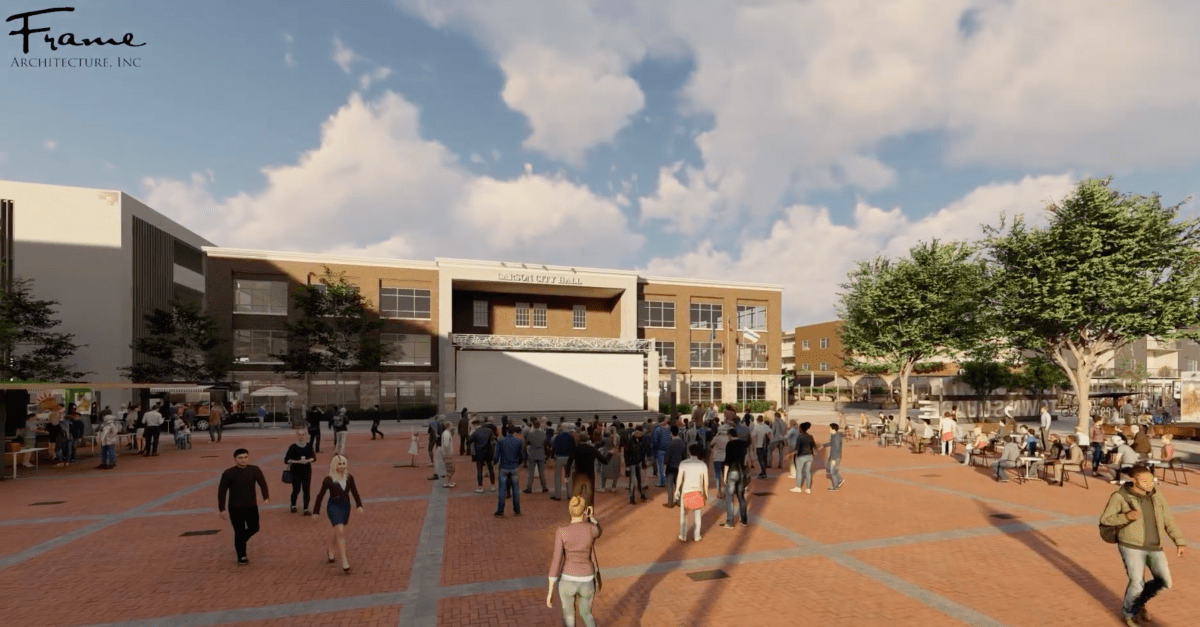
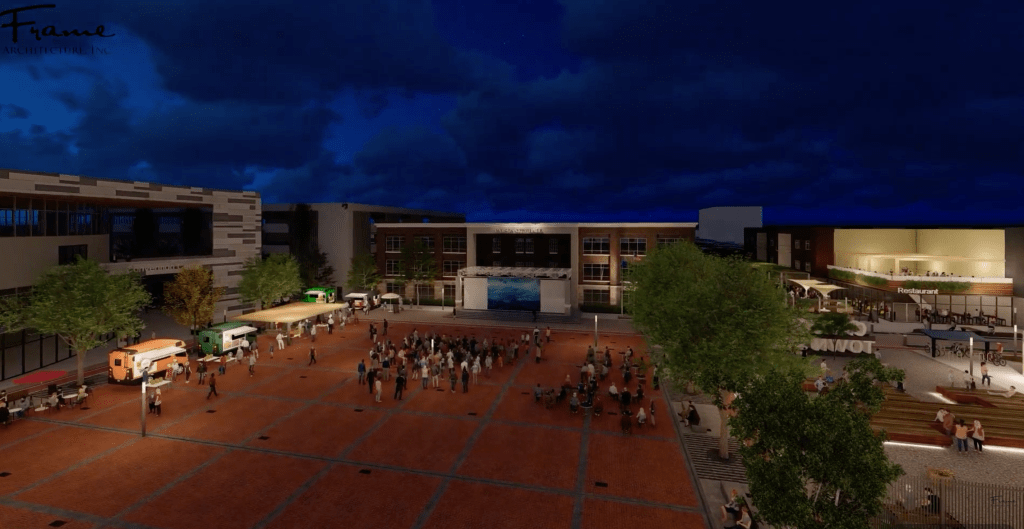
Mayor Lori Bagwell also took time to clarify the limits of the city’s financial involvement with the developer’s broader town square vision. While the city will partner on a shared parking garage—taking responsibility for 200 spaces—no public funds will subsidize the developer’s future phases, such as a potential hotel or conference center.
See the full vision for the downtown “town square” published in 2022:
Bagwell also defended the reputation of developer Steve Neighbors of the Adams Foundation, pointing to his track record rehabilitating the Northgate property for local nonprofits as well as the 308 N. Curry Street mixed-use development downtown among others.
“I tend to look at vendors that I want to get into business with, right? And what do they got in the history that tells me they honor their word?” Bagwell said.
Exploring Alternatives
Prior to approving the motion, the board reviewed a list of alternative properties considered by staff, many of which were brought up by public commenters, detailing why each fell short of the city’s criteria.
Bagwell addressed frequent public requests to utilize the vacant Ormsby House, revealing she heavily pressured staff to find a way to make the property work.
Ultimately, the building’s 200,000 square feet was deemed far too expansive for the city’s needs, and rehabbing the 1970s-era structure would require tens of millions of taxpayer dollars.
The following is list of the alternative properties the city evaluated to become the new City Hall and why they were deemed unsuitable according to staff:
- Expand Existing City Hall: Adding floors is structurally complex and fiscally impractical due to the building’s dated construction. It would also require spending potentially millions to temporarily relocate staff during construction and still wouldn’t provide sufficient parking.
- Ormsby House: At nearly 200,000 square feet, the building is roughly four times larger than the city’s needs and would require tens of millions of taxpayer dollars to rehabilitate. The city would also have to take on the burdensome task of acting as a property manager to lease out unused space.
- 600 East William Street (Former Bank of America): The property appraised for less than the owner’s asking price, and the necessary tenant improvements would cost approximately $2 million for just one floor. It also lacks sufficient space for a new board room, has insufficient parking, and poses potential asbestos and lead paint issues.
- Capitol Plaza: Because the property consists of four separate buildings, it would prevent the city from creating a single, centralized customer service center. It would also require over $10 million in tenant improvements and the city would have to absorb the deferred maintenance liabilities of the older structures.
- Kmart Shopping Center: The lease and purchase options were deemed too expensive, especially considering the interior is “essentially dirt” as it was not developed, and requires significant tenant improvements. It is also located too far from the downtown corridor and lacks space for a new board room.
- Harley-Davidson Building (3850 Arrowhead Drive): The building was located too far from downtown and possessed nearly double the square footage the city needed. Then, the State of Nevada ultimately “swooped in” and purchased the building, taking it off the market.
- Federal Building: The city hit federal red tape attempting to acquire the building because Carson City did not meet the specific “education component” required for the property’s public-use disposal. It would also likely require unknown remediation dollars and renovation costs.
- King Street Property: City staff quickly ruled out this property when it temporarily popped onto the market because it lacked both the necessary square footage and sufficient parking.
One alternative did pique some interest from supervisors though — the old GSA state building at 1390 S. Curry Street which is currently on the market.
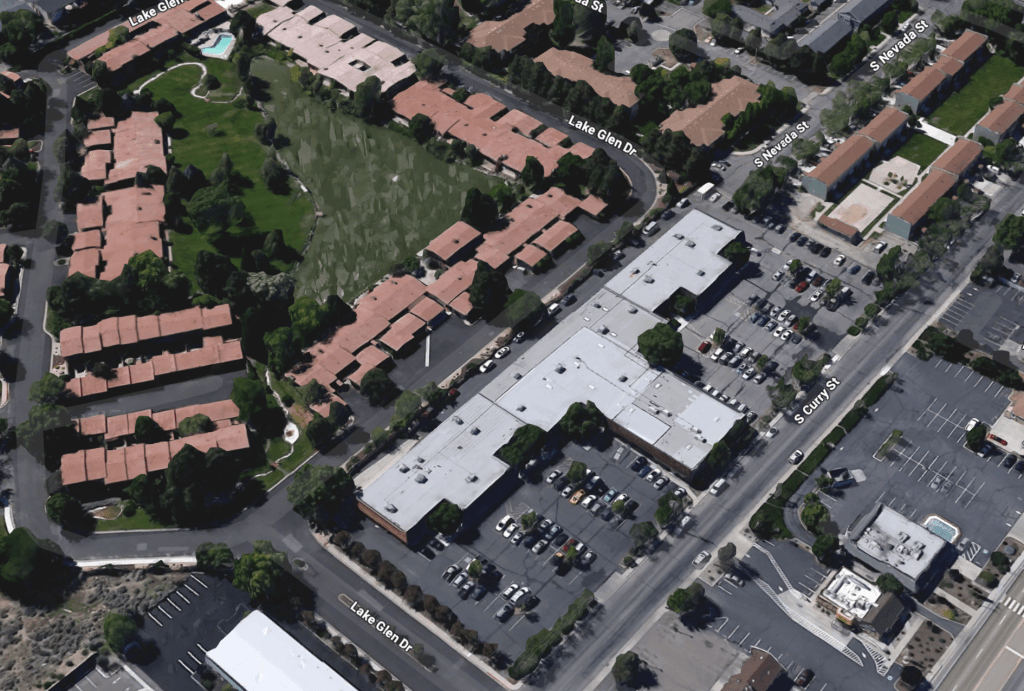
The Curry Street Building
The Curry Street property, an office building that previously housed the General Services Administration (GSA), was initially evaluated several years prior when the city first considered relocating the clerk-recorder’s office according to staff.
Following a site tour with the former clerk, the city determined the property was unsuitable because it possessed existing tenants, failed to meet all the criteria of the city’s strategic plan, and was originally only available for lease rather than purchase.
Mayor Bagwell reiterated the city’s stance that it is generally not in the community’s best interest to engage in long-term leases, preferring instead to acquire and own municipal assets.
Planning Commissioner Teri Preston who serves professionally as a realtor and attended the meeting as a representative for the property said that a 44,000-square-foot portion later became available after the state vacated the space.
However, city staff said the property was no longer on their radar when it returned to the market for sale in November 2025. By that time, the Board of Supervisors had already directed staff to exclusively pursue the Hop & Mae Adams Foundation proposal.
While supervisors could not legally ask staff to specifically look into that property as a “Plan B” due to the way the agenda was written, staff was directed to continue with due diligence not only moving forward in discussions with the Adams Foundation, but in looking at additional alternatives as well.
Before the final vote, Bagwell said that despite utilizing a specific developer’s land, the construction project must go through a formal, public bidding process overseen by city staff to protect taxpayer dollars.
“It is imperative that the public, and I think us as a board, know that the project is bid,” Bagwell said. “So it will not be granted to a friend or somebody that went to school with somebody,” she added, referencing prior public comment alleging that there might be “sweetheart” deals between the city, the foundation, and/or local development agencies.
The motion to proceed with preparatory tasks, due diligence, and negotiations for the new downtown City Hall passed 4-1 with Supervisor White voting no.