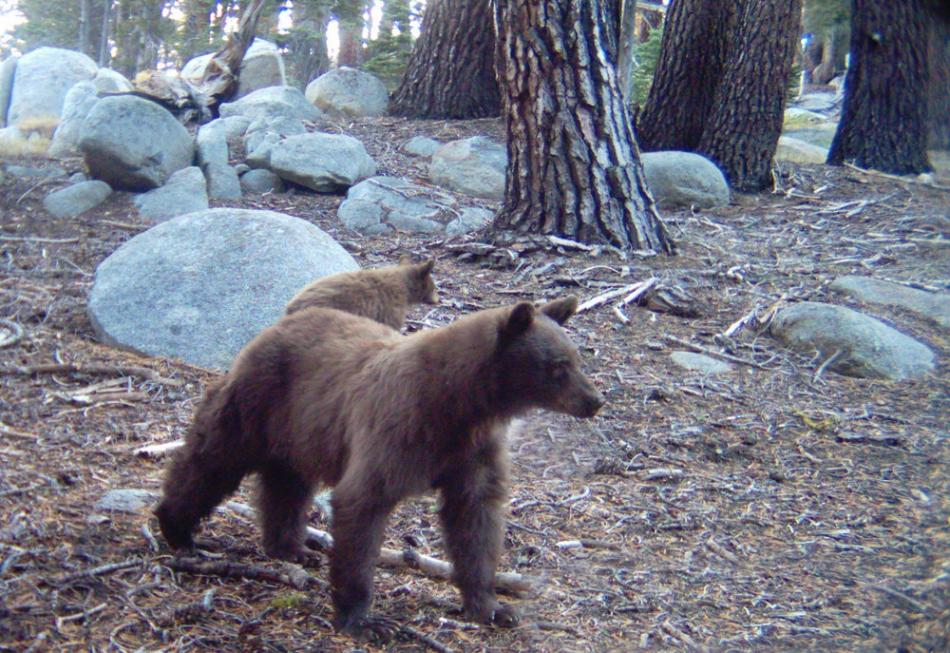
Northern and western Nevada bears are beginning to wake up after winter hibernation, serving as a good reminder to residents that this is bear country and they will be out foraging for food and nourishment for themselves and their young cubs.
Carson Now reader Patrick Justice alerted us to his recent sighting of a bear “out and about” Tuesday around 11:30 p.m. on Carson River Road. With a mild winter and warmer temperatures across the region, bears are waking up and lumbering about, according to the Nevada Department of Wildlife.
Bears in the lower valley areas of Reno, Carson City, Carson Valley and surrounding counties do hibernate while bears in the Lake Tahoe Basin are increasingly finding food sources and are not going down for winter, said NDOW spokeswoman Ashley Zeme.
“Bears do hibernate, most of our valley bears do go into their dens, but if food is available there are a few stragglers,” said Zeme. “For the most part, Reno, Carson City and all the other valley bears go into hibernation but at Tahoe, it’s almost non-existent. It’s about food ability and they’re finding it.”
The Tahoe Interagency Bear Team, a collective of bear experts across federal, state and local agencies, study bear habits across the region and is reminding residents both in the valleys and around the Lake Tahoe Basin of bear behavior as we edge closer to spring.
“It’s a good reminder that bears are a year-round responsibility,” said Zeme.
The bear team provides proven and scientifically backed information about real issues and solutions for living and recreating in bear country. Bears may at times seem unique due to their learned lack of fear and boldness around humans, known as habituation, but these black bears follow the usual biological patterns of black bears across Nevada and California.
Whether living in or visiting bear country, the team is providing information that aims to clarify what is really needed to help wild bears survive and thrive. See the videos below.
Don’t Let Your House Become a Makeshift Den
Many have seen photos and videos perpetuating the myth that property owners and residents should allow bears to den under homes and in crawl spaces. Some may have even seen people encourage this unwanted behavior by laying out hay and other materials for bears. Surprisingly however, most homeowners aren’t even aware that a bear is under or around their home until it has already established a makeshift den.
Bears often damage the insulation, exposing pipes to freezing temperatures or even damaging them in the process. Once a bear gets comfortable, it can be difficult to make it leave. This increases the chances of human-bear conflict and habituated behavior.
Bears under homes need to be addressed by trained agency professionals, as bears can be dangerous. If disturbed, mother bears with newborn cubs may abandon the den, orphaning the cubs in the process. For this reason, only a wildlife professional should evaluate the situation and offer advice to homeowners.
It’s important to remember, that bears have evolved to comfortably survive winter without human help, so it is essential to board up all crawl spaces around homes to discourage them from denning and damaging property. For more information about securing crawl spaces, watch this TIBT video.
Secure Your Trash
Black bears are very resilient and adaptive animals, and, as opportunistic omnivores, they will take advantage of any available food source, including human supplied foods like garbage. Their highly developed sense of smell allows them to find these food sources, even when locked in a vehicle or home, which in turn may lead bears into conflict with people.
NEVER Feed Bears; Intentionally or Accidentally
It is true that bears need A LOT of calories, especially in preparation for winter, but giving them handouts will not set them up to thrive. Repeated exposure to human foods can lead to food-conditioned bears that view neighborhoods as reliable sources of food.
When mother bears teach their cubs to access human foods, they not only continue the cycle of human food-conditioning, but the cubs are much more prone to conflict, including being hit and killed by vehicles.
Consuming human garbage can also be harmful for bears because the high sugar content can increase tooth decay and painful abscesses. Additionally, intentionally feeding bears is ILLEGAL in both California and Nevada.
As omnivores, a bear’s diet is about 85 percent plant-based, with the remaining proportion coming from consuming insects, small mammals, and carrion. Thus, bears should be allowed to fulfill their very important and vital ecological role as seed dispersers, predators, and scavengers.
Black bears are smart. They have learned how to unscrew lids, and open sliding glass and vehicle doors. They are also strong. In order to access food, they can peel a car door down from the top or break through a typical home door or window. Even after an incident like the 2021 Caldor Fire, where a huge swath of vegetation was burned, wildlife biologists saw these resilient omnivores find natural ways to survive.
Protecting Human Life and Property
On rare occasions, the California Department of Fish and Wildlife (CDFW) and Nevada Department of Wildlife (NDOW) must remove bears that are putting human life and property at risk. No one, including the agency biologists who have dedicated their lives and careers to protecting bears, want this outcome. It is only used with great discretion and as a last resort.
Bears are large, strong animals and once they become conditioned to human foods or habituated to people, they pose a significant threat to human safety. For these reasons it is very important for people to be educated and dedicated to being BearWise. Learn how to live responsibly with black bearsat the BearWise website.
It’s also important to note, that except in the case of immediate protection of human life, the only people who can legally interact with wildlife are designated state agency or law enforcement professionals.
Protecting Bear Health and Wildness
It can be exciting to see a big, beautiful animal like a black bear in a neighborhood, but it is not where they belong. Human developed areas pose many dangers to bears, particularly roads with cars, which bears must cross to get to the unhealthy human food and garbage in developed areas.
By allowing bears to comfortably live in or pass through neighborhoods, the chances that they will get struck and killed by vehicles increases immensely. If a bear is in your neighborhood, encourage it to move on by scaring it away so that it can lead a much safer life away from developed areas and conflict. For more information on bear-vehicle collisions, check out the TIBT video.
The TIBT is dedicated to creating the best environment for bears to thrive and remain wild in an ever-growing, ever-changing environment like the Lake Tahoe Basin.
CDFW and NDOW should be the only point of contact for any bear-related incidents or questions. CDFW and NDOW have trained black bear experts who can help navigate any human-bear conflicts.
We encourage the public to visit the TIBT website TahoeBears.org for accurate information about bears and to report any bear sightings or incidents.
To report bear incidents or conflict in the Lake Tahoe Basin, use the following:
- In California, contact CDFW at 916-358-2917 or report online using the Wildlife incident Reporting (WIR) System.
- Non-emergency bear collisions in California State Parks can be reported to public dispatch at 916-358-1300.
- In Nevada, contact NDOW at 775-688-BEAR (2327).
- If the issue is an emergency, call the local sheriff’s department or 911.