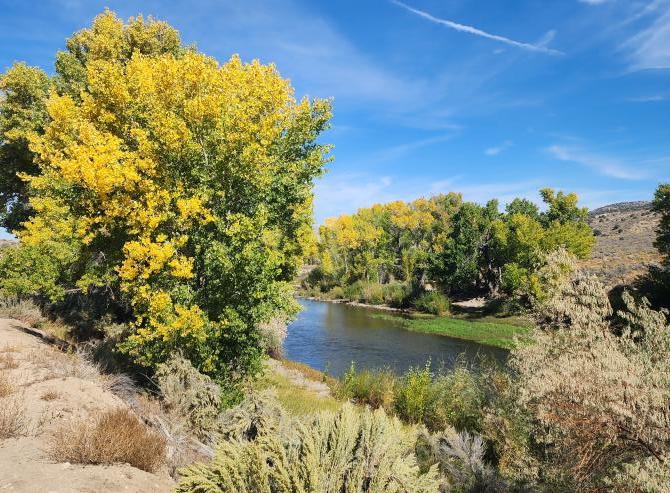
Continuing with the climate change observations I wrote about a couple of weeks ago, here it is October and still no freezes. Although we had one night of 37 degrees, followed by another at 38 degrees, most have been in the 40s to low 50s.

In fact, as I write this, it is supposed to reach 88 degrees today. I turned the sprinklers and drip systems on again. One of my young lavender plants has decided now is the time for its first bloom even as the trees and shrubs are changing color.
My husband was asking about leaves changing color. Many people think temperature triggers the color change, but that is not the primary driver. While temperature can influence the depth and vibrancy of color, the actual main influence is day length. Shorter days make the plants produce less chlorophyll, the ingredient that makes leaves green. Less chlorophyll allows the yellow, orange or, as the nights get cold, purples and reds pigments to show through (Source: Michigan State University).
I want you all to congratulate me. After two years of writing “I need to fertilize the lawn,” I finally did it! I had the fertilizer, a 29-0-4 slow release, since spring. I had left it out by the garage so every day it reminded me of a job left undone for too long. Once we had a cool cloudy day, the perfect fertilizing weather spurred me on. Has any other gardener out there ever procrastinated on a long-needed task?! I’m sure I’m not the only one.
I’m hoping with a dose of nitrogen that the black medic (a relative to clover) will decline. The fertilizer may also reduce the clover. These two nitrogen-fixing plants oddly do not like to be fertilized with a typical lawn fertilizer.
What is nitrogen-fixation? It is a chemical process that is a mutually beneficial relationship (symbiosis) between a legume plant (peas, beans, clover, etc.) and Rhizobium bacteria in the soil. While these bacteria infect the root hairs of the legume, they also convert atmospheric nitrogen into compounds the plant can use. This provides the plant with nitrogen, and the plant the provides the bacteria with carbohydrates for energy. Pretty cool. Nature can teach us a few things about cooperation.
I want you to know I’m certainly not complaining about this beautiful weather. The light is soft, the colors are bright and the temperatures are mild. What’s not to like?
— JoAnne Skelly is an Associate Professor and Extension Educator, Emerita, University of Nevada Cooperative Extension. She can be reached at skellyj@unr.edu.