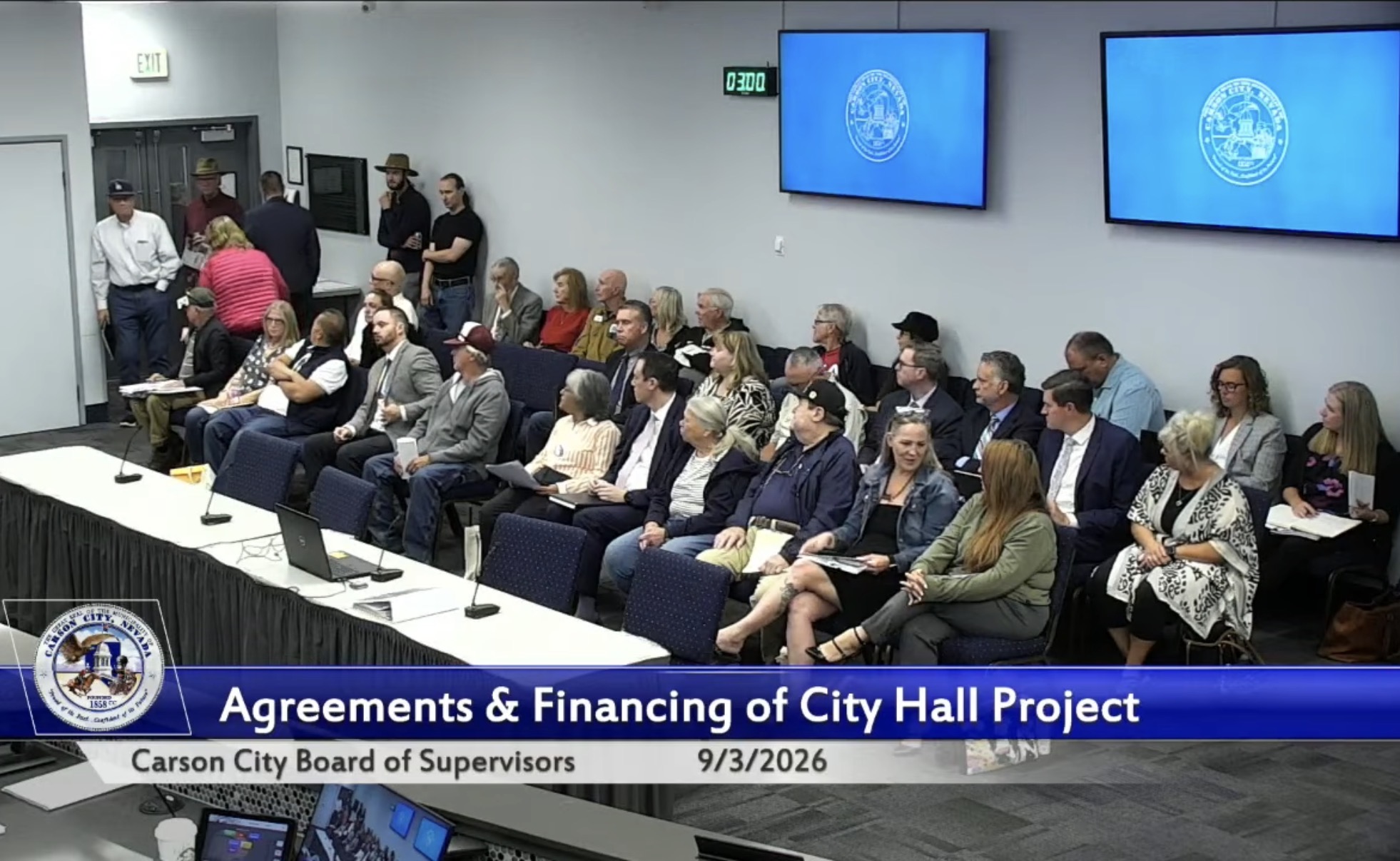

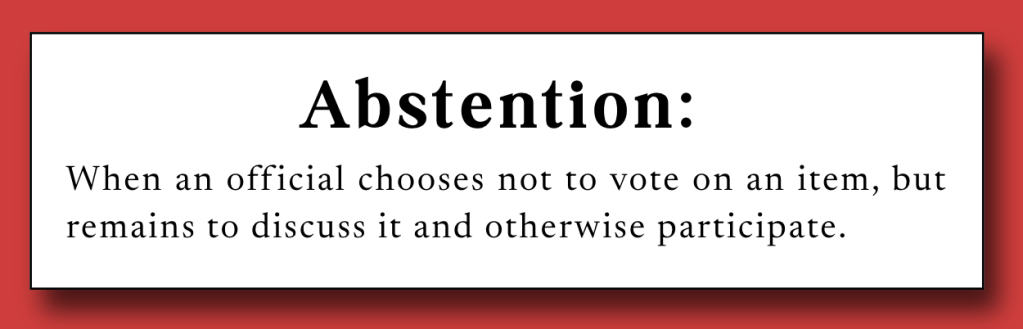
Two Carson City commissioners say last-minute calls from the district attorney’s office led them to abstain from voting on items connected to the now-dead $30 million downtown City Hall project, despite their belief that neither had a conflict of interest requiring them to step aside.
Debt Management Commissioner Mary Sanada stayed away from a Sept. 10 vote on the project’s proposed financing after receiving legal advice the afternoon before.
Planning Commissioner Teri Preston abstained from Sept. 30 proceedings involving downtown street abandonments and a proposed parking garage after receiving similar advice just hours before the meeting.
Both commissioners told Carson Now during an Oct. 1 interview that they believe the timing was intentional and that the advice was intended to limit their scrutiny of the project. District Attorney Garrit Pruyt said his office contacts public officials when it learns of potential conflicts to help prevent ethics violations and preserve public trust. He could not provide an analysis of either commissioner’s individual circumstances.
On Oct. 16, the city announced that the proposed City Hall and parking garage agreements would not move forward after negotiations with the Hop and Mae Adams Foundation failed to produce acceptable terms.
The City Hall project fell through last week, and the reasoning provided appears to be the exact questions about project financing the commissioners publicly questioned— and why they believe they were told to step down.
The demise of the project appears to be rooted in the financial terms, in that the 5% interest rate promised by the Hop & Mae Adams Foundation did not come to fruition. Accepting a higher interest rate would mean the cost of the project would either increase past the $30 million approved cost, or they would have to reduce the scope of the project to hit the $30 million threshold.
The fact that there was no set-in-stone interest rate at any point since this project was first discussed in 2022 was one of the reasons commissioners began speaking publicly about their concerns.
Briefly, what the law says
NRS 281A.420 covers when officials need to disclose private commitments or relationships, and when they need to abstain due to those commitments.
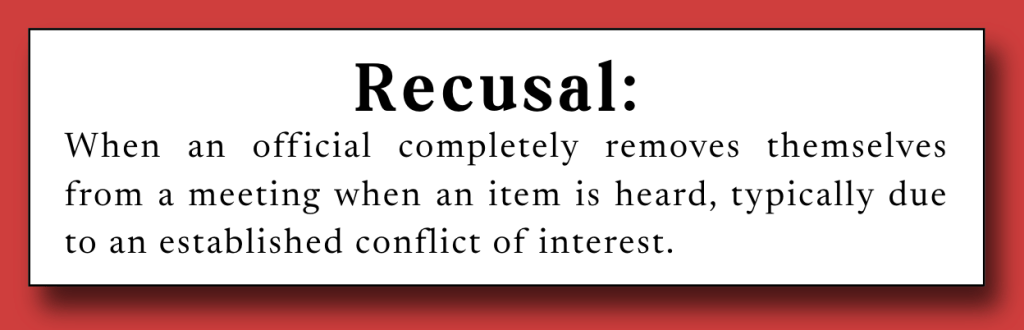
Abstention is generally discouraged, and intended only for clear-cut cases of conflict, typically involving some financial interest or significant obligation to another party.
This is because, according to the statute, Nevada law recognizes that officials serve to represent the public. When they are prevented from voting, the public loses their voice in that decision.
An important thing to note is bias is not the same thing as a conflict of interest that would require abstention.
For example, if an official routinely speaks out against dog parks in their private or professional capacity, the statute does not require an abstention if a dog park item comes before them. Perhaps they were elected based on their hatred of dog parks and, therefore, they are representing their constituents.
However, if they are employed by the Stop All Dog Parks Company, and are paid a commission for every dog park converted to a dog-free park, that would likely be seen as a clear conflict requiring abstention. Or, perhaps they are not themselves employed by the Stop All Dog Parks Company, but their spouse or child is, and a vote against it could then harm their family members’ ability to earn a living advocating against dog parks.
Disclosures and abstentions are not rare, and occur often — however, it is typically the board members themselves who reach out to the DA’s office, not the other way around.
Mary Sanada and the Debt Management Commission
The Debt Management Commission exists by state law to analyze proposals that would create debt for local municipalities. The Carson City Debt Management Commission oversees the City of Carson City, and the Carson City School District.
In this case, the commission was tasked with determining whether Carson City could afford roughly $2 million annually proposed at the time for the City Hall project.
The commission consists of one representative from each governmental board and three public representatives selected by those two commission representatives.
This year marks Mary Sanada’ seventh on the Debt Management Commission.
During that time, she said that she has never been asked to recuse herself, and cannot remember a single time anyone else on the commission has been approached by the DA’s office for a similar disclosure.
“Never, never. It’s just preposterous,” she said. “You know, most of what we do is pretty mundane. Nobody’s ever been asked to recuse themselves before.”
However, that changed in September when, similarly to what occurred with Planning Commissioner Teri Preston, she received a phone call at around 4 p.m. from the District Attorney’s Office the evening before the 9 a.m. Debt Management Commission meeting.
She said that the DA’s office told her that because Sanada served as treasurer of ‘Let Carson Vote’ (a recently formed political action committee advocating for a public vote on the City Hall project), she owed a “fiduciary duty” to them which was considered to be a conflict of interest.
Sanada said she argued that, to her understanding, she needed to have a financial interest, “and I didn’t have any financial interests” that could cause a conflict, especially since she was volunteering in her private capacity.
However, she was told that if she did not recuse herself, she’d be opening herself to “liability,” similarly to what had been relayed to Preston.
Sanada said that she believes she was asked to recuse herself because she had spoken out against the city hall project, and questioned the finances during public comment at a Board of Supervisors meeting.
“So they found a way to make an excuse,” she said, adding that “if it wasn’t the
‘Let Carson Vote’ reason, they probably would have found something else.”
She said that the implication that she could not be objective about the lease purchase agreement because of her private views she takes personally.
“To me, that’s a real insult because above all else, I would never compromise myself and my integrity. If I have a task to do, I use my skills and my knowledge to do it properly. And that’s very important to me.”
However, because she had no time to seek an outside opinion given the short period of time, Sanada said she agreed to recuse herself even though she did not believe she had a conflict.
“They didn’t want me asking questions,” she said. “They preferred that I get off the board, so they had the district attorney dig for an excuse and make something up that I’ve been told by another attorney was totally bogus. [The outside attorney said] there was no legitimate reason that they should have asked me to recuse myself.”
During the commission meeting, Sanada said that Commissioner Molly Walt also recused herself, as she serves as director for RSVP, a local nonprofit whose offices are in a building owned by the Hop and Mae Adams Foundation.
During the meeting, Deputy District Attorney Todd Reese cited NRS 281A.420(5) and explained that Walt’s on-record abstention reduced the number of affirmative votes needed to approve the financing from four to three. The remaining commissioners approved the resolution.
It’s important to note, however, that had Sanada not recused herself and voted “no,” the three “yeses” still would have met the two-thirds majority vote required for the passage due to Walt’s abstention.
Despite what her personal feelings may have been, based on the narrow limitation of their scope, Sanada said that she likely would have voted for the proposal — unless answers significantly altered her understanding of the project.
The questions she said she would have asked are provided below:
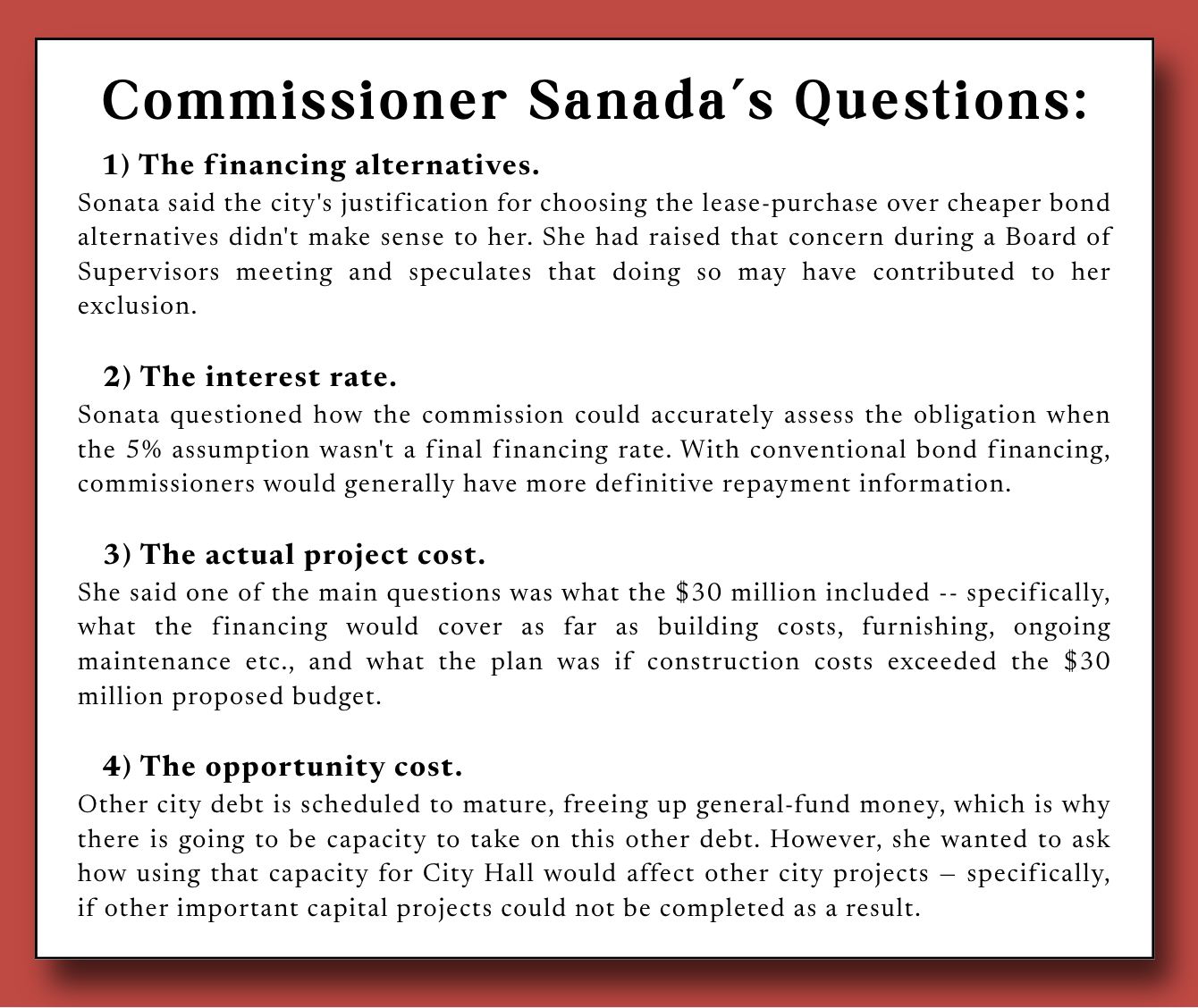
Sanada was advised to recuse herself prior to the Sept. 10, 2026 meeting.
The day of the Planning Commission meeting on Sept. 30, 2026, Planning Commissioner Teri Preston received a nearly-identical call — the timing of which, both agree, appeared to be “calculated.”
Teri Preston and the Planning Commission
Carson City’s Planning Commission is an advisory board, meaning they provide recommendations to Supervisors about planning or development project proposals. Supervisors can choose to follow their advice, or overturn it.
Commissioner Teri Preston has sat on the Planning Commission for nine years. In her private capacity, she is a real estate agent, and the former Manager of Leasing and Contract Services for the State of Nevada.
Preston has been outspoken regarding her questions about the City Hall project — a project she’s referred to often as a “barrel of air” — and says this is likely the reason she fell in the crosshairs of the city.
During her time on the Planning Commission, Preston said she has never been asked to recuse herself, and cannot recall a time any of her fellow commissioners has been asked to either.
Typically, commissioners will approach the DA’s office for advice if they believe they may have a conflict of interest. Commissioners discuss whether they should abstain, disclose, or if the situation does not pose a conflict.
Preston maintains that she has no conflict of interest relating to her recusal. However, she received a phone call around noon the day of the Planning Commission meeting advising her to step down.
Preston said that the DA’s office told her because of her role as a real estate agent, and because a building owned by a company she represents could have been a potential building for City Hall, she could therefore have a future financial interest and must recuse herself to avoid being sued.
Although the applications were connected to the larger downtown development proposal by the Hop & Mae Adams Foundation, the Planning Commission was not being asked to approve City Hall itself. Its responsibilities were limited to reviewing proposed street abandonments relating to the overall downtown development project, and a special use permit for a parking garage.
In addition, the City also previously rejected the Curry Street property in question, and Preston said while she had brought forward the property months prior during public comment — at the request of Supervisor Maurice White — it was under contract with a different buyer and could no longer be considered.
Carson Now has reached out to White several times asking for comment on his request to Preston to bring the building forward as an alternative, but he has not responded.
After asking for clarification from the DA’s office, Preston received an email at 3:06 p.m. — just 54 minutes prior to the meeting’s start time, stating that the DA’s office had become aware of the conflict due to Preston’s comments during public comments made at Board of Supervisors meetings in her private capacity, as well as “concerns made from other City employees.”
The DA’s office said that despite Preston relaying the property is under contract, “this information does not change my analysis and recommendation.”
With less than an hour to evaluate the email sent, Preston recused herself out of fear of being sued if she did not — but not before publicly stating from the dais that the decision was not her own, and that she felt she was being “forced” by the city to do so.
In the email sent to Preston, the DA’s office stated that if she did not abstain from voting, it did not necessarily mean the DA’s office would not represent her. However, they said that if an ethics complaint is made, she could not use the “safe harbor” provision — which would mean Preston could state that she acted in good faith upon the advice of the DA’s office.
Preston, like Sanada, said that since the meeting occurred, she asked outside counsel to review the opinion, and was similarly told they could not establish a clear conflict of interest.
In the email provided to Preston, the DA’s office said that based on their review of Ethics Law and Ethics Commission opinions, they believed a conflict of interest existed due to Preston’s ongoing responsibility to her employer.
However, in the legal citations provided in the email, one case summary specifically states that a “speculative benefit” to an official relating to properties only requires disclosure, rather than abstention.
Preston said the advice from the DA’s office depends on several separate possibilities aligning all at once: that the City Hall project would fall through, that the City would reconsider Preston’s property despite already rejecting it, and that Preston’s property (which, as of this publication, has now finalized with its new owners) would be back on the market for consideration.
Preston said she believes that the advice was provided not for her own protection, but as a threat: “The intent of it felt like: somebody’s going to sue you. The city has a problem with it. If they do, we won’t defend you, and you’re going to lose your house. And I’m thinking, what kind of a threat is that?”
Sanada said she too felt threatened by the advice, adding: “And you have no way to address it, there was no time to talk to an outside attorney to ask, ‘am I really subject to this?’”
No email was ever provided to Sanada regarding her recusal, though they said they would type up an abstention statement to read during the meeting. However, because Sanada would only be going to the meeting to read the statement, she said it would have been a waste of time.
When asked why she believed she’d been asked to recuse, Preston said “They are concerned about what I would say, because the fact is that we [Preston and Sanada] won’t agree to it blindly, and we’re not drinking the Kool-Aid. And there’s two things — I’m like Mary [Sanada], I have always tried to separate it out and that’s what I tried to explain to the Deputy Attorney. I said, ‘what we are addressing are abandonments, one, parking garage, two. City Hall is not part of this. You’re trying to conflate this with City Hall, but it’s not. And either way, I can separate that.’”
Preston, like Sanada, said she in her capacity as a Commissioner, she would have had to focus narrowly on what was brought before them.
“What I would have said is: I appreciate this is coming forward; however, in 18 years, none of this has come through fruition.”
Both Sanada and Preston believe that the timing was intentional on when they were told they should recuse so they would not have time to consider the options.
The District Attorney weighs in
When we reached out the City for comment, District Attorney Garrit Pruyt responded to our questions on the recusal process.
For clarity, while Pruyt serves as the District Attorney, there are a number of deputy district attorneys who serve in the Office of the District Attorney, including those who conveyed opinions to Preston and Sanada. The Board of Supervisors also employed Special Board Counsel Daniel Yu from the DA’s Office, who has been the counsel in charge of the City Hall project.
Pruyt told Carson Now that public officials generally identify their potential conflicts of interest and contact the DA’s office for analysis and recommendation.
However, he said that in circumstances where the DA’s Office becomes aware of a client’s — in this case, a representative of the City — potential conflict, “the DA’s Office will take it upon itself to contact the client to provide guidance both as a matter of professional courtesy, and for the purpose of mitigating against the possibility of an ethical violation that could expose the client to liability and undermine the public trust in the voting process.”
He added that, as with all attorney-client relationships, clients may accept or reject legal advice but are informed of the potential consequences.
One of the reasons Preston said she recused herself is because she believed that if she did not, and a complaint or legal action was filed against her, that she would have to fund her defense alone, and be responsible for any associated costs levied by courts.
When asked if this was the case, Pruyt — speaking generally, as he said they cannot weigh in on any particular circumstance — said his office evaluates each request for legal representation individually according to the law.

“After a complaint, lawsuit, or ethics violation is filed, the DA’s Office reviews the matter for conflicts of interest, determines whether the conduct at issue occurred within the course and scope of City service, and whether the individual acted in good faith or engaged in malfeasance (knowing what they did was against the law, and doing so anyway).”
He said that, if an individual knowingly violated the law while acting in their official capacity, then representing them would “be an improper use of taxpayer resources.”
However, he said that “if the individual acted appropriately in good faith within the course and scope of City service and no conflict exists, the DA’s Office generally provides representation.”
Both commissioners maintain they could have evaluated the matters before them independently of their personal views on City Hall. Sanada acknowledged that she likely would have supported the financing proposal if her outstanding questions were answered, while Preston said she could have evaluated the Planning Commission applications separately from the larger development.
Although the proposed agreement was abandoned Oct. 16, the disagreement over the legal advice remains unresolved: whether the commissioners’ outside relationships warranted abstention under Nevada law, and why they received that advice so close to their respective meetings.