
Contained within:
- Compliance & Transparency Issues
- State testing and unclear 'proficiency' definitions
- Growth and Achievement
- Standardized testing is unpopular with stakeholders
- Session ’27: What districts and parents are asking lawmakers to change
Parents pushing Nevada lawmakers for greater accountability in public education face a basic obstacle: The records and measurements needed to determine whether schools are succeeding are often difficult to find, or difficult to understand.
A Carson Now review found most Nevada school districts publish their required wellness policies but little of the public-facing information those policies say must be provided. At the same time, a student who receives a “meets standards” score on Nevada’s reading assessment is not necessarily reading at grade level.
Those gaps complicate efforts by the Washoe Parents Coalition to determine whether investments in educational technology, additional recess and other education initiatives are improving student outcomes.
In the final series installment, we’re tackling what is potentially the most complex — and confusing — facet: how can schools, districts and the state tell if investments into EdTech, more recess time or other pilot programs are working?
View the rest of this series at the links below:
Compliance & Transparency Issues
When it comes to how well districts are complying with state wellness laws, levels of transparency range significantly between districts.
While each district is required by law to submit an annual wellness report and maintain a wellness advisory group — materials of which are required to be made available online — locating that data has proven impossible for most districts.
Under state law, each district must provide for public consumption:
- The website address for the Student Wellness Administrative Regulation and/or how the public can receive/access a copy of the Regulation;
- A description of each school’s progress in meeting the local school wellness goals;
- A summary of each school’s events or activities related to Student Wellness Administrative Regulation implementation;
- The name, position(s)/title, and contact information of the designated Student Wellness Coordinator at the district and/or school level; and
- Information on how individuals and the public can get involved with the Student Wellness Advisory Committee.
Each district reviewed does have a near-identical Wellness Policy within their policy packets. However, a review of available district documents and website directories have resulted in a finding that most districts only contain that policy document, and nothing else.
This is despite the fact that these policies all contain the above language, in addition to acknowledging that a Wellness Practices Progress Report is required to be submitted to the Dept. of Agriculture each year.
Despite repeated requests over several weeks to the Carson City School District on providing information as to where the public can view their Wellness data, or name who is on their wellness advisory group, the district has refused to answer those questions.
According to a state audit in February 2025, this is because the district was cited for not adhering to the wellness laws, and audits found no committee existed. In addition to other corrective mandates, the district was required to develop a procedure for how the wellness policy requirements will be met each school year including how the advisory committee will meet twice a year, how the annual assessment will be completed and how documentation will be made available to the public. Submission of corrective action was due March 2025; however, it is unclear if any of those actions were ever taken.
In June 2025, the district reviewed the policy for the first time since 2016 — acknowledging it is meant to be reviewed every three years, but COVID disrupted the 2019 review and it was not picked up again until June of last year. Language was updated to be in compliance with state changes, but there was no discussion on wellness goals, progress, reporting, or an indication that a committee had been created as required by the audit.
Washoe County created its own Safe and Healthy Schools Commission, and student wellness was moved under their purview.
Clark County School District lists their committee meeting dates and coordinator name in addition to their policy; the committee meets twice a year.
Douglas County School District lists who their district wellness policy coordinator is, but does not provide information on if a committee exists or who is on it, and there are no documents other than the policies available.
The last state audit for all district wellness practices was conducted in 2015
State testing and unclear ‘proficiency’ definitions
Parents attempting to use statewide or district data to gauge the efficacy of these tech platforms will also find themselves bogged in the weeds of contradictory technical jargon.
Publicly available state data for the 2025 school year shows that in Carson City, 62% of students were not meeting their reading standards.
But the definition of “meeting standards” is a can of worms in and of itself.
Under the Nevada School Performance Framework, a student between 3rd and 8th grade who achieves a “meets standards/Level 3” reading score does not necessarily mean that a student is reading at their grade level.
Instead, a Level 3 score is defined as a student who “demonstrates progress toward mastery of the knowledge and skills needed for likely success in entry-level credit-bearing college coursework after high school.”
Wait, what?
While speaking with parents, educators and even trustees throughout the process of writing this series, this definition was read aloud to them. This resulted in a near-identical response from each:
“Wait, what?”
According to an independent assessment conducted of Nevada’s testing framework in 2019, a significant number of educators polled also demonstrated similar confusion — and even irritation — relating to state testing.
Scoring breakdown
Most of us are familiar with the classic version of testing. If a test has 10 questions and I get 7 correct, I receive a 70% score which corresponds to a C. If I receive mostly A’s and B’s, my overall grade will result somewhere in the realm of an A- or a B+. If I receive mostly D’s and C’s, my overall grade will result something like a D+ or a C-.
However, this is not how state testing functions.
Nevada Academic Content Standards outline specific skills and tasks students should understand by the time they enter a new grade to be considered performing at grade level.
For Kindergarten reading, this includes skills like identifying the main characters and events in a story. In high school students, are expected to be able to show more complex reading skills such as the ability to analyze character development throughout a story’s progression.
Families in our region are likely familiar with two of the state’s main testing mechanisms: Measures of Academic Progress (MAP) and Smarter Balanced Assessment Consortium (SBAC).
MAP testing is utilized in grades K-3, while SBAC is utilized in grades 3-8.
Boiling it down into the simplest of terms, MAP testing monitors student reading growth defined as progression both over time and in comparison with the relative growth of their academic peers. If a student’s initial reading ability is clocked at one level in Kindergarten, and they do not progress to the next level by first grade, the school can identify they are struggling early and provide additional supports.
However, an independent audit determined that MAP testing only addresses a portion of the state’s reading standards at each grade. In addition, receiving a “good” MAP score does not necessarily indicate that a student is reading at grade level, only that they are progressing in their reading skills year over year or at a rate comparable to their peers.
SBAC gets significantly more complicated.
Growth and Achievement
While SBAC has been developed in conjunction with common core standards (what Nevada’s curriculum standards are built from) it’s thresholds do not test whether or not students correctly answer 25, 50, or 75% of the questions assessing proficiency of those common core standards.
Instead, SBAC testing at its core is rooted in whether or not 11th grade students who receive a certain score are projected to be successful in their first year of college given their current trajectory.
This is similar to MAPs focus on growth except, in the case of SBAC, it’s not only assessing where the student’s current growth is, it’s using their answers to predict the likelihood of reaching a college-ready level by the time they finish high school.
The usefulness of the Smarter assessment data is minimal
Speaking metaphorically, think about SBAC as a Google Maps projection. You input your destination and maps projects you’ll reach it in 8 hours under the assumption that you will relatively stick to the posted speed limits along the way. However, if you are going 20 mph below the speed limit for the first three hours, then maps adjusts, as you will be unlikely to reach the destination within the originally projected 8 hours. Or if you are going 40 mph over for the first two hours, it adjusts by showing you are exceeding the projection and will reach the destination sooner.
While educators and families alike indicate both have their merits, especially when it comes to measuring student progress over time, or evaluating schools and districts as a whole, the main issue is that there appears to be no standardized test evaluating whether or not students are proficient in their grade level standards despite the fact that all states must adhere to the minimum common core standards.
Standardized testing is unpopular with stakeholders
For the past decade, many districts and even entire states lobbied against a range of implemented standardized tests. In 2015, eighteen states utilized SBAC testing. In 2025, that number fell to only nine, Nevada included.
Those who are pushing back against some of the traditional standardized tests argue they take up too much time and don’t provide meaningful data that assists in individual student impacts. This is especially found in audits of the SBAC testing, in which educators reported that “the usefulness of the data is minimal.”
During a 2014 audit that occurred as SBAC testing achievement standards were being created, auditors observed a number of inconsistencies and flaws in the process due to some facilitators being “inexperienced.” In addition, standards were shifted and altered multiple times after group discussions, which included voiced concerns by stakeholders of what would happen if too many students were deemed below a benchmark score, and if it would result in teachers being fired.
Five years later, the 2019 WestEd evaluation of Nevada’s assessment system found that 43% of District Test Directors rated the clarity of the SBAC annual results as either “poor” or “very poor.” In addition, cycling an entire school through the online testing platform can take up to two months, and requiring 9-year-old students to test for two hours in a single sitting was described by stakeholders as “a tremendous amount of time”
The audit also reported significant frustrations from district officials regarding state communications, including guidance being frequently delayed, inconsistent, or changed after training had already occurred, leading to confusion and contradictory testing protocols.
Educators criticized the tests for offering only a vague, “30,000-foot-level view” of student achievement rather than the granular, student-level data necessary to inform daily instruction.
These are just some of the reasons that i-Ready and similar EdTech platforms have become so popular in recent years by comparison. They promise immediate student-by-student results that allow educators to evaluate individualized student progress, but also allows districts and states to evaluate their schools as a whole.
Since education was standardized across the US in the late 19th century, a requirement for testing has existed to make sure students are learning what is being taught. While calls for lessening the burden of testing can be heard across the country, families like those within the Washoe Parent Coalition aren’t asking for districts not to test their students.
Instead, they’re asking for districts to provide findings on whether or not the investments they’re making — whether it be in EdTech, curriculum purchases, or increasing overall instructional time — is resulting in increased achievement.
But when the definition of achievement isn’t easily understood, parents like those in the coalition argue that it makes it impossible for both families and schools alike to accurately assess whether these investments are effectively improving student academics.
Session ’27: What districts and parents are asking lawmakers to change
Parents and districts are readying to battle over what the future of education looks like, and what they’re asking of lawmakers is very different.
During the 2025 session, Senate Bill 460, the “education accountability bill,” passed, which pushed significant structural changes of public education into law.
This includes the ability for the state to place schools or districts on probation and, if they don’t increase performance, take over them entirely to instill corrective actions. It also mandates K-3 teachers to be trained in the science of reading and phonics-based foundational literacy education, creates an apprenticeship support program to recruit and train new teachers, expands funding eligibility for Pre-K, and more.
SB460 brought in some pretty draconian measures in terms of how schools and districts are considered to be succeeding or failing.
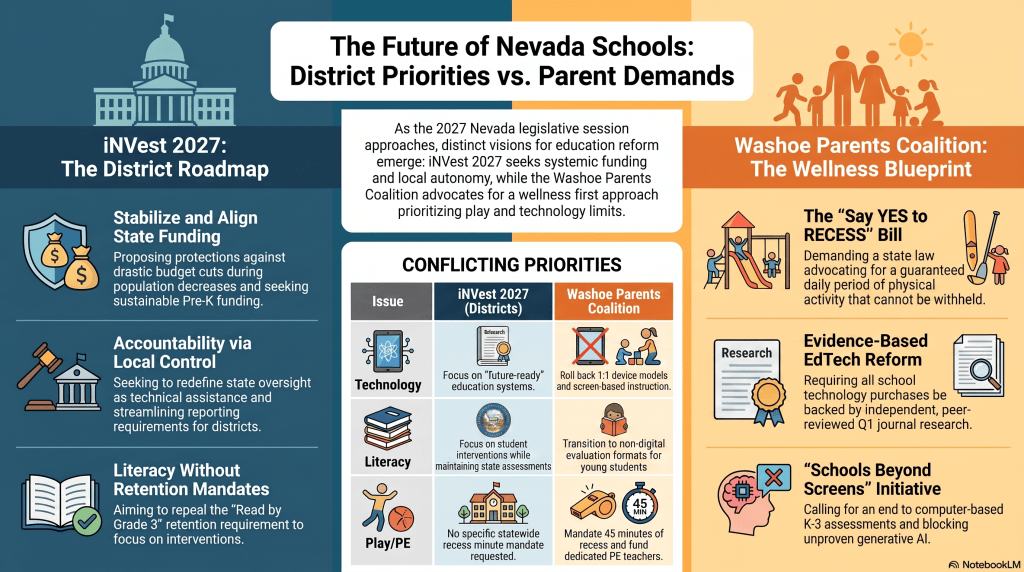
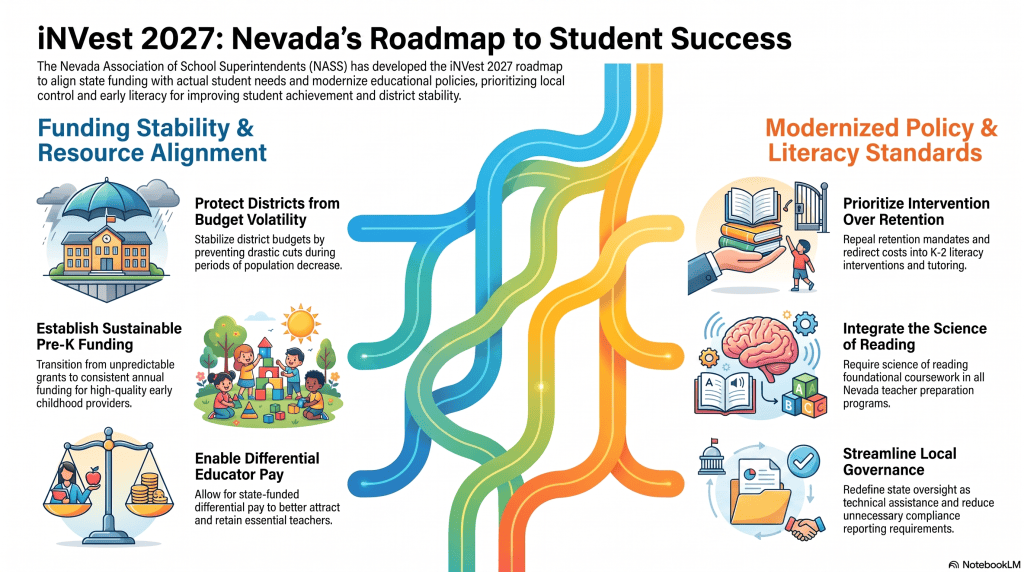
However, the leaders of many Nevada school districts are pushing back through the iNVest 2027 legislative platform, which seeks to roll back or refine several new state mandates.
iNVest 2027: What districts want
Carson City Superintendent Andrew Feuling expressed significant concern over measures within SB460, calling them “draconian” and a quiet rebranding of No Child Left Behind.
“SB460 brought in some pretty draconian measures in terms of how schools and districts are considered to be succeeding or failing,” Feuling said. “And what are some pretty substantial consequences coming out of that … all of the districts support modifying some of the language within that law.”
He and other statewide district leadership are especially critical of a mandatory requirement within the Read by Grade Three law to hold students back if they cannot read by the end of third grade. The law was reinstated in 2023, and the retention mandate will go into effect July 1, 2028.
Proponents of the mandate say that if students cannot read fluently by third grade, they cannot succeed academically from fourth grade on — a concept described as “learning to read” from 1st through 3rd grade, whereas 4th grade marks the beginning of “read to learn.”
However, Feuling said this requirement is nothing more than an extension of the widely unpopular No Child Left Behind act implemented in the early 2000s, and research shows that retention harms children in the long-term.
“There are pieces within that bill we all feel can be improved and be a little less harsh in terms of the punitive measures which … we view as a return of No Child Left Behind back in 2001, which was looking at shutting down schools firing people — a bunch of nonsense that didn’t work.”
He said that while all superintendents have agreed they’d be in favor of “more intensive interventions” between Kindergarten and third grade for students struggling with literacy, they are completely against the concept of holding students back for illiteracy.
“Everyone has probably heard about the Read by Grade 3 laws; under current law if a student is not deemed proficient — but actually proficient in this case is not proficient as far as how our school ratings are done, which seems kind of silly — they must be retained.”
Under the state’s Read by Grade 3 law, schools are identifying whether a student is “performing below grade-level” to determine if they need mandatory intervention or if they must be retained in third grade
When implemented, the state board has proposed to set the deficiency threshold at the 40th percentile. If a student scores at or below the 40th percentile on either the MAP or the approved i-Ready alternate assessment and their teacher confirms the deficiency through observation, they qualify for intensive intervention. If they score above that 40th percentile threshold, they are deemed proficient enough to be promoted to the fourth grade.
However it should be noted that the state is still in the process of refining the recommendations and are evaluating similar assessments from 16 other states that have a Read by Grade 3 law with retention mandates. There will also be alternative measures in place to assess proficiency, and alternatives for students with IEPs and verified neurodivergence.
The iNVest 2027 platform focuses on four major goals:
- Stabilize and Increase Funding: fix state funding formulas to protect schools from sudden budget shocks caused by declining enrollment, secure alternative state revenue sources, and gain local control over differential educator pay
- Refine SB 460 Accountability Measures: reduce administrative compliance burdens and legally redefine state oversight from punitive intervention to “technical assistance”
- Repeal Mandatory Student Retention: eliminate the Read by Grade 3 mandate to hold back non-proficient third graders, opting instead to redirect those funds into early K-2 literacy interventions, summer learning, and tutoring
- Expand Pre-K Access: replace ‘unpredictable’ grants with stable formula-based funding to expand Pre-K access in high-need areas and grow the early-childhood workforce
Washoe Coalition: What parents want
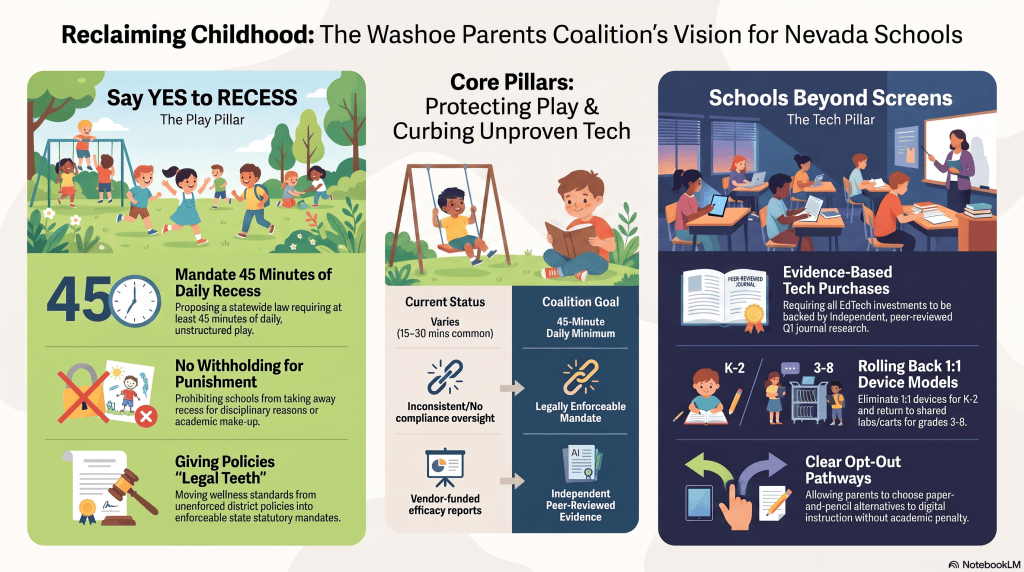
At the state level, the coalition is asking lawmakers to:
- Pass a law mandating 45 minutes of daily recess and prohibiting schools from withholding recess for academic or disciplinary reasons.
- Pass a law requiring districts to create “intentional tech-use policies” backed by independent, peer-reviewed research published in Q1 journals.
- Stop computer-based assessments for K-3 students, arguing that they necessitate screen time for practice and have not improved literacy rates.
From the Washoe County School District Board of Trustees, the coalition is requesting:
- Develop a policy mandating transparency regarding how much recess children receive at each school and whether it is ever withheld.
- Create a local, kid-centered tech-use policy based on peer-reviewed research.
- Reverse the board’s vote to renew the “unrequired” i-Ready lesson platform for the 2026-27 school year, citing a lack of independent, peer-reviewed evidence that it is helpful.
- Develop a policy that allows parents to easily opt their children out of weekly i-Ready lesson minutes in favor of reading physical books or doing math on paper.
- Stop using the unrequired i-Ready reading assessments for grades 4-8 and i-Ready math assessments for grades K-8, again arguing they necessitate screen time and have not improved academic performance.
Additionally, the coalition is organizing attendance for a July 28 WCSD board meeting, where they state the board will vote on whether to review student screen time and discuss instructional minutes for recess, PE, and art.
While it’s anyone’s guess how lawmakers will respond to the coalition’s requests, it’s clear that their policies are gaining traction with the public.
The group’s “Wait Until 8th” campaign, which asks parents to delay giving their children smartphones, saw a “20-fold increase” in pledges over a seven-month period, approaching 600 total pledges by mid-2026. By March 2026, the movement had already gathered commitments from families across 35 different public schools, as well as over a hundred private school families. The campaign’s momentum even prompted Sparks Mayor Ed Lawson to issue a local proclamation declaring April as “Wait Until 8th Month.”
The coalition’s demands regarding EdTech are also gaining heavy traction among teachers. A survey conducted by the Washoe Education Association garnered over 930 responses from educators, reflecting widespread alignment with the parent coalition’s concerns. Less than 30% of the surveyed teachers felt students were engaged with the i-Ready platform, more than 70% said it took time away from other instructional priorities, and roughly 75% believed the program was “not worth” the district’s investment.
What began as a local effort by two moms to delay smartphone use has quickly expanded into a multi-initiative advocacy organization. The coalition now drives four active campaigns—”Say YES to RECESS,” “Schools Beyond Screens,” “Wait Until 8th,” and “Let Grow”—and is advancing multiple statewide and local petitions to legally change Nevada laws and district policies.