By Felicia Archer
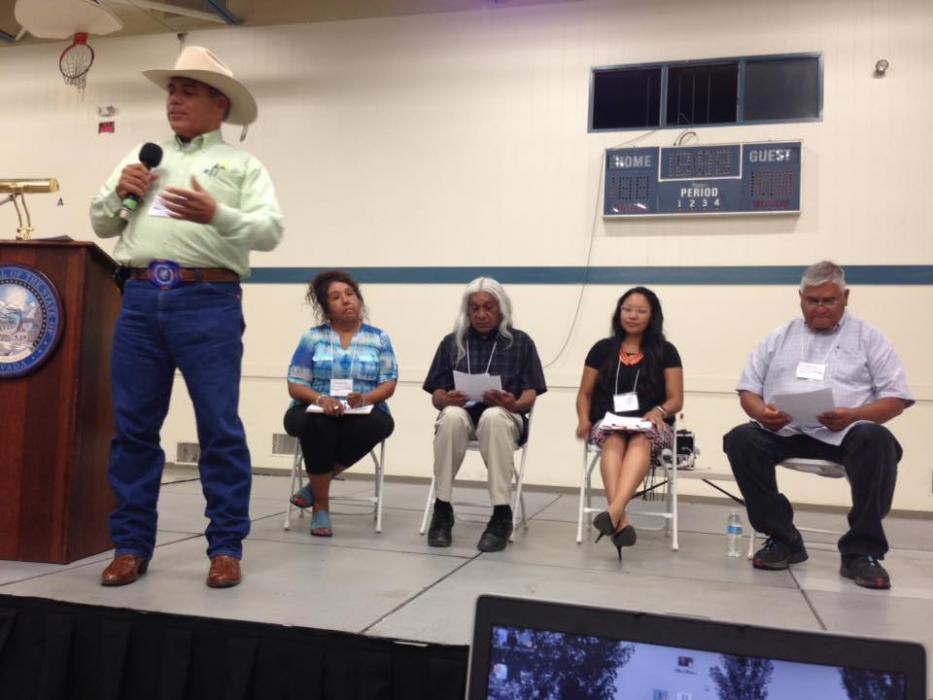
The Nevada Indian Commission in conjunction with the Bi-State Executive Oversight Committee launched an open open forum Tuesday to discuss the best practices for integrating traditional ecological knowledge into the management of sagebrush and pinyon-juniper ecosystems by federal land agencies.
The event is at the Stewart Indian School Gym in Carson City and runs through Thursday, June 30. Nearly 200 arrived Tuesday for the forum’s first day.
The Commission, in partnership with federal, state, and local agencies and organizations, will host the forum where tribal leaders, tribal members and agency resource managers in the Bi-State area will discuss the management practices of sagebrush and pinyon-juniper ecosystems in a manner that achieves protection of Bi-State sage-grouse habitat and populations while also protecting and respecting tribal practices and ancestral lands.
“This is not an either or issue for the Commission. It is imperative that we protect the Bi-State sage-grouse and their habitat, but we must also protect traditional gathering areas for our people and share our understanding and connection to the land over the years, an understanding that should bring much to inform this process, said Sherry L. Rupert, of the State of Nevada Indian Commission. “This forum is designed to help merge these mutually beneficial objectives.”
The range of the Bi-State sage-grouse is the area east of the Sierra Nevada along the California-Nevada border from approximately Carson City, in the north to Big Pine, Calif., in the south including the Pine Nut, Sweetwater, Mount Grant, Bodie, Mono Lake, Long Valley, White Mountain, and Silver Peak areas.
Registration for the event is free. However, seating is limited and interested attendees are encouraged to sign up early. Scholarships for tribes to attend are available.
Registration forms and additional information may be found on the NIC website at: http://nic.nv.gov/.
About the organizations:
The Nevada Indian Commission is a State agency created by statute in 1965 to study matters affecting the social and economic welfare and well-being of American Indians residing in Nevada, including, but not limited to, matters and problems relating to Indian affairs and to federal and state control, responsibility, policy and operations affecting such Indians.
Commission activities are aimed at developing and improving cooperation and communications between the Tribes, State, local governments, and related public agencies with the purpose of improving, education, employment, health, well-being and socio-economic status of Nevada’s American Indian citizens and enhancing tribal sovereignty, economic opportunities and community development.
The Bi-State Sage-grouse Executive Oversight Committee is a multiagency collaborative organization with representatives from the state and federal levels dedicated to the conservation of Bi-State Distinct Population Segment of the Greater Sage-Grouse and the ongoing restoration of Bi-State Sage-grouse habitat.
The goal of the EOC is to work with all partners to conserve the Bi-State Distinct Population Segment of the Greater Sage-Grouse and its habitats and to provide habitat availability and suitability that will support stable to increasing populations of sage-grouse over the long-term.