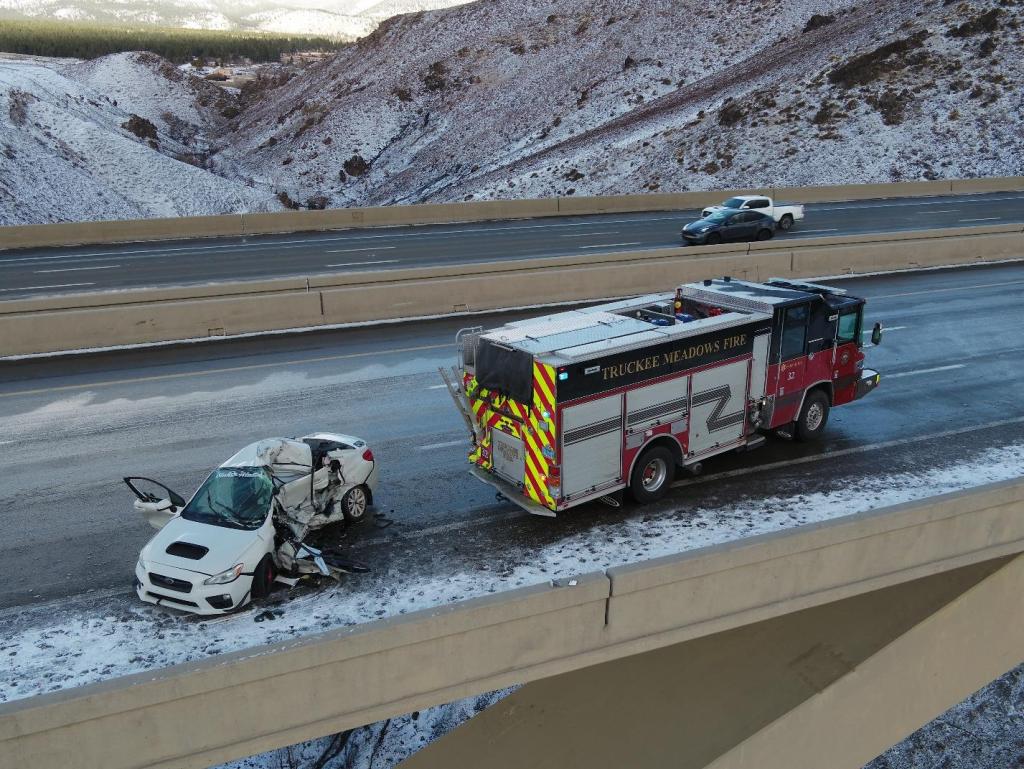
Last Friday, a multi-car crash occurred on Galena Creek Bridge between Carson City and Reno that resulted in one fatality.
A fire engine had responded to the bridge to assist in an initial crash, when a Subaru lost control and struck the fire engine, killing the driver.
Nevada State Police (NSP) said ice and speed were a factor in the crashes. Photos and video from the time of the crash and immediately after also showed a significant amount of ice on the roadway. This led to members of the public questioning whether or not the anti-icing mechanisms installed in the bridge had failed.


According to Nevada Department of Transportation spokeswoman Meg Ragonese, “Automatic anti-icing systems on multiple bridges on I-580 between Reno and Carson City are one supplemental tool NDOT also uses to help combat winter weather.”
When freezing conditions set in, pavement sensors will automatically spray a potassium acetate anti-icing solution from disk sprays embedded in the roadway.
“This solution is further spread by traffic, helping delay and reduce the formation of ice,” she said. However, anti-icing is only supplemental; she said the main factor used during freezing conditions is through NDOT highway maintenance crews, who are staggered into separate 12 hour shifts to provide 24-hour snow and ice control.
“In advance of and during winter storms, including (Friday) morning’s weather event, NDOT road maintenance staff patrol state highways and apply brine, salt and sand to roadways where needed for reduced roadway icing and enhanced traction,” Ragonese said. “Road crews are routinely utilized instead of the automatic system to enhance reliability. Specifically, NDOT also spreads salt, sand and brine as additional methods to help delay and reduce roadway freezing.”
When asked if the anti-icing systems were functional during the accident, Ragonese said: “The anti-icing system was active on two of the four bridges on this section of I-580 last Friday morning (before and after the crash) to supplement roadway salt, sand and brine placed by NDOT highway maintenance crews.”
When asked when the system was last inspected, Ragonese first said the system was inspected annually, then said the system is inspected by the manufacturer, not NDOT, twice a year.
When pressed for a date, she said the most recent manufacturer inspection took place from Sept. 19 through Sept. 22, 2024.
Tips for Safe Driving
Ragonese said that while NDOT tries to reduce impacts of winter weather, motorists need to use caution and slow down during winter driving conditions, and offered the following tips:
- Only travel in winter weather when necessary, leave enough time to safely reach your destination and plan your route to avoid snowy/icy areas and steep hills
- Before leaving home, check weather and road conditions by dialing 511 within Nevada
- Buckle up
- Turn off cruise control
- Avoid quick starts, stops and fast turns. Accelerate, brake and steer smoothly and gradually
- Reduce speed. Keep additional distance from other vehicles
- Do not slam on brakes. Apply steady pressure on ABS-equipped vehicles and pump the brakes if necessary on non-ABS vehicles
- Watch carefully for snow removal equipment
- Use extra caution on bridges, ramps, overpasses and shaded areas- they may freeze first
“Even while NDOT uses many tools to delay to formation of snow and ice on highways, ice is always a potential during winter driving,” she said. “I-580 between Reno and Carson City, in particular, can remain prone to ice and snow due to higher elevations, wind speeds and heavy precipitation.